Awarded as the best online publication by CIDC

New Civil Engineering Topics

THE FIRST TRAIN IN INDIA

By
Kaushal Kishore
Materials Engineer, Roorkee

The above engine model was made at Amritsar workshop of Northern Railway. It was unveiled infront of Roorkee railway station in July, 2005. This engine model is replica of the first rail engine used to transport construction materials for the construction of Ganges canal project brought from England and arrived in India in 1851. The engine was designed by David Joy and build by E.B.Wlson of Leeds.
Read More

BHIMGODA BARRAGE

By
Kaushal Kishore
Materials Engineer, Roorkee

I myself and Dr. G.C.Nayak remain engaged in consultency work long after our retirement. One day about 8 A.M Dr. Nayak phone me: Kaushal Engineers of irrigation department Haridwar are sitting at my house, they have a problem of granite blocks at BHIMGODA BARRAGE site. You have to go at this site at what time you will be ready to go, I said with in 30 minutes I will be ready to go.

Granite blocks are used at the fall of the BHIMGODA BARRAGE in Haridwar to control water flow and prevent erosion of the river bed. The blocks are used to dessipate the kinetic energy of the falling water, reducing its destructive power as it hits the downstream river bed.
Read More

CAUTLEY

By
Kaushal Kishore
Materials Engineer, Roorkee

Sir Proby Thames Cautley KCB ( 3 January 1802-25 January 1871 ) was the English engineer who conceived and supervised the Ganges canal during the East India Company’s rule in India. Known for his perseverance and meticulous planning, he led the massive project from 1842 to 1854, creating a canal that was the largest irrigation canal in the world at its completion. Cautley also established the Thomason college of Engineering in Roorkee (now IIT Roorkee) to train engineers for the canal project.

Read More

AQUEDUCT

By
Kaushal Kishore
Materials Engineer, Roorkee

The new Solani aqueduct on Ganges canal Roorkee was built with prestressed concrete which allows for longer spans and a simple more robust design compared to old bricks, lime- surkhi mortar masonry arches of the old aqueduct, in which 8.5 crores bricks were used, while iron railing used in the sides of two lanes were imported from England. This is interesting to note that materials bringing those days on ship from England to Indian ports take 6-10 weeks via the Suez canal or 3 to 6 months via the longer Cape of Good Hope. Calculate in it also time taken on road from Indian ports to Roorkee.

After retirement from University of now IIT Roorkee I joined M/S Roffe Construction Chemicals Pvt.Ltdd, Mumbai as it’s Chief Concrete Technologists afterwards I became it’s one of the Director.
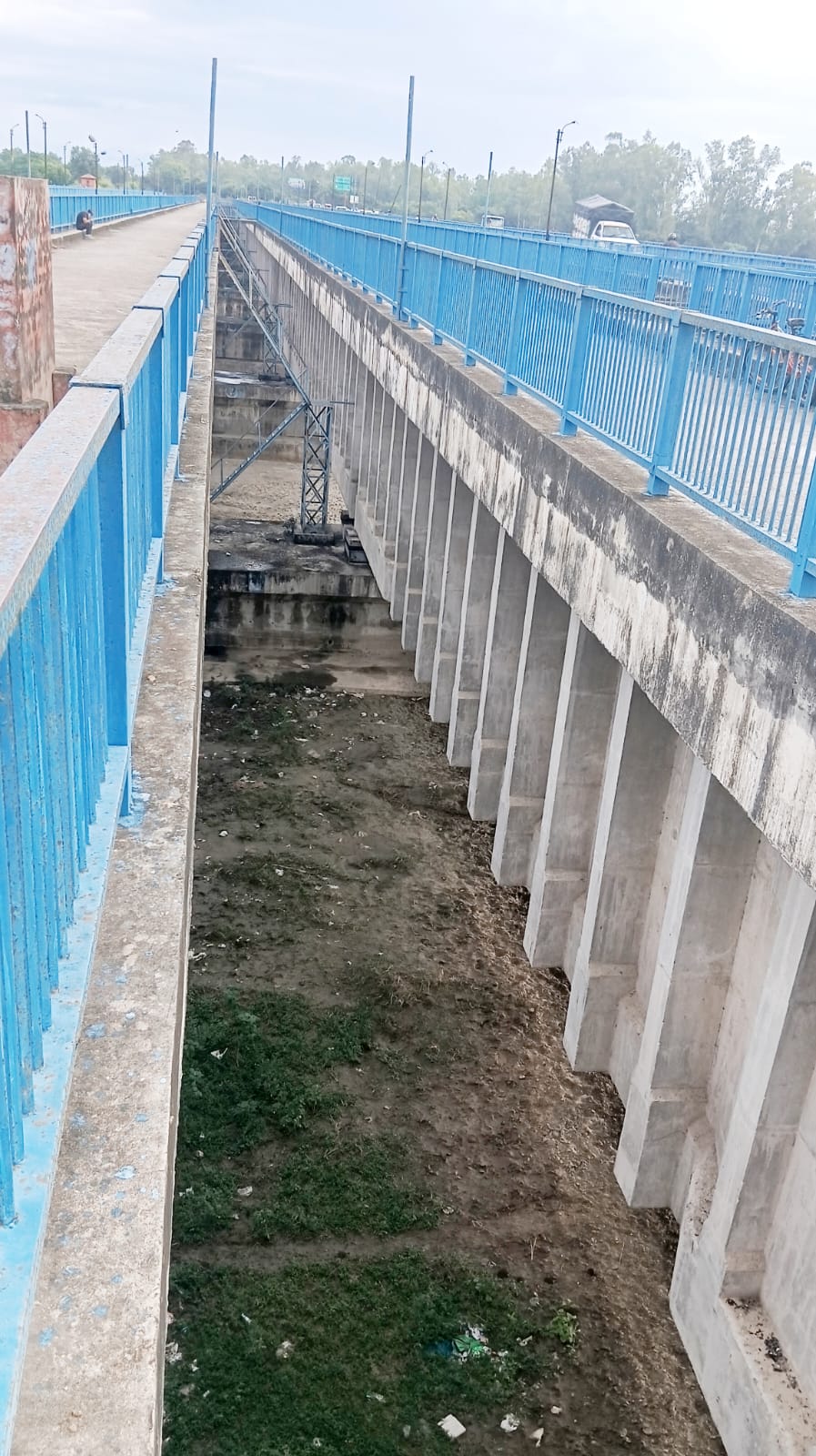

AQUEDUCT picture taken on 7/10/2025
For the contractor of above aqueduct I designed M-40 grade of concrete with Roffe superpladticizer. Those interested may read my paper by visiting Google site and log in; Civil engineering portal The Ganges canal by Kaushal Kishore.

I had designed numerous concrete mix design almost all cements of India in this I find Utra Tech cement as one of best cement OPC and PPC both With Ultratech cement I had designed numerous concrete mixes from ordinary strength to M-80 grade concrete, self compacting concrete, shot crete concrete, fibre reinforced concrete, fly ash concrete and more There is life after retirement and after retirement I worked for 30 year’s which includes in free time working in home research and testing laboratory and numerous construction sites visits almost all India and outside India. At my age of 92 years I still work for 12 hours daily.

I had never worked for money. In spite of doing so gigantic work what to say about car I even do not have 2 wheeler not any of my house not a single inch of land in this world only pension from IIT Roorkee and few clothes


IIT Roorkee Main Building

By
Kaushal Kishore
Materials Engineer, Roorkee

The Roorkee college, the first engineering college in the British Empire was established in 1847. In 1854, the college was renamed the Thomson College of Civil Engineering. In 1949, it was renamed the University of Roorkee. On September,21, 2001, it became the seventh IIT in India.

The main building of IIT, Roorkee was conducted during 1852-1854. During this period Lt.George Price, and assistant engineer on Ganga Canal, was the designer and likely supervisor of the IIT Roorkee main building. The original building finished in January, 1856.

Lt.George Price was a junior officer of the infantry. The main building is designed in the Renaissance style, a significant architectural achievement for a junior officer at that time.

LIONS STRUCTURE, THE PRIDE OF ROORKEE

By
Kaushal Kishore
Materials Engineer, Roorkee

Two lions in sitting position on both sides of Ganga Canal between Roorkee and 2.5 kilometres away at Mehwar village were build during 1840. The fifth lion statue was installed in Sher Kothi, Roorkee, where Cautley used to live.


It is said the lions are similar in structure to the ones erected in Trafalgar square London. They are made of black granite while the lions in Roorkee are of bricks, lime- surkhi mortar. The Mason’s and other artisan’s must be from Roorkee and other places of India whose hands have made our great structures but we never know their names though their contribution in any construction is not less than other staff.

The lion statues between Roorkee and Mehwar village are built as a mark of danger zone as between these two places lot of land fillings had to be done for the canal to keep the required level.

The lions flanking the entrance of the IIT Roorkee main building were likely to be erected around 1846.

Why our cities are flooding?

By
KAUSHAL KISHORE
Materials Engineer, Roorkee

Many cities tend to expand, changing their original land and waterscapes so they become prone to flooding.

CAUSES OF FLOODING
1. Over population

In 1947 India’s population was 34 crores, now in 2024 India population is 144.2 crores increasing at the rate of 3.5 crore per year. China present population is 142.5 crore and they have controlled their population.

The land area of India is 3.3 million sq.km and China 9.6 million sq.km. Our population is more than China but our land area is about 37 percent of China land area . One of route cause of our problems is overpopulation. Our land and environment can hold only a limited population.

Read More

Types of Loads on Buildings

Introduction
Analysis of structures is important for safe design and serviceability to resist loads coming from various sources. These loads re taken into account while designing so that the building does not fail under the application of these loads. These loads may be in the form of uniformly distributed load, concentrated load, triangular load and so on. All these have various points of application and so the center of mass is to be detected for making the calculations easy in every aspect. For example, in seismic zones, the earthquake load plays an important role which is to be considered in seismic analysis. Similarly, in some areas wind is the predominant force and it imposes load on the building which needs to be analysed before any disaster strikes. All these loads create a significant impact in performing structural analysis and any slight calculation mistakes can create life threatening situations.

Read More

Recently Added Topics

Civil Engineering Branches

About Civil Engineering

Engineering is a term applied to the profession in which a knowledge of the mathematical and natural sciences, gained by study, experience, and practice, is applied to the efficient use of the materials and forces of nature. Engineers are the ones who have received professional training in pure and applied science. Before the middle of the 18th century, large-scale construction work was usually placed in the hands of military engineers. Military engineering involved such work as the preparation of topographical maps, the location, design, and construction of roads and bridges; and the building of forts and docks; see Military Engineering below. In the 18th century, however, the term civil engineering came into use to describe engineering work that was performed by civilians for nonmilitary purposes.

Civil engineering is the broadest of the engineering fields. Civil engineering focuses on the infrastructure of the world which include Waterworks, Sewers, Dams, Power Plants, Transmission Towers/Lines, Railroads, Highways, Bridges, Tunnels, Irrigation Canals, River Navigation, Shipping Canals, Traffic Control, Mass Transit, Airport Runways, Terminals, Industrial Plant Buildings, Skyscrapers, etc. Among the important subdivisions of the field are construction engineering, irrigation engineering, transportation engineering, soils and foundation engineering, geodetic engineering, hydraulic engineering, and coastal and ocean engineering.

Civil engineers build the world’s infrastructure. In doing so, they quietly shape the history of nations around the world. Most people can not imagine life without the many contributions of civil engineers to the public’s health, safety and standard of living. Only by exploring civil engineering’s influence in shaping the world we know today, can we creatively envision the progress of our tomorrows.

Civil Engineering
Information

Read More

Measurement
Units

Read More

Student Corner

Read More

Civil Engineering Universities/Events

Comments

3,830 comments on "Civil Engineering Home"

James Bahagho says:

please i need a very brief and precise details on the similarities and differences between BS 5950 and Eurocode 3 design criteria for steel beams (bending only) and that of steel columns (flexural and tortional buckling).

uthra jagadeesh says:

Is it a good option to study constructiona law in Dubai having 2 years of work experience as a Quantity surveyor?!

suresh agnihotri says:

cement mortar and lime mortar

miftahul haq syawal says:

what is simple way to calculate force in bridge? cremona or cullman? i’m little bit confuse about this. thanks for your attention

nuthan says:

sir pls help me i have a less time to ssc exam i want to prepare to exam how can i sir pls give me a overall summary and most important points from each subjets to crack easily in less time plsssssiam reuesting u sir plsss help me

Ganesan KG says:

I like this web site, I am M.E Structural Engg I had gain many informations from this web site.

Anas khamis says:

HOW TO COMPUTE THE DEADLOADS ON RAILWAY BRIDGE?

Pradeep kumar says:

I have completed my diploma in civil engg. . now wt to do …

VIVEK KUMAR SHARMA says:

What is Acceptable % of field dry density of soil

aashish dhoju says:

i am reading +11 in civil engineering and its easy now but i want to ask it is difficuli or not

sd says:

first take weight of cube as w1(natural state as it contains air, moisture that is 3 phase), then immerse the cube in water for 24 hours after 24 hours take it out it take weight as w2(fully saturated), dry it it in oven for 10 minutes measure the weight as w3(dry), and amount of water=w2-w3.
unit weight of water=weight/volume from this relationship we can find volume of water which is nothing but volume of voids.

Bharat nathani says:

Details regarding establishment of civil engineering laboratory.

Zaid ullah says:

i am the student of civil engineering 1st semester some one kindly direct me about all test that we can do for cement and concrete. tell me about its names only

Hans says:

how to draw profile and cross-section of a road using autocad 2007??

Mohit Parashar says:

I want to know about ‘authorised overlap’ in column, beam and slab reinforcement for measurement purpose.

R Suman says:

Dear Mohith, with your question I presume that you are asking about lap length for measurement purpose only. it depends how the contract rate was. If the item description says rate includes all laps,chairs,ties no measurement lap shall not be considered. If not, normally it will be as mentioned in the drawing say 50d or 35 d. If drawing also not specifies anything (It has to be ), needs to be calculated as per IS 456 according to concrete grade. Hope this explanation is useful for you. regards, Suman.

Hobart Civil Engineer says:

This website has really very informative data and I had gained many pieces of information from this website.

Ammit Khanna says:

Hi I have to make a techinal paper of 2500 words on Estimation & Costing Subject, to be submitted as my project for BTECH. Can anyone help me.

Avijit Biswas says:

Excellent site you have here.. It’s difficult to find good quality writing like yours these days. I truly appreciate individuals like you! Take care!!

Muhammad ubaidullah says:

i am working on the slope stability analysis of permanent access road at Tarbela Dam Pakistan…..as a project on for MS (Geotech) Engg…..need your valuable suggestions please…..

Sourav Dutta says:

Use TaLREN SOFTWARE FOR ANALYSIS.

vasumathi sampath says:

i am preparing for competitive exam (GATE).So please ,can any one suggest some materials for me.

Er.Shivam Sood says:

You should buy books especially for Gate other than that use your lecture notes. Most effective way as it appears to me is buy a copy of solved previous years GATE exams and practice and read all of them but dont go for answers directly do some brainstroming if you get struck it will consume some time but it will help alotnot only for GATE other exams too.
All the best!

Er.Shivam Sood says:

You must also go for handbooks and text books especially for GATE published by Made Easy.

Leave a Reply

Your email address will not be published. Required fields are marked *

Ask a question