Awarded as the best online publication by CIDC

New Civil Engineering Topics

THE FIRST TRAIN IN INDIA

By
Kaushal Kishore
Materials Engineer, Roorkee

The above engine model was made at Amritsar workshop of Northern Railway. It was unveiled infront of Roorkee railway station in July, 2005. This engine model is replica of the first rail engine used to transport construction materials for the construction of Ganges canal project brought from England and arrived in India in 1851. The engine was designed by David Joy and build by E.B.Wlson of Leeds.
Read More

BHIMGODA BARRAGE

By
Kaushal Kishore
Materials Engineer, Roorkee

I myself and Dr. G.C.Nayak remain engaged in consultency work long after our retirement. One day about 8 A.M Dr. Nayak phone me: Kaushal Engineers of irrigation department Haridwar are sitting at my house, they have a problem of granite blocks at BHIMGODA BARRAGE site. You have to go at this site at what time you will be ready to go, I said with in 30 minutes I will be ready to go.

Granite blocks are used at the fall of the BHIMGODA BARRAGE in Haridwar to control water flow and prevent erosion of the river bed. The blocks are used to dessipate the kinetic energy of the falling water, reducing its destructive power as it hits the downstream river bed.
Read More

CAUTLEY

By
Kaushal Kishore
Materials Engineer, Roorkee

Sir Proby Thames Cautley KCB ( 3 January 1802-25 January 1871 ) was the English engineer who conceived and supervised the Ganges canal during the East India Company’s rule in India. Known for his perseverance and meticulous planning, he led the massive project from 1842 to 1854, creating a canal that was the largest irrigation canal in the world at its completion. Cautley also established the Thomason college of Engineering in Roorkee (now IIT Roorkee) to train engineers for the canal project.

Read More

AQUEDUCT

By
Kaushal Kishore
Materials Engineer, Roorkee

The new Solani aqueduct on Ganges canal Roorkee was built with prestressed concrete which allows for longer spans and a simple more robust design compared to old bricks, lime- surkhi mortar masonry arches of the old aqueduct, in which 8.5 crores bricks were used, while iron railing used in the sides of two lanes were imported from England. This is interesting to note that materials bringing those days on ship from England to Indian ports take 6-10 weeks via the Suez canal or 3 to 6 months via the longer Cape of Good Hope. Calculate in it also time taken on road from Indian ports to Roorkee.

After retirement from University of now IIT Roorkee I joined M/S Roffe Construction Chemicals Pvt.Ltdd, Mumbai as it’s Chief Concrete Technologists afterwards I became it’s one of the Director.
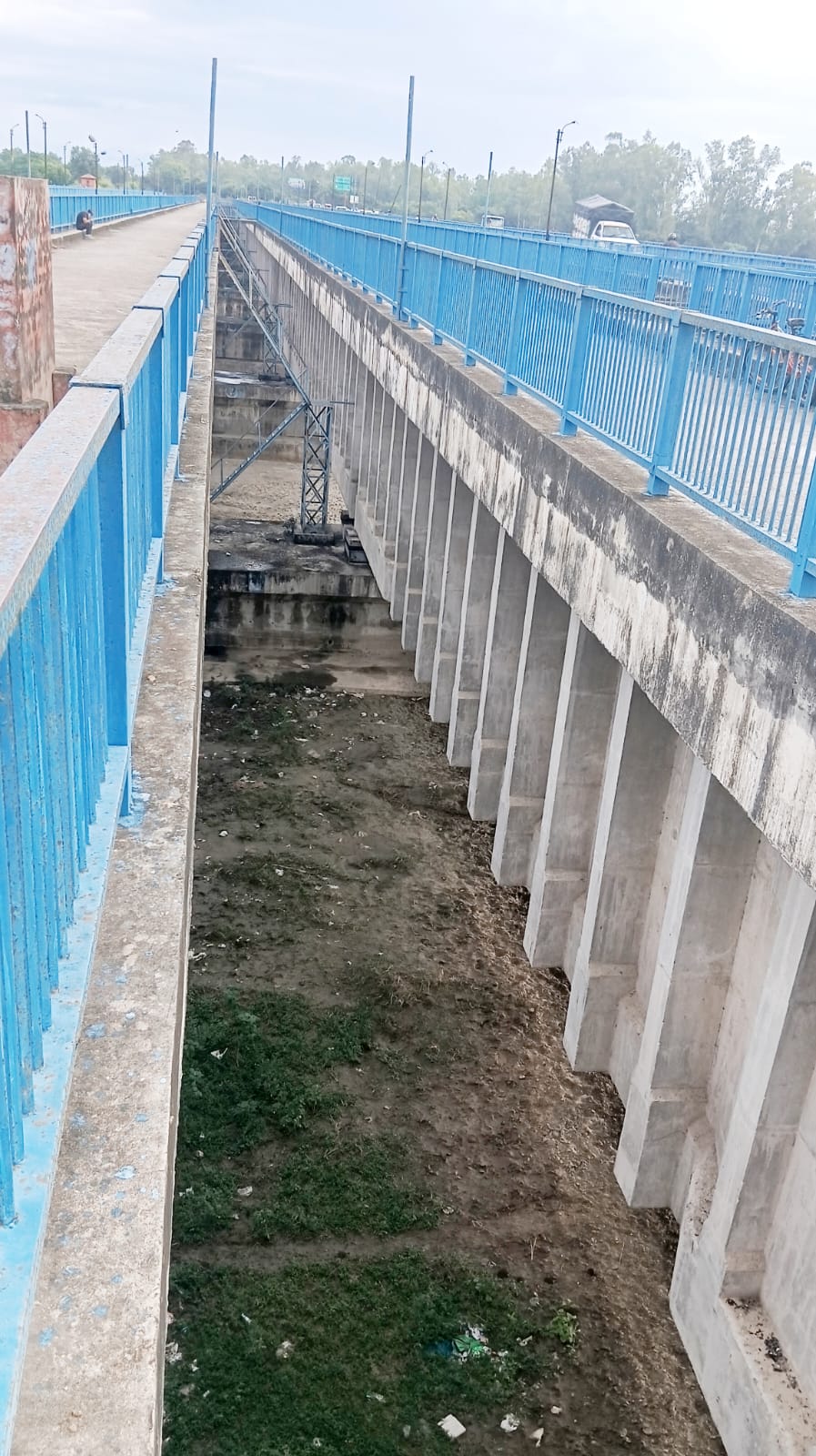

AQUEDUCT picture taken on 7/10/2025
For the contractor of above aqueduct I designed M-40 grade of concrete with Roffe superpladticizer. Those interested may read my paper by visiting Google site and log in; Civil engineering portal The Ganges canal by Kaushal Kishore.

I had designed numerous concrete mix design almost all cements of India in this I find Utra Tech cement as one of best cement OPC and PPC both With Ultratech cement I had designed numerous concrete mixes from ordinary strength to M-80 grade concrete, self compacting concrete, shot crete concrete, fibre reinforced concrete, fly ash concrete and more There is life after retirement and after retirement I worked for 30 year’s which includes in free time working in home research and testing laboratory and numerous construction sites visits almost all India and outside India. At my age of 92 years I still work for 12 hours daily.

I had never worked for money. In spite of doing so gigantic work what to say about car I even do not have 2 wheeler not any of my house not a single inch of land in this world only pension from IIT Roorkee and few clothes


IIT Roorkee Main Building

By
Kaushal Kishore
Materials Engineer, Roorkee

The Roorkee college, the first engineering college in the British Empire was established in 1847. In 1854, the college was renamed the Thomson College of Civil Engineering. In 1949, it was renamed the University of Roorkee. On September,21, 2001, it became the seventh IIT in India.

The main building of IIT, Roorkee was conducted during 1852-1854. During this period Lt.George Price, and assistant engineer on Ganga Canal, was the designer and likely supervisor of the IIT Roorkee main building. The original building finished in January, 1856.

Lt.George Price was a junior officer of the infantry. The main building is designed in the Renaissance style, a significant architectural achievement for a junior officer at that time.

LIONS STRUCTURE, THE PRIDE OF ROORKEE

By
Kaushal Kishore
Materials Engineer, Roorkee

Two lions in sitting position on both sides of Ganga Canal between Roorkee and 2.5 kilometres away at Mehwar village were build during 1840. The fifth lion statue was installed in Sher Kothi, Roorkee, where Cautley used to live.


It is said the lions are similar in structure to the ones erected in Trafalgar square London. They are made of black granite while the lions in Roorkee are of bricks, lime- surkhi mortar. The Mason’s and other artisan’s must be from Roorkee and other places of India whose hands have made our great structures but we never know their names though their contribution in any construction is not less than other staff.

The lion statues between Roorkee and Mehwar village are built as a mark of danger zone as between these two places lot of land fillings had to be done for the canal to keep the required level.

The lions flanking the entrance of the IIT Roorkee main building were likely to be erected around 1846.

Why our cities are flooding?

By
KAUSHAL KISHORE
Materials Engineer, Roorkee

Many cities tend to expand, changing their original land and waterscapes so they become prone to flooding.

CAUSES OF FLOODING
1. Over population

In 1947 India’s population was 34 crores, now in 2024 India population is 144.2 crores increasing at the rate of 3.5 crore per year. China present population is 142.5 crore and they have controlled their population.

The land area of India is 3.3 million sq.km and China 9.6 million sq.km. Our population is more than China but our land area is about 37 percent of China land area . One of route cause of our problems is overpopulation. Our land and environment can hold only a limited population.

Read More

Types of Loads on Buildings

Introduction
Analysis of structures is important for safe design and serviceability to resist loads coming from various sources. These loads re taken into account while designing so that the building does not fail under the application of these loads. These loads may be in the form of uniformly distributed load, concentrated load, triangular load and so on. All these have various points of application and so the center of mass is to be detected for making the calculations easy in every aspect. For example, in seismic zones, the earthquake load plays an important role which is to be considered in seismic analysis. Similarly, in some areas wind is the predominant force and it imposes load on the building which needs to be analysed before any disaster strikes. All these loads create a significant impact in performing structural analysis and any slight calculation mistakes can create life threatening situations.

Read More

Recently Added Topics

Civil Engineering Branches

About Civil Engineering

Engineering is a term applied to the profession in which a knowledge of the mathematical and natural sciences, gained by study, experience, and practice, is applied to the efficient use of the materials and forces of nature. Engineers are the ones who have received professional training in pure and applied science. Before the middle of the 18th century, large-scale construction work was usually placed in the hands of military engineers. Military engineering involved such work as the preparation of topographical maps, the location, design, and construction of roads and bridges; and the building of forts and docks; see Military Engineering below. In the 18th century, however, the term civil engineering came into use to describe engineering work that was performed by civilians for nonmilitary purposes.

Civil engineering is the broadest of the engineering fields. Civil engineering focuses on the infrastructure of the world which include Waterworks, Sewers, Dams, Power Plants, Transmission Towers/Lines, Railroads, Highways, Bridges, Tunnels, Irrigation Canals, River Navigation, Shipping Canals, Traffic Control, Mass Transit, Airport Runways, Terminals, Industrial Plant Buildings, Skyscrapers, etc. Among the important subdivisions of the field are construction engineering, irrigation engineering, transportation engineering, soils and foundation engineering, geodetic engineering, hydraulic engineering, and coastal and ocean engineering.

Civil engineers build the world’s infrastructure. In doing so, they quietly shape the history of nations around the world. Most people can not imagine life without the many contributions of civil engineers to the public’s health, safety and standard of living. Only by exploring civil engineering’s influence in shaping the world we know today, can we creatively envision the progress of our tomorrows.

Civil Engineering
Information

Read More

Measurement
Units

Read More

Student Corner

Read More

Civil Engineering Universities/Events

Comments

3,830 comments on "Civil Engineering Home"

santosh says:

all the best you should construct our india

prIyAn says:

helo sir. im doin my final year of diploma in civil engineering. could u pls suggest me a final year project tat i may carry out. TQ sir.

Nikhil Malpani says:

Hi,

I am right now working on a project for boundary wall. The problem is we have a black cotton soil upto a depth of 1.3-1.5 mtr and the boundary is surrounded by water cannels from 3 sides. I want to know whether it will be good to have footings or doing the plinth method is more appropriate.
Also please tell me what will be the consequences if we built it on footings.

Eluwa Victor says:

Sir, Pls which book on highway design is advisable for me to read in other to improve my knowledge on highway design, but i am already a graduate of structural engineering.

malak says:

hi am a new student in civil engineering . What is the most important thing we must focus on during the study period ???

vishal says:

u should only focus on the basics of every construction techniques.

charles says:

sir
i have completed B.E. civil Engineering! I wish to study M.E. infrastructure Engineering. will u please tell me what is that course related to & how about the job oppurtunities for that course!

nyotz says:

hello…
sir…i would like two ask sum question n i hope u cn xplain in mre dtail….
1)what elements of cost need to be considered in carrying out economic evaluation of a highway project?
2)give me two approaches used to carry out evaluation of transportation alternatives.

svsr mahesh says:

Proper planning and erecting of plants in suitable location to reduce lead

Jeff_Dagami says:

Greetings !

Sir, i would like to ask the LOAD Checklists used for Structural Analysis of a Two-Storey Residential House.

almonzer mostafa says:

I’m very pleased to know on this site, I am a civil engineer and I will try to take advantage of it

ROBERT OUKO says:

Who is greater between an architect and a civil engineer?

Joel O says:

Robert, for a project to be birthed and implemented to completion, you will reqiure the client (owner), an architect, a civil engineer and many other specialists depending on the size of the project.
At the end of the project you will not say this one was greater than the other.
Actually the enginieers and architect may work together as the consultant (i.e planners, project managers etc).

budzgomz says:

then.. why should there be difference in there studies if they can work or function as one..?

sesibabu.gantyada says:

hollo mr. Robbert.in civil engineering.team work is most important (working together with coordinating all departments. then any project will success, this question should not arise in our mind….mother and father who is the great?

yogesh says:

how to know slab is one way or two way

rajendra zende says:

use aspect ratio for finding one way or two way rajendra zende

Ritesh F. Patel says:

Slab calculated as per this equation,(L/B is equal or greater than 2 is called ONE WAY SLAB and less than 2 is called TWO WAY SLAB.

yogesh satpute says:

how can we find out send and cemant ratio in plaster

Belman says:

Sir, please help me,, I work at contractor, but i have a little order from my patner, they ask me to design an indoor soccer field, and i’ve completed the design, but now I have problem when he ask me to make table tennis at above soccer field, because I must to make a steel beam with a stretch of 17 meters. steel profile what should I make to it? Thanks

yoshi remz says:

I want to know if this course is Easy to study?

bishnu tamang says:

i m a civil engineer, now i want 2 further improve my knowledge through this site, help me.

kangkan says:

I am doing a seminar on Pavement Quality concrete,any kind of suggestion is highly appreciated.

muthukumar.s says:

Hello sir ….., i hav to take a seminar on fiber reinforcement ,now i need net source to knw abt my topic, pls giv me idea abt net source which gives more information

rajendra zende says:

wonderful website for civil engineering information

abdurrahman says:

sir, tell me what is difference b/w right bank and left bank of the river.and why right bank is more soil erison than left bank.

srinath says:

how to manage and maintained civil site fields?

Leave a Reply

Your email address will not be published. Required fields are marked *

Ask a question