Awarded as the best online publication by CIDC

Posts by Kanwarjot Singh

In the design of watermain, the normal practice is to use ductile iron for pipe size less than 600mm and to use steel for pipe size more than 600mm. Why?

For watermain pipe size less than 600mm, ductile iron is normally used because internal welding for steel pipes below 600mm is difficult to be carried out. Moreover, it requires only simple jointing details which allow for faster rate of construction. For watermain pipe size above 600mm, steel pipes are recommended because steel pipes are lighter than ductile iron pipes for the same material strength and therefore the cost of steel pipes is less than that of ductile iron pipes. In addition, in areas of difficult access the lighter mild steel pipes pose an advantage over ductile iron pipes for easy handling.

Advertisements

This question is taken from book named – A Self Learning Manual – Mastering Different Fields of Civil Engineering Works (VC-Q-A-Method) by Vincent T. H. CHU.

What does the pipe thickness of ductile iron pipes generally larger than that of steel pipes?

Both steel pipes and ductile iron pipes use hoop stress equation to model internal pressure design. The difference in pipe thickness arises as a result of more conservative approach in DI pipes.

For ductile iron pipes, surge pressure is considered as part of design pressure and they are added together before applying a safety factor of 2 as follows:

t=[F(P+S)D]/2Y
where t = Pipe thickness
F = Factor of Safety of 2
P = Working pressure
S = Surge pressure
Y = Yield strength of ductile iron

For steel pipes the design of working pressure is based on 50% of steel yield strength (i.e. a factor of safety of 2). The presence of surges could be allowed to increase the stress in pipe to 75% of yield strength. The design is based on the following steps:

Advertisements

(A) If surge pressure is less than or equal to one-half of working pressure, the pipe shall be designed using working pressure only with 50% yield strength as allowable stress.

t= PD/2Y where Y = 50% of yield strength

(B) If surge pressure is more than or equal to one-half of working pressure, the pipe shall be designed using working pressure and surge pressure only with 75% yield strength as allowable stress.

t= [(P+S)D]/2Y where Y = 75% of yield strength

For case A, the use of 50% yield strength is essentially the same of adopting a safety factor of 2 in DI pipe design. However, as surge pressure is not considered, the thickness calculated is smaller than that in DI pipe design.

Advertisements

For case B, the use of 75% yield strength is essentially the same of adopting a safety factor of 1.33 in DI pipe design. As such, the thickness calculated is smaller than that in DI pipe design.

This question is taken from book named – A Self Learning Manual – Mastering Different Fields of Civil Engineering Works (VC-Q-A-Method) by Vincent T. H. CHU.

What is the difference between ductile iron pipes and steel pipes in resisting external loads?

Ductile iron pipes normally possess thicker pipe walls and are generally stiffer than steel pipes. As such, it replies less on side fill soils to support external loads. Hence, it is not necessary to achieve highly-compacted soils for ductile iron pipes for sustaining external loads.

For steel pipes, owing to less stiffness associated with thinner pipe walls, it relies heavily on the stiffness of backfill soils in resisting external loads. Hence, to enhance the external load-carrying capacity of steel pipes, the most convenient methods are to improve the quality of backfill materials and to increase the level of soil compaction.

Advertisements

This question is taken from book named – A Self Learning Manual – Mastering Different Fields of Civil Engineering Works (VC-Q-A-Method) by Vincent T. H. CHU.

Which one is better, ductile iron pipes and mild steel pipes as pressurized pipelines?

For watermain pipe size less than 600mm, ductile iron is normally used because internal welding for steel pipes below 600mm is difficult to be carried out. Moreover, it requires only simple jointing details which allows for a faster rate of construction. For watermain pipe size above 600mm, steel pipes are recommended because steel pipes are lighter than ductile iron pipes for the same material strength and therefore the cost of steel pipes is normally less than that of ductile iron pipes. In addition, in areas of difficult access the use of lighter mild steel pipes has an advantage over ductile iron pipes for easy handling.

Advertisements

This question is taken from book named – A Self Learning Manual – Mastering Different Fields of Civil Engineering Works (VC-Q-A-Method) by Vincent T. H. CHU.

How do we compare Rowe cell and Oedometer apparatus?

The advantages of using Rowe cell over oedometer apparatus are:

(i) It possesses the control facilities for drainage and for the measurement of pore water pressure.

(ii) It is capable of testing larger diameter soil samples. Hence, more reliable data can be provided by using Rowe’s cell because of the relatively smaller effect of structural viscosity in larger specimens.

Advertisements

(iii) Rowe cell uses hydraulic loading system which is less susceptible to the effect of vibration than oedometer apparatus.

This question is taken from book named – A Self Learning Manual – Mastering Different Fields of Civil Engineering Works (VC-Q-A-Method) by Vincent T. H. CHU.

Is it worthwhile to carry out tests on particle density of soil particles for geotechnical design?

Particle density of soils is defined by the ratio of soil particle mass and soil particle volume. Depending on soil types, the range of variation of soil particle density varies not significantly, i.e. by 4%. Therefore, it may not be worthwhile to order laboratory tests and incur additional expenditure just to determine the particles density by recognizing that the variation of particles density is not significant.

Advertisements

This question is taken from book named – A Self Learning Manual – Mastering Different Fields of Civil Engineering Works (VC-Q-A-Method) by Vincent T. H. CHU.

What is the purpose of adding hydrogen peroxide in sedimentation analysis?

There are two major techniques of particle size distribution:

(i) Sieve analysis – for soil particles larger than 60?m they can be separated by this method.

(ii) Sedimentation analysis – for soil particles smaller than 60?m, they are too small to be sieved by sieve analysis. Instead, the particle size distribution is worked out from the rate of settlement of soil particles suspended in water by Stoke’s law.

Advertisements

In sedimentation analysis, the soil under testing is firstly boiled with little distilled water to wet and break up the particles. After that, hydrogen peroxide is added to remove any organic material. Then the whole mixture is allowed to stand still for a night and then boiled again to remove hydrogen peroxide.

This question is taken from book named – A Self Learning Manual – Mastering Different Fields of Civil Engineering Works (VC-Q-A-Method) by Vincent T. H. CHU.

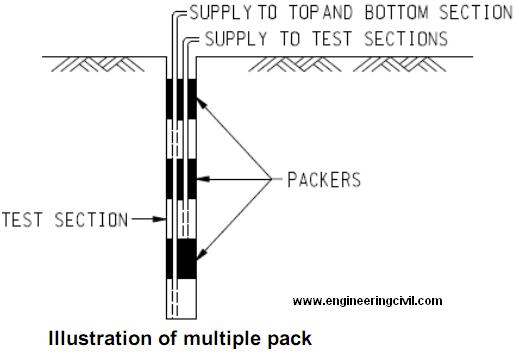
Why is multiple packer test instead of single packer test sometimes adopted in testing permeability of rock?

Packer test is used in unlined drillholes in rock to test the permeability. In single packer test, the hole is drilled to the bottom of first test section and the top of the test section is sealed off by a packer. Water is then delivered to the test section and it is kept at constant pressure and the flow is measured.

In highly fractured rock there is a high chance that water tends to leak around the packer which gives inaccurate result. As such, multiple packers are adopted instead in which three sections of the drillhole are sealed up and water is pumped to them at equal pressure. This eliminates the tendency for water to flow around the packers from the middle section.

Advertisements

Hence, a more accurate result could be obtained by measuring flow from the middle section alone.

Illustration of multiple pack

This question is taken from book named – A Self Learning Manual – Mastering Different Fields of Civil Engineering Works (VC-Q-A-Method) by Vincent T. H. CHU.

What are the limitations in multi-stage test of triaxial tests?

The maximum load acted on the soil specimen is limited because a highly deformed soil sample is not suitable for further testings. For instance, soft samples like clay display large failure strain and hence it may be not considered acceptable for multi-stage trial axial tests.

Moreover, multi-stage trial axial tests may not be suitable for residual coils whose cohesion is established based on the remaining rock strength mass. At the stage of shearing, part of cohesion may be destroyed and it is irrecoverable in other stages of triaxial tests.

Advertisements

This question is taken from book named – A Self Learning Manual – Mastering Different Fields of Civil Engineering Works (VC-Q-A-Method) by Vincent T. H. CHU.

Multistage triaxial test may not be preferable for consolidated drained test. Why?

In multistage consolidated drained test, the soil sample is consolidated under all round pressure and then loaded by applying an axial stress. Prior to failure, loading is stopped and the specimen is consolidated under a higher confining pressure. The above steps are repeated for 3 stages to
obtain the failure envelope.

Advertisements

The main problem associated with multistage consolidated drained test lies in the practical difficulty in determining the failure state of the soil sample. Judgment has to be made regarding the condition of “immediately prior to failure” on stress strain curves. It is not uncommon that wrong estimation of the failure state occurs when interpreting the stress strain curves. When there is an underestimation of deviator stress at failure, it would result in overestimation of friction angle and underestimation of cohesion. In case actual failure of soil samples occurs before visual recognition, the sample undergoes overstressing so that the deviator stress at failure in later stages is reduced. As such, this leads to overestimation of cohesion and underestimation of friction angle.

This question is taken from book named – A Self Learning Manual – Mastering Different Fields of Civil Engineering Works (VC-Q-A-Method) by Vincent T. H. CHU.

Ask a question