Awarded as the best online publication by CIDC

Posts by Kanwarjot Singh

What is the reason of retightening in flanged joints?

Traditional gaskets are non-elastic in nature. As such, this property of gasket results in a reduction in the bolt’s preload as time goes by. In fact, this phenomenon usually takes place shortly after installation leading to bolt relaxation. To reduce the effect of bolt relaxation which may cause subsequent water leakage during operation, retightening the bolts is carried out some time latter after initial tightening.

Advertisements

This question is taken from book named – A Self Learning Manual – Mastering Different Fields of Civil Engineering Works (VC-Q-A-Method) by Vincent T. H. CHU.

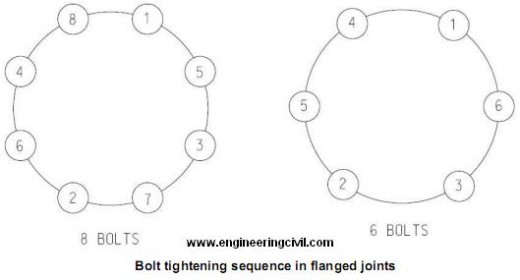
What is the purpose of bolt tightening sequence in flanged joints?

Bolted flange joint is widely used in watermains. In essence, a bolt axial tension is applied by the torque control method. The preload values are recommended by gasket suppliers to control gasket crushing and to achieve proper gasket seating stress. A proper bolt tightening sequence in flanged joints is essential to control stress variation in flange joint components. Otherwise, leakage occurs at flanged pipe joints during operating conditions.

Advertisements

Most joint surface of joints is not completely flat. The sequence of bolt tightening exerts a huge effect on the resulting preloads. Since joints containing gaskets have a comparatively low compressive stiffness, bolt preloads in such joints are particularly sensitive to the tightening sequence. Owing to the compression of joint surfaces, tightening one bolt close to another pre-loaded bolt will affect the preload generated by the firstly-tightened bolt. A proper bolt tightening sequence ensures that an even preload distribution is achieved in the flanged joint.

bolt tighting system in flange

This question is taken from book named – A Self Learning Manual – Mastering Different Fields of Civil Engineering Works (VC-Q-A-Method) by Vincent T. H. CHU.

What is the difference between linear characteristic and equal percentage characteristic in controlling butterfly valves?

For “linear characteristic”, the flow rate is directly proportional to the amount of travel of butterfly disk. For example, at 25% open of butterfly disk, the flow rate of 25% of maximum flow.

For “equal percentage characteristic”, equal increment of opening of butterfly disk leads to equal percentage change in flow rate. For example, when butterfly disc open from 30% to 40%, it generates a change in flow rate of 50%. Therefore, when butterfly disc open from 40% to 50%, it also generates a change in flow rate of 50%. If the flow rate at 30% is 200m3/s, then the flow rate of 40% and 50% open are 300m3/s and 450m3/s respectively.

Advertisements

The use of different characteristics depends on the amount of pressure drop available to the butterfly value. Should more than 25% of system pressure drop is available to the butterfly value, then the employment of linear characteristic would provide the best results. On the contrary, if less than 25% of system pressure drop is available to the butterfly value, then the employment of equal percentage characteristic would be a better choice.

This question is taken from book named – A Self Learning Manual – Mastering Different Fields of Civil Engineering Works (VC-Q-A-Method) by Vincent T. H. CHU.

What is the purpose of embedding puddle flange inside the walls of closed valve chambers?

When valves are closed to stop water flow in a pipeline, a thrust is generated along the direction of the pipeline. Hence, it is necessary to restrain the valves during closure to prevent it from moving in the thrust direction. If the closed valve is situated inside valve chambers, it is connected to a puddle flange embedded inside a wall of the chamber. As such, the closed valves can be effectively restrained from the thrust action during the closure of valves.

Advertisements

This question is taken from book named – A Self Learning Manual – Mastering Different Fields of Civil Engineering Works (VC-Q-A-Method) by Vincent T. H. CHU.

Why are two gate valves required in normal practice to form a washout valve?

In fact, the situation is analogous to that of fire hydrants in which two gates valves are installed with a single fire hydrant. Washout valves are used for normal maintenance work of watermain like allowing flowing out of water during cleaning of watermain. At the junction where a tee-branch out to a washout point, a gate valve is installed to separate the two pipelines. However, this gate valve is open during normal operation while another gate valve further downstream is installed (closed during normal operation). If the downstream gate valve is not installed in position, then the pipe section of branched-out watermain will be left dry during normal operation and there is a high probability that damage to watermain and frequent leakage would occur. With the downstream gate valve installed, the segment of branched-out watermain contains water in normal operation. In case there is any leakage, it can be readily detected by using the two gate valves.

Advertisements

This question is taken from book named – A Self Learning Manual – Mastering Different Fields of Civil Engineering Works (VC-Q-A-Method) by Vincent T. H. CHU.

In the design of watermains, how to decide the usage of double air valves and single air valves?

Single air valves allow squeezing air out of the pipeline in automatic mode in high-pressure condition and are normally designed in high points of watermain in which air voids are present. Double air valves basically serve the same purpose except that it has another important function: it can get air into/out of the pipeline during low-pressure condition.

Advertisements

In WSD practice, watermain are normally divided into sections by installation of sectional valves to facilitate maintenance. In a single isolated pipeline section bounded by two sectional valves, at least a double air valve should be installed. During normal maintenance operation like cleansing of watermain, water inside pipelines is drawn from washout valves. However, as normal watermain is subject to very high pressure like 1.5MPa and the sudden withdrawn of water will cause a transient vacuum condition and will damage the watermain. Therefore at least one double air valve should be present to allow air to squeeze in to balance the pressure and this protects the pipeline from damaging.

In essence, for local high points single air valves should be installed. Within a section of pipeline, at least one double air valve should be installed.

This question is taken from book named – A Self Learning Manual – Mastering Different Fields of Civil Engineering Works (VC-Q-A-Method) by Vincent T. H. CHU.

Why is the presence (or absence) of air undesirable in pressurized pipelines?

Air valves are broadly classified into two main types: single air valves and double air valves. Single air valve contains a small orifice air valve which allows automatic release of a small amount of accumulated air during normal operation of the pressurized pipeline. Double air valves contain a small orifice air valve and a large orifice air valve. The large orifice air valve exhausts air automatically during filling and permits admission of air during emptying of the pipeline. However, it cannot perform the function of a small orifice air valves.

Advertisements

The presence of air in the pressurized pipeline is undesirable due to the following reasons:

(i) The presence of air causes significant impedance to water flow and in the worst case it may even cause complete blockage of the system.

(ii) The air induces considerable head loss to the system and causes the wastage of useful energy.

(iii) It may cause serious damage to meters and even cause inaccurate reading of the meters.

(iv) The presence of air causes water hammer damage to the pipeline.

The absence of air (i.e. during emptying operation of pipeline in routine maintenance) may also generate problems owing to the following:
(i) The suction generated draws in dirt and mud through faulty connections and cracks in pipelines.

(ii) The seals, gaskets and internal accessories will be suctioned inside the pipelines.

(iii) Sometimes, the suction forces may be so significant to cause collapse of pipelines.

One may query that if a large orifice air valves can perform the functions of filling and release of air, why is it necessary to add small orifice air valves in the pipeline system for release of accumulated air during normal operation? The reason is that the air accumulated at the high points of pressurized system will be expelled through the large orifice air valves (in case no small orifice air valves are installed in the system) upon starting of a pump and with such rapid outflow of air through the large valves, high slam pressure may be produced resulting in the damage of the pipelines.

Advertisements

This question is taken from book named – A Self Learning Manual – Mastering Different Fields of Civil Engineering Works (VC-Q-A-Method) by Vincent T. H. CHU.

What is the purpose of polyethylene encasement for ductile iron pipes?

The provision of polyethylene encasement avoids the direct contact of ductile iron pipes with surrounding aggressive environment. However, polyethylene encasement is not intended as a water-tight system. Initially moisture between ductile iron pipes and polyethylene encasement contains some oxygen which shall be ultimately depleted and this would put a stop to the oxidation reaction. This process leads to a stable and stagnant environment near the pipe and it provides a protective environment.

Advertisements

This question is taken from book named – A Self Learning Manual – Mastering Different Fields of Civil Engineering Works (VC-Q-A-Method) by Vincent T. H. CHU.

In some countries like the United States, asphaltic seal-coat is used in cement mortar lining of ductile iron pipes. Why?

The original intention of adding a thin asphaltic seal-coat on freshly placed cement-mortar lining is to reduce water loss during hydration so as to achieve better curing of the linings. In fact, it also helps hinder the leaching of cement by corrosive water. Otherwise, leachates from cement linings may cause a rise in pH in water.

Advertisements

However, asphaltic seal-coat is considered undesirable from environmental point of view. The seal-coat material is solvent-based which contains volatile organic compounds, which is an air pollutant.

This question is taken from book named – A Self Learning Manual – Mastering Different Fields of Civil Engineering Works (VC-Q-A-Method) by Vincent T. H. CHU.

Why are some ductile iron pipes cement-mortar lined?

Cement mortar lining provides a high pH in the inner surface of ductile iron pipes and it serves as a physical barrier to water to guard against corrosion of iron from acidic water. Moreover, owing to smooth nature of cement lining, it results in the provision of high flow.

For cement-mortar lined ductile iron pipes to convey water, water infiltrates the pores of lining and releases some calcium hydrate. The freed calcium hydrate form calcium carbonate with calcium bicarbonate in water so that it serves to clog the pores of linings and avoid further permeation of water. Moreover, iron also reacts with lime to precipitate iron hydroxide which also seals the pores of linings. As such, the lining provides both chemical and physical barrier to aggressive water.

Advertisements

This question is taken from book named – A Self Learning Manual – Mastering Different Fields of Civil Engineering Works (VC-Q-A-Method) by Vincent T. H. CHU.

Ask a question