
Introduction:
Soil is a very important part of the design and building of any structure. Since the soil is in direct contact with the structure, it acts as a way to transfer loads. Any analysis of forces acting on the structure must consider how stresses are spread through the soil since the structure’s stability depends on the soil’s properties. At the feasibility stage, it is important to conduct a geotechnical study of the site before the design begins. It is a key design input that helps to understand the subsoil on which the structure will stand.
What is Soil Stabilization, and what are the Methods of Soil Stabilization?
Underpinning Method of Foundation
What is Underpinning?
Underpinning is a method used to repair and strengthen the foundation of a building. During underpinning, reinforcements are positioned throughout the length or breadth of an already established base. Because of this, its weight is distributed across a larger area and rests on solid earth layers. Micro-piling and jet grouting are common underlying methods, despite being time-consuming and costly.
Underpinning is excavating the soil that’s pulling away from the structure and eliminating the foundation holding it up. There will be movement in the building when the current foundations become weakened. The property’s foundations and structure are strengthened by installing new, more robust materials and digging deeper footings on top of the more stable growth.
Read More
Well Foundation- Types, Advantages and Disadvantages
Like an open caisson, a well foundation built on the dry bed or after the sand island has been built. Wells can be dug on the river bank and floated to their final location if the water velocity is high and the depth is greater than 5 to 6 meters. When grounding a well, extreme caution is used to ensure that the well is in the proper position. Sandbags are placed around the well. Due to its weight, the well may sink 500 mm to 600 mm into the river. The procedure for sinking wells on the dry bed is identical to that of the wet bed.
Grillage Foundation – Design, Installation & Types
What Grillage Foundation?
Grillage foundations are made of one, two, or more levels of beams (usual steel) superimposed on a layer of concrete to distribute load across a large area. It is found at the bottom of the columns. These layers are concrete-encased and at right angles to one another. This foundation form commonly supports heavy building columns, piers, and scaffolds.
Even though foundation and grillage appear to be the same, they are not. Grillage disperses huge loads across broad areas, similar to how foundations distribute the load from the structure to the ground.
Ground Improvement Techniques
Introduction
Ground Improvement in its broadest sense is the alteration of any property of a soil or rock to improve its engineering properties. This may be a permanent measure to improve the completed facility or a temporary process to allow the construction of a facility. Various processes of ground improvements are available to increase the strength, reduce compressibility, reduce permeability, or improve groundwater conditions. Further, if there is any foundation distress in the existing structures, in-place foundation treatment can be applied to rehabilitate the structure. The techniques involved in the attainment of the required improvement facilities are referred to as geotechnical processes.
Ground Improvement Techniques may be classified based on the nature of the process involved; the material used, the desired results, etc. Various techniques used are compaction, drainage methods, pre-compression, and vertical drains, vibration methods, grouting, and injection, mechanical, cementing and chemical stabilization, geosynthetics, and miscellaneous methods.
Read More
Foundation in Expansive Soil
Expansive soil or swelling soil are those soil that has the tendency to increase in volume when water is available and decrease in volume if the water is removed. Expansive soil is common in Africa, Australia, India, South America, Indonesia, Burma, and some countries of Europe. In India, nearly 20% of the total area is covered by expansive soil. The area includes the entire Deccan Plateau, Western Madhya Pradesh, parts of Rajasthan, Bundelkhand region in Uttar Pradesh, and parts of Andhra Pradesh and Karnataka. The expansive soil in India is commonly called ‘Black Cotton Soil’ because of its colour. The soil is most favorable for cotton growth.
The characteristic feature of swelling and shrinkage of the soil with respect to water is due to the presence of a clay mineral montmorillonite. Among all the clay minerals, montmorillonite has the largest specific surface. Due to the chemical properties and the structure of the mineral, a large amount of water and other exchangeable ions can easily enter between the layers causing the layers to be separated. Because of the affinity for water, clay soil containing montmorillonite minerals are susceptible to substantial volume change. They swell as soon as the water gains entry into the lattice structure and shrink if the water is removed. In moist state montmorillonite is highly plastic and has little internal friction. Its excessive swelling capacity may seriously endanger the stability of overlaying structures and road pavements.
How to identify?
In order to determine which soil type is expansive, some laboratory tests are available for this purpose. The commonly used methods are thermal analysis (DTA), X-ray diffraction method, and electron microscopy.
The DTA method is based on a certain characteristic reaction that takes place at specific temperatures for different minerals when these minerals are heated to high temperatures. It results in the loss of grain in heat. A soil specimen with the unknown mineral is heated continuously heated along with an inert substance in an electric oven. The record of change in temperature is plotted against oven temperature. By comparing with other available records of several known minerals it is possible to identify the type of minerals present in the given soil and their quantity is known.
Different minerals with different regular crystalline structures diffract X-Rays to yield different X-Ray diffraction patterns. With the help of the patterns obtained, it is possible to tell which types of minerals are present in what proportions.
In electron microscopy, the soil is observed under polarized light in an electron microscope. It requires both skill and experience. With the help of certain characteristic stains, the nature of present clay minerals is known. This method is mostly used to supplement other test data.
Foundation on expansive soil
Before designing foundation on expansive soil, we should follow certain recommendations. This are-
- The safe bearing capacity value should not exceed 50 kN/.
- Minimum depth of foundation should be 2 m.
- The bottom of the foundation trench should be filled with sand or murrum or broken stones. Sand filling on sides of trench is also recommended.
- Reinforced concrete bands should be used at the foundation, plinth and lintel levels.
A low value of safe bearing capacity is recommended apparently because of poor performance of the foundation due to poor supporting power of soil. Foundation designed for such small bearing pressure is totally unable to counteract the swelling of the expansive soil. It is shocking that it is seldom that heavily loaded structures have problems with swelling soil while the lightly loaded structure with single and two storeyed building experience maximum damage.
The rational methods of foundation design which are being used now to reduce or prevent the effects of swelling can be grouped into three categories –
- Isolation of the structure from the swelling soil.
- Designing a structure to withstand the effects of swelling, and
- Preventing the swelling.
The important factor which influences the expansive soil is swelling pressure. It indicates the property of the soil. From the below table of swelling potential, we can easily identify the soil as swelling type or not.
|
Sl No
|
Soil Property |
LOW |
MEDIUM |
HIGH |
VERY HIGH |
| 1.
2.
3.
4.
5.
|
Liquid Limit
Plastic Limit
Shrinkage limit
Colloidal content
Shrinkage index
Free swell index |
<35
<15
>18
<12
<20 |
35-50
10-35
8-14
12-27
20-40 |
50-70
20-55
6-12
18-38
40-90 |
>70
>55
<10
>27
>90 |
Methods of Foundation Practices:
The following important methods are adopted while constructing foundation on expansive soils.
- Footing with special cushions.
- CNS-MSM Technologies.
- Strip footing.
- Granular pile anchor.
- Stiffened mat foundation.
- Chemical stabilization.
- Moisture control.
Footing with special cushions
In this method, excavation is carried out up to a depth of greater than the depth of foundation. After that freely draining soil such as mix of sand and gravel is filled up and compacted up to the base of foundation level. Reinforced concrete footing is constructed at this level and brick wall may be constructed over the footing. Mixture of sand and gravel is filled up loosely over the footing. This cushion of granular soil absorbs the effect of swelling and so its effect on foundation will considerably reduce.
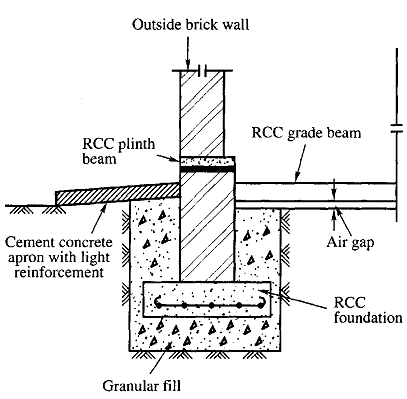
Fig 1: Footing with special cushion
CNS-MSM Technologies
CNS Technology or the concept is based on self-equilibrating phenomenon with a difference that clay minerals present in CNS are non-expanding such as kaolinite, chlorite etc. The thickness of CNS needed to prevent transmission of swelling pressure and heave to the foundation. CNS can be obtained as a natural material or can be made produced by blending two or more materials.
In MSM Technology, to improve the bearing capacity of the system the layer of Mechanically Stabilized Mix is intercepted over CNS intercepting layer. Normally MSM consists of graded aggregate, sand and fines with more plasticity, similar to that allowed in water bounded macadam mix.
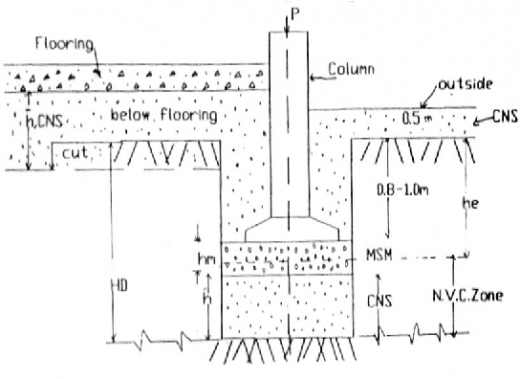
Fig 2: CNS-MSM Technology used in foundation
Strip footing
It was found that conventional strip foundations with sand cushions were inadequate reinforcing the shallow strip footings was tried and inverted “T” foundation is commonly used. The common types of strip footings that have been used for light buildings are-
- Unreinforced with plinth band.
- Nominally reinforced with plinth band.
- Nominally reinforced inverted T.
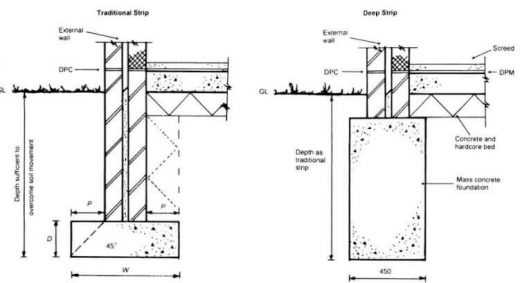
Fig 3: Strip Footing
Granular pile anchor
Granular anchor pile is one which the foundation is anchored at the bottom of Granular pile, to a mild steel plate through a mild steel rod. It helps in holding the particulate granular medium and prevents the granular pile from swelling and uplifting.
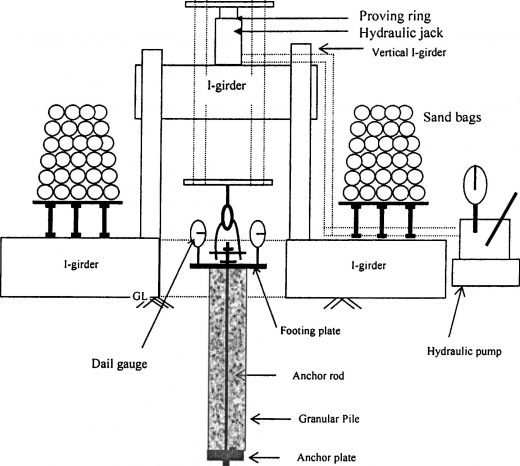
Fig 4: Pull out behavior of Granular anchor Pile
Stiffened mat foundation
The common method of stiffening consists of a slab cast beams 3-4 meters apart both longitudinally and laterally. The rigidity of mat minimizes distortion of the superstructure from both horizontal and vertical movements of the foundation soil. Differential heave also reduced when stiffness of slab and superstructure is increased.
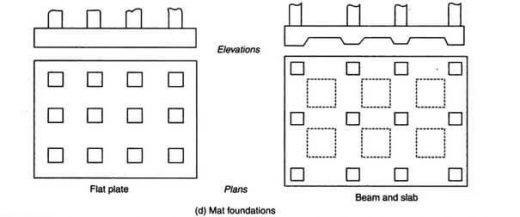
Fig 5: Mat foundation
Chemical stabilization
Phosphoric acid combined with wetting agent can be used for stabilization of expansive soils. Because it reacts with clay minerals and forms insoluble aluminum sulphate which serves as a moisture proof. Some chemicals such as sodium silicate, alkyl chloro silanes, siliconate amines, chrome lignin can be used for the water proofing of soils. The soils treated with calcium carbide do not easily pickup water as it is deliquescent and hygroscopic. When sodium chloride is added to the soil crystallization occurs in the pores of the soil and it forms a dense hard mat. So absorption of moisture is prevented.
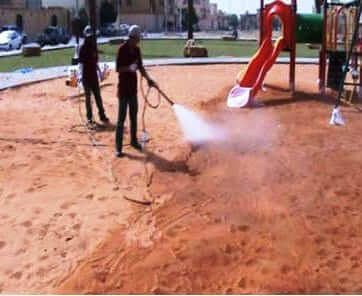
Fig 6: Chemical stabilization of soil
Moisture control
Swell and shrinkage can be reduced if water is prevented from moving into soil under and near the building post construction. For this purpose, moisture barriers are placed around the perimeter of the building. They efficiently reduce the variations in water content and differential heave.
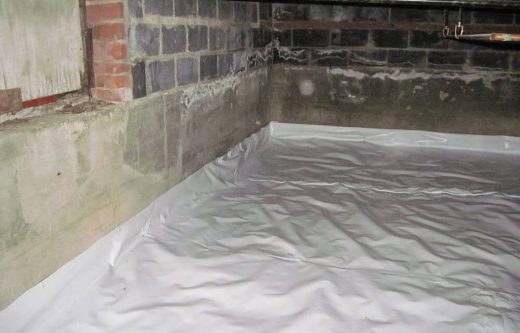
Fig 7: Moisture barrier for moisture control
Seismic Refraction Method
It is also called a seismic refraction survey. It is one of the types of geophysical methods used in civil engineering. We know that seismic waves have different velocities in different types of soil or rock. The seismic waves are refracted when they cross the boundary between different types of soils. The seismic refraction method is based on these two facts. This method helps us to determine the types of soil and the approximate depth of boundaries of strata or the bedrock.
The method consists of inducing impact by striking a plate on the soil with a hammer or generating shock by exploding a small charge at or near the ground surface. It radiates the shock waves which are recorded by a device called a geophone. The geophone records the time of travel of the waves. These are installed at suitable known distances on the ground in a line from the source of shock. Some of the waves known as direct or primary waves travel directly from the shock point along the ground surface. These waves are first picked by geophones. The other generated waves travel in a downward direction at various angles to the horizontal. These waves get refracted at the interface of two soil strata if they travel into a stratum at different seismic velocities. These waves are picked up by geophones. As the distance between the source of shock and the geophones increases, the refracted waves reach the geophone earlier than the direct waves. By knowing the time of travel primary and refracted waves at various geophones, the depth of various strata can be evaluated by preparing distance-time graphs and analyzing them.
Electrical Resistivity method for Soil Exploration
It is one of the types of geophysical methods in civil engineering. It is based on the measurement and recording of changes in the mean resistivity or apparent specific resistance of various soil. The resistivity of soils is a complicated function of porosity, permeability, ions present in the pore water, and clay mineralization. The most common electrical methods used in hydrogeological ad environmental investigations are vertical electrical sounding (resistivity sounding) and resistivity profiling. The resistivity ρ is defined as the resistance between the opposite faces of a unit cube of material. The variations in resistivity can be detected significantly between different types of soil strata, above or below the water table, between unfissured rock and soil, between voids and soil or rock.
Read More
Zero circle
Keywords: Zero circle, circle of correction, planimeter, area computation using planimeter
We already discussed the instrumental method for area computation i.e., the planimeter method. If you want to freshen your knowledge then read it here.
Zero circle or the circle of correction, is the circle around whose circumference if the tracing point is moved but no rotation of the wheel will be caused.the wheel will slide on the paper without causing any change in the reading.
Read More
Measurement of the area using Planimeter
Keywords: Planimeter, measurement of area, zero circle method
Planimeter is an accurate instrumental method used for the computation area. Read more about Planimeter here.
For measuring the area of plots with planimeter, two methods are generally adopted.
Read More