
Awarded as the best online publication by CIDC

Posts by Kanwarjot Singh

Economical Sizing

ECONOMICAL SIZING OF DISTRIBUTION PIPING.

An equation for the most economical pipe diameter for a distribution system for water is

D=0.215*(fbQ3aS/aiHa)1/7

where

D= pipe diameter, ft (m)

f =Darcy–Weisbach friction factor

b =value of power, $/hp per year ($/kW per year)

Qa= average discharge, ft3/s (m3/s)

S =allowable unit stress in pipe, lb/in2 (MPa)

a= in-place cost of pipe, $/lb ($/kg)

i =yearly fixed charges for pipeline (expressed as a fraction of total capital cost)

Ha =average head on pipe, ft (m)
Flow From Wells

The steady flow rate Q can be found for a gravity well by using the Dupuit formula:

Q =[1.36K(H 2-h 2)]/log(D/d)

where
Q =flow, gal/day (liter/day)

K= hydraulic conductivity, ft/day (m/day), under
1:1 hydraulic gradient

H= total depth of water from bottom of well to free-water surface before pumping, ft (m)

h= H minus drawdown, ft (m)

D= diameter of circle of influence, ft (m)

d =diameter of well, ft (m)

The steady flow, gal/day (liter/day), from an artesian well is given by

Q=[2.73Kt(H -h)]/log(D/d)

where
t = thickness of confined aquifer, ft (m).

Water Flow For Firefighting

The demand rate of water for fighting fire is very high though the total quantity of water used for fighting fires is normally quite small. The fire demand as established by the American Insurance Association is

G=1020P1/2(1 -0.01P1/2)

where
G =fire demand rate in gal/min (liter/s)
P= population in thousands.

Groundwater

Groundwater is subsurface water in porous strata within a zone of saturation. Aquifers are groundwater formations capable of furnishing an economical water supply. Those formations from which extractions cannot be made economically are called aquicludes.

Permeability indicates the ease with which water moves through a soil and determines whether a groundwater formation is an aquifer or aquiclude.

The rate of movement of groundwater is given by
Darcy’s law:

Q=KIA

where
Q =flow rate, gal/day (m3/day)

K= hydraulic conductivity, ft/day (m/day)

I =hydraulic gradient, ft/ft (m/m)

A =cross-sectional area, perpendicular to direction of flow, ft2 (m2)

Method For Determining Runoff

METHOD FOR DETERMINING RUNOFF FOR MINOR HYDRAULIC STRUCTURES

The most common means for determining runoff for minor hydraulic structures is the rational formula:

Q=CIA

where
Q= peak discharge, ft3/s (m3/s)

C =runoff coefficient percentage of rain that appears as direct runoff

I= rainfall intensity, in/h (mm/h)

A= drainage area, acres (m2)

COMPUTING RAINFALL INTENSITY.

Chow lists 24 rainfall-intensity formulas of the form:
Read More

Evaporation And Transpiration

The Meyer equation, developed from Dalton’s law, is one of many evaporation formulas and is popular for making evaporation-rate calculations:

E=C (ew-ea) K

K=1+0.1w

where

E= evaporation rate, in 30-day month

C= empirical coefficient, equal to 15 for small, shallow pools and 11 for large, deep reservoirs

ew=saturation vapor pressure, in (mm), of mercury, corresponding to monthly mean air temperature observed at nearby stations for small bodies of shallow water or corresponding to water temperature instead of air temperature for large bodies of deep water.

ea=actual vapor pressure, in (mm), of mercury, in air based on monthly mean air temperature and relative humidity at nearby stations for small bodies of shallow water or based on information obtained about 30 ft (9.14 m) above the water surface for large bodies of deep water.

w=monthly mean wind velocity, mi/h (km/h), at about 30 ft (9.14 m) aboveground

K =wind factor

Prediction Of Sediment Delivery Rate

Rate of sediment accumulation in a reservoir can be found by two methods.
One approach depends on historical records of the silting rate for existing reservoirs and is purely empirical. The second general method of calculating the sediment delivery rate involves determining the rate of sediment transport as a function of stream discharge and density of suspended silt.

The quantity of bed load is considered a constant func- tion of the discharge because the sediment supply for the bed-load forces is always available in all but lined channels. An accepted formula for the quantity of sediment trans- ported as bed load is the Schoklitsch formula:

Gb=86.7*S3/2 (Qi – bqo)/ ? Dg
Read More

Weirs

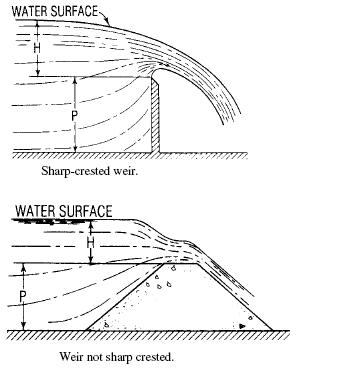
Weir is defined as a barrier over which the water flows in an open channel. The edge or surface over which the water flows is called the crest. The overflowing sheet of water is the nappe.
If the nappe discharges into the air, the weir has free discharge. If the discharge is partly under water, the weir is submerged or drowned.

Types of Weirs.

A weir with a sharp upstream corner or edge such that the water springs clear of the crest is a sharp-crested weir.
All other weirs are classed as weirs not sharp crested. Sharp-crested weirs are classified according to the shape of the weir opening, such as rectangular weirs, triangular or V-notch weirs, trapezoidal weirs, and parabolic weirs. Weirs not sharp crested are classified according to the shape of their cross section, such as broad-crested weirs, triangular weirs, and trapezoidal weirs.

The channel leading up to a weir is the channel of approach. The mean velocity in this channel is the velocity of approach. The depth of water producing the discharge is the head.
Sharp-crested weirs are useful only as a means of meas- uring flowing water. In contrast, weirs not sharp crested are commonly incorporated into hydraulic structures as control or regulation devices, with measurement of flow as their secondary function.

hydrualics 10
Read More

Extreme Engineering – HongKong’s airport

The most complicated engineering project in history of civil engineering,but with the power of iimagination and technical skills the engineers made the impossible possible
Read More

Extreme Engineering – California Academy of Sciences

The most advanced history museum in the world.Inspite the technical challenges,civil engineers took the extreme engineering project to build the museum in the worlds most earthquake prone
area
Read More

Ask a question