Awarded as the best online publication by CIDC

Posts by Kanwarjot Singh

How to Control Vibration In Blasting?

When ever explosive substances are used to blast, a large amount of vibration occurs. This vibration is not only dangerous for people working their but also to the neighboring structures. Therefore proper care must be taken to keep vibration in check.

The vibrations caused by blasting are related to velocity (V), wavelength (L) and frequency (f) as
L= V/f

Now Velocity V depends on the amplitude of the vibrations A and is given by
v=2pfA
Where p – pie = 3.14

Case – When we know velocity velocity v1 at a distance D1 from the explosion and wish to find velocity v2 at a distance D2 from the explosion
v2=(approx) v1(D1/D2)1.5

The scaled-distance formula is used for vibration control
V=H[D/(W)1/2]-b

Where
b and H are constants and depend on site.

Earth Quantities Hauled

Many people wonder that why the soil looks bulkier after excavation. The answer is that with increase in voids, the volume of soil increases and thus the soil pile looks bulkier. Here is a mathematical formula for this change in soil volume

Vb = VbL = (100/(100 + % swell))VL
where
Vb = original volume, yd3 (m3),
VL = loaded volume, yd3 (m3),
L = load factor

Similarly when we compact the soil, its volume decrease as voids are now filled.
Vc = VbS
where
Vc = compacted volume, yd3 (m3)
S = shrinkage factor.

What are the formulas For Earth Moving?

Whenever their is a movement, friction comes into action. The same is the case with earth moving equipments. We term this as rolling resistance and this has to be overcomed by vehicle engine so that it can move on that surface. This is the formula to calculate rolling resistance

R=RfW + RpPW
where
R = rolling resistance, lb (N)
p = tire penetration, in (mm)
Rf = rolling-resistance factor, lb/ton (N/tonne)
W = weight on wheels, ton (tonne)
Rp = tire-penetration factor, lb/ton in (N/tonne mm) penetration
Rf usually is taken as 40 lb/ton (or 2 percent lb/lb) (173 N/t) and Rp as 30 lb/ton in (1.5% lb/lb in) (3288 N/t mm).

So the above equation becomes
R=(2%+1.5 % p) W’=R’W’

where
W’ = weight on wheels, lb(N)
R’ = 2% + 1.5%p.

Case – When we have a slope
G = RgsW
where
G = grade resistance, lb(N)
Rg­ = grade-resistance factor = 20 lb/ton (86.3 N/t) = 1%
s = percent grade which is positive for uphill motion and negative for downhill motion.

The total road resistance is calculated by adding the rolling and grade resistances and is given by:
T = (R’+Rg s )W’ =(2%b + 1.5%p + 1%s)W’

Loss due to Altitude
Generally we take 3 percent pull loss for each 1000 ft (305 m) above 2500 ft (762 m).

Describe Compaction Equipment Rollers

Soil compaction is done by Rollers. Many models of these rollers can be found in the market. Depending on the soil type and conditions, we chose rollers to work on them. For example, for soils with high % of clay we mainly use Sheepsfoot rollers and for granular soils we use vibrating rollers. The selection of roller depends on other factors like speed, desired compaction etc

The table below shows the average speeds, mi/h (km/h) under normal conditions:

Type mi/h km/h
Grid rollers 12 19.3
Sheepsfoot rollers 3 4.8
Tamping rollers 10 16.1
Pneumatic rollers 8 12.8

To calculate compaction production use the following formula
yd3/h (m3/h) = 16WSLFE/P
where
W = width of roller, ft (m)
P = number of passes
S = roller speed, mi/h (km / h)
L = lift thickness, in (mm)
F = ratio of pay yd3 ( m3) to loose yd3 ( m3)
E = efficiency factor for excellent =0.90, average=0.80, poor= 0.75

Soil Compaction Tests

There are many types of Soil compaction tests which are performed on soil. Some of these are :-

1) The Sand Cone Method
One of the most common test to determine the field density of soil is the sand-cone method. But it has a major limitation that this test is not suitable for saturated and soft soils

The formula used are
Volume of soil, ft3 (m3)=[weight of sand filling hole, lb (kg)] /[ Density of sand, lb/ft3 (kg/m3)]

% Moisture = 100(weight of moist soil – weight of dry soil)/weight of dry soil

Field density, lb/ft3 (kg /m3)=weight of soil, lb (kg)/volume of soil, ft3 (m3)

Dry density=field density/(1 + % moisture/100)

% Compaction=100 (dry density)/max dry density

Maximum density is found by plotting a density–moisture curve.

2) California Bearing Ratio
The California bearing ratio (CBR) is used as a determine the quality of strength of a soil under a pavement. It also measures the thickness of the pavement, its base, and other layers.
CBR = F/Fo
where
F = force per unit area required to penetrate a soil mass with a 3-in2 (1935.6-mm2 ) circular piston (about 2 in (50.8 mm) in diameter) at the rate of 0.05 in/min (1.27 mm/min)

F0 = force per unit area required for corresponding penetration of a standard material.

3) Soil Permeability
Darcy’s law is applicable in determining the soil permeability. Darcy law states that
V = kiA

where
V = rate of flow, cm3 /s,
A = cross-sectional area of soil conveying flow, cm2
k = Coefficient of permeability which depends on grain-size distribution, void ratio and soil fabric. The value varies from 10 cm/s for gravel to less than 10–7 for clays.

To check Various Lab Test On Soil see this

What is the Settlement Under Foundations?

To calculate the approximate value of settlement the following equations is used. This establishes a relationship between loads on foundations and settlement

q/P = C1(1+2d/b) + C2/b
where
q = load intensity, lb/ft2 (kg/m2)
P= settlement, in (mm)
d =depth of foundation below ground surface, ft (m)
b=width of foundation, ft (m)
C1 =coefficient dependent on internal friction
C2 = coefficient dependent on cohesion

Bearing Capacity Of Soils

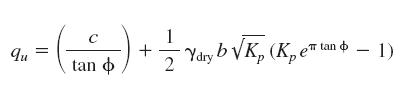
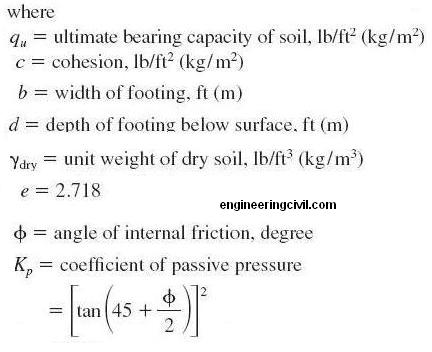
Ultimate bearing capacity is calculated by using Prandtl equation. When the footing is below the surface the ultimate bearing capacity of the soil is modified by (1 + Cd/b) where C = 2 for cohesionless soils and C= 0.3 for cohesive soils.

The Prandtl’s equation is :-
Prandtl’s equation

Prandtl’s-equation-formula

How to Determine the Stability Of Slopes?

To determine the stability of slopes, we first need to identify the type of soil. A cohesive soil behaves differently then Cohesionless Soils

Case 1 – When we have Cohesionless Soils
We consider the slope stable if it satisfies the following condition. Please note we consider no water seepage in this situation
i < f where i = slope of ground surface f = angle of internal friction of soil When seepage factor is introduced parallel to the slope and we assume that soil is totally saturated, the slope is considered stable if it fulfill this condition tan i < (Yb/Ysat) tan f

Case -2 When we have Cohesive Soils
The slope on a cohesive soil is considered stable if
H < (C/YN) where H = height of slope, ft (m) C = cohesion, lb/ft2 or kg / m2
Y = unit weight, lb/ft3 or kg / m3
N = stability number and is dimensionless

Lateral Pressure From Surcharge

To counter any effect of a surcharge on retaining wall on a cohesionless soil or an unsaturated cohesive soil we need to apply a uniform horizontal load of magnitude KAp. This load is applied over the entire wall height.

In case of saturated cohesive soil, the entire surcharge value acts on the entire wall height. This is considered to be a uniform load acting horizontally.

What is the Water Pressure Retained by Retaining Walls?

We know that water exerts a pressure on the wall and this thrust is calculated by using the following formula

P = ½Yo H2
where H = height of water above bottom of wall, ft (m)
Yo= unit weight of water.

Unit of water is 62.4 lb/ft3 1001g/m for freshwater and 64 lb/ft3 or 1026.7 kg/m3 for saltwater.

The thrust applied by water is considered to be acting at a distance of H/3 from the bottom of the retaining wall. The pressure distribution is triangular and has the maximum pressure of 2P/H at the bottom of the wall.

Ask a question