
Awarded as the best online publication by CIDC

Posts by Kanwarjot Singh

How can shotcrete stabilize tunnels?

When shotcrete is sprayed on a rough ground surface, it fills small openings and cracks. It serves as initial support and also immediate support after excavation. It decreases the possibility of relative movement of rock bodies or soil particles and, therefore, controls the loosening of the exposed ground surrounding the tunnel.

Advertisements

Shotcrete lining could take up significant loads though it forms a flexible support system. In fact, shotcrete lining is expected to undergo large deformations which enable the intrinsic strength and self-supporting properties of the ground to be mobilized as well to re-distribute stresses between the lining and ground. During the deformation of lining, stresses within the shotcrete lining are relocated to the surrounding ground. As such, this mechanism of load transfer in turn generates subgrade reaction of the ground which gives support to the shotcrete lining.

Friction between shotcrete and the ground also reduces the differential movement of the ground. Even though shotcrete may not form a complete ring, the frictional forces between shotcrete and the ground could provide support to the ground.

Advertisements

This question is taken from book named – A Self Learning Manual – Mastering Different Fields of Civil Engineering Works (VC-Q-A-Method) by Vincent T. H. CHU.
In Slurry Shield TBMs, should high or low slurry pressure be maintained to support excavated face?

In Slurry Shield TBMs, the slurry supports the wall of tunnel face in a manner similar to diaphragm wall. The bentonite forms a filter cake on the tunnel face on which the slurry exerts its pressure.

Advertisements

The face of a slurry shield tunnel boring machine is stabilized by bentonite slurry, which is kept under pressure. If the slurry pressures provided are too low, instability of the face results with occurrence of large settlements. On the contrary, in case the slurry pressures are kept too high, it leads to an excessive loss of bentonite and significant soil disturbance would occur.

This question is taken from book named – A Self Learning Manual – Mastering Different Fields of Civil Engineering Works (VC-Q-A-Method) by Vincent T. H. CHU.

What is the difference between single shield and double shield tunnel boring machine (TBM)?

In single shield TBM, it extends and moves forward by thrust cylinders on the last segment ring installed.

In double shield TBM, it consists of an extendable front shield which enhances the cutterhead to be extended. The gripper in the middle section of TBM is mobilized so that it pushes against the tunnel walls to react the boring forces. As these forces are dissipated, it allows the installation of lining segments during tunnel so that it increases the speed of tunneling. Upon completion of a trust stroke, the grippers are retracted and the end portion of TMB is pushed against the front shield by thrust cylinders.

Advertisements

Double shielded TBM is normally used in rock strata with geological fault zones and when a high rate of advancement is required. Single shielded TBM is more suitable to hard rock strata.

This question is taken from book named – A Self Learning Manual – Mastering Different Fields of Civil Engineering Works (VC-Q-A-Method) by Vincent T. H. CHU.

What is the difference between open shield and closed shield for TBM?

Open shield type TBM refers to those providing lateral support only. They can be further classified into single shield and double shield.

Closed shield type TBM refers to those providing lateral support and frontal support. Some common TBM method under this category includes compressed air TBM, slurry shield TBM, earth pressure balance machine and mixed confinement shield.

Advertisements

Compressed air TBM is suitable for cohesive soils under water table (e.g. ground with low permeability with no major discontinuities). Slurry shield TBM is suitable for soft ground and soft rock under water table and also for ground for high permeability. Earth pressure balance machine is suitable for soft ground and soft rock under water table. It is not recommended for very abrasive and hard ground.

This question is taken from book named – A Self Learning Manual – Mastering Different Fields of Civil Engineering Works (VC-Q-A-Method) by Vincent T. H. CHU.

Polymer-Modified Mortars And Concrete Mix Design

By
Kaushal Kishore
Materials Engineer, Roorkee

Polymer-modified Concrete (PMC) has also been called polymer-Portland cement-concrete (PPCC) and latex-modified concrete (LMC). It is defined as Portland cement and aggregate combined at the time of mixing with organic polymers that are dispersed or redispersed in water. This dispersion is called latex; the organic polymer is a substance composed of thousands of simple molecules combined into large molecules. The simple molecules are known as monomers, and the reaction that combine them is called polymerization. The polymer may be a homopolymer if it is made by the polymerization of one monomer, or a copolymer when two or more monomers are polymerized.

Of various polymer-modified mortar and concrete, latex-modified mortar and concrete have superior properties, such as high tensile and flexural strength, excellent adhesion, high waterproofness, high abrasion resistance and good chemical resistance, to ordinary cement mortar and concrete. Accordingly they are widely used in many specialized applications in which ordinary cement mortar and concrete have been employed to a lesser extent till now. In these applications, the latex-modified mortars are widely used rather than the latex-modified concrete from the viewpoint of a balance between their performance and cost.
Read More

Quality Control Of Construction Testing Of Concrete Cubes

By Kaushal Kishore
Materials Engineer, Roorkee

The acceptance criteria of quality of concrete is laid down in IS:456-2000. The criteria is mandatory and various provisions of the code have to be complied before the quality of concrete is accepted. In all the cases, the 28-days compressive strength shall alone be the criterion for acceptance or rejection of the concrete. In order to get a relatively quicker idea of the quality of concrete, optional test for 7 days compressive strength of concrete be carried out.

6 Cubes of 150 x 150 x 150 mm size (the nominal size of aggregate does not exceed 38 mm) shall be cast, 3 for 7-days testing and 3 for 28-days testing. A set of
3 cubes (specimen) average strength will be a sample. The individual variation of a set of 3 cubes should not be more than ± 15% of the average. If more, the test result of the sample is invalid.

Note:- For aggregates larger than 38 mm, bigger than 150 mm moulds are to be used. See IS:10086-1982
Read More

What are the situations which warrant the use of pipe ramming instead of other trenchless methods?

There are two main distinct advantages of pipe ramming:

(i) Settlement and heaving of existing ground.
Where a pipe have to be installed under an existing railway or heavily-trafficked highway, it is almost impossible to install the pipes by open excavation. In particular, if the pipes to be installed are of shallow depth, the use of some trenchless methods (e.g. pipe jacking and heading) may cause considerable ground settlement because the soil loss within shallow zone would induce larger settlement. As such, the use of pipe ramming could resolve this concern. Pipe ramming is a displacement method which generally would not result in ground loss. For open-ended steel casing, the soils inside the pipe are not removed until the entire casing is installed in place.

Advertisements

(ii) Muck Disposal
For microtunneling, spoils are removed from the excavation face in a slurry so that the spoil are wet. Hence, sufficient space has to be provided to allow for drying of spoils or the wet spoils have to be removed off site immediately. For pipe ramming slurry is not used so that the spoil retains only it natural moisture content. Therefore, it is easier to handle in-situ soils than wet spoils. On the other hand, the amount of spoil produced by pipe ramming is smaller when compared with pipe jacking and microtunneling

This question is taken from book named – A Self Learning Manual – Mastering Different Fields of Civil Engineering Works (VC-Q-A-Method) by Vincent T. H. CHU.

Would pipe ramming increase the vertical soil loads on installed pipes?

Consider a certain cross section along the line of pipe ramming. When the pipe is rammed close to the cross section, the horizontal and vertical soil pressure would increase owing to the effect of soil compaction brought about by dynamic ramming operation. Upon reaching the cross section, soil pressure is redistributed around the pipe such that the vertical pressure above the pipes is reduced while the vertical pressure in pipe abutment locations is increased. When the pipe is advanced further, the load on pipes tend to increase owing to reorientation of soils around pipe wall. Finally, when the pipe is rammed some distance away from the cross section, a stable state is achieved in which there is smaller earth pressure on the pipe’s top and higher vertical soil pressure on soils at both sides of the pipe.

Advertisements

This question is taken from book named – A Self Learning Manual – Mastering Different Fields of Civil Engineering Works (VC-Q-A-Method) by Vincent T. H. CHU.

Should closed-end or open-end pipes be used in pipe ramming?

It is more common to adopt open-end pipes in pipe ramming because it is not readily to undergo surface heaving or pipe deflection when compared with closed-end pipes. Moreover, the use of open-end pipes requires lower ramming force.

Closed-end pipes are only used in the following conditions:

Advertisements

(i) Ground with poor self-support so that inflow of soils inside the pipes would render ground settlement and loss of support to utility services.

(ii) Small size of pipes.

This question is taken from book named – A Self Learning Manual – Mastering Different Fields of Civil Engineering Works (VC-Q-A-Method) by Vincent T. H. CHU.

In pipe jacking/microtunneling, it is commonly accepted that cover depths of jacking pipes cannot be too shallow (i.e. less than 2D where D is the diameter of jacking pipes). Why?

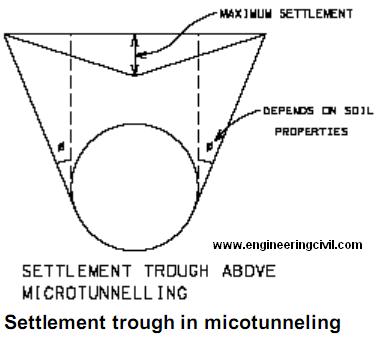
For pipe jacking/microtunneling, the causes of large settlement are loss of face stability, failure to stabilize ground around shafts, presence of annular space around pipes and shield, drag along pipe joints, etc. The settlement mechanism of shallow depths of pipe jacking/microtunneling is the formation of a settlement trough on top of the jacking pipes. The width of the trough depends on soil properties; the larger is the cover depth of jacking pipes, the larger is the width of settlement trough. For the same soil volume loss due to pipe jacking/microtunneling, the width of settlement trough for shallow cover depth is smaller and therefore it results in a larger vertical maximum settlement.

Advertisements

Settlement trough in micotunneling

This question is taken from book named – A Self Learning Manual – Mastering Different Fields of Civil Engineering Works (VC-Q-A-Method) by Vincent T. H. CHU.

Ask a question