
Awarded as the best online publication by CIDC

Posts by Kanwarjot Singh

Why does settlement occur in microtunneling?

Settlements occur in microtunneling, or other tunnel construction methods in two forms: large settlements and systematic settlements. The cause of large settlements is the over-excavation by microtunneling machine leading to the loss of stability at the tunnel face and the formation of empty space above the tunnel. The occurrence of large settlements is attributed to the improper operation of the tunneling machine or rapid unexpected changes in ground conditions.

Systematic settlements are mainly caused by the collapse of the radial overcut between the jacking pipe and the excavation. The annular space between the jacking pipe and the excavation is essential in microtunneling and pipe jacking for the following purposes:

Advertisements

(i) Reduction of jacking forces
(ii) Injection of the lubrication
(iii)Steering of the microtunneling boring machine

During tunneling, the soils may collapse onto the pipe, resulting in subsidence at the ground surface. Systematic settlements can be controlled by limiting the radial overcut and by filling the annulus with bentonite lubricant during tunneling, and with cement grout after tunneling is completed.

This question is taken from book named – A Self Learning Manual – Mastering Different Fields of Civil Engineering Works (VC-Q-A-Method) by Vincent T. H. CHU.
What are the situations which warrant the use of microtunneling instead of other trenchless methods?

There are two main advantages of microtunneling:

(i) Difficult ground conditions
Microtunnels could operate under a water head of 30m or more. It is capable of handling a wide range of soils such as cobble, boulders and rock without the need of dewatering.

Advertisements

(ii) Surface settlement
Surface settlement could be minimized by using microtunneling. For example, the use of earth pressure balance method in microtunneling helps balance the external soil loads and groundwater. Moreover, the rate of advancement of machine and the rate of excavation of tunnel face can be readily controlled so that it reduces the occurrence of over-excavation at tunnel face and hence the ground settlement.

This question is taken from book named – A Self Learning Manual – Mastering Different Fields of Civil Engineering Works (VC-Q-A-Method) by Vincent T. H. CHU.

Does microtunneling refer to tunnel size less than 1000mm?

The international definition of microtunneling includes pipe with diameter up to 1,000mm only. However, in the United States, it allows for larger pipe size when defining microtunneling in which pipe with diameters up to 144 inches are also counted within the ambit of microtunneling.

Advertisements

The basic concept of microtunneling has changed gradually owing to recent technological developments and past experience. For instance, the use of alignment control system with advanced surveying techniques allows for longer drives with good control and curved microtunneling. The use of automatic lubrication system enhances lower jacking forces. The employment of gripper in microtunneling machines helps develop adequate loads on cutter discs for cutting rock.

This question is taken from book named – A Self Learning Manual – Mastering Different Fields of Civil Engineering Works (VC-Q-A-Method) by Vincent T. H. CHU.

What is the difference between pipe jacking and micro-tunneling?

Pipe jacking is a general technique of the installation of pipes with a tunneling shield in front and the pipes are jacked from a jacking pit to a receiving pit. The tunneling shield for pipe jacking can be electrical and mechanical equipment for conducting the excavation work or it can be a manual shield for workers going inside the shield to carry out manual excavation. For microtunneling, it is a kind of pipe jacking of small sized non-man-entry pipes which are remotely controlled. In general, there are two common types of micro-tunneling machines:

(i) Pressurised slurry
Similar to the Pressurised slurry TBM, excavated material is transported from the excavation face to the surface suspended in a slurry.

Advertisements

(ii) Auger machine
Excavated material is transported from the excavation face to the drive pit through a cased screw auger.

This question is taken from book named – A Self Learning Manual – Mastering Different Fields of Civil Engineering Works (VC-Q-A-Method) by Vincent T. H. CHU.

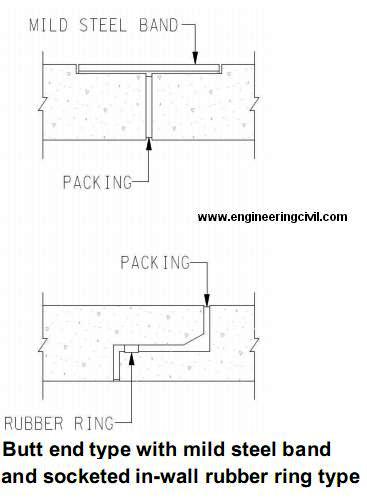
In concrete pipe joint for pipe jacking, butt end type with mild steel band and socketed in-wall rubber ring type are commonly used. Which one is better?

Butt end type with mild steel band is commonly used for storm water application. The mild steel band serves to prevent lateral displacement if pipe joint during pipe jacking.

Advertisements

Socketed in-wall rubber ring type is normally used for sewer and pressure pipe situation and for pipe size exceeding 1200mm in diameter. The rubber ring is designed to provide a seal to pipe joint to ensure water tightness, which is essential in sewage pipelines.

Butt end type with mild steel band and socketed in-wall rubber ring type

This question is taken from book named – A Self Learning Manual – Mastering Different Fields of Civil Engineering Works (VC-Q-A-Method) by Vincent T. H. CHU.

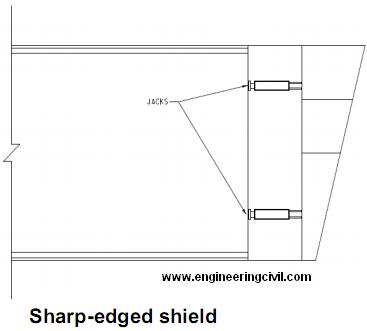
Why is sharp-edges shield normally used in pipe jacking with manual excavation?

The shield connected to lead pipe is normally sharp-edged in design because:

(i) It helps to reduce the resistance when the shield enters into soils;

(ii) It reduces the amount of soil dropping into the shield.

Advertisements

Sometimes the shield is equipped with jacks so that it allows tilting of the shield and adjustment could be made to the direction of pipe jacking.

sharp-edge-shield

This question is taken from book named – A Self Learning Manual – Mastering Different Fields of Civil Engineering Works (VC-Q-A-Method) by Vincent T. H. CHU.

Why do Slurry Shield TBMs have difficulty when tunneling in clay?

In Slurry Shield TBMs, the slurry forms a filter cake on the face of excavation which has the following purposes:

(i) It provides the surface for slurry pressure to act on.

(ii) It acts as a seal against the y of groundwater into the tunnel.

Advertisements

(iii) In case the TBM breaks down, this filter cake serves as a sealing membrane at the tunnel face which allows man-entry into the excavation and working chamber upon provision go compressed air.

Slurry Shield TBMs are widely used for non-cohesive soils ranging from fine-grained sand to coarse-grained gravel. It is less suitable when operating in clay because:

(i) Most slurry separation plant could not separate clay from slurry. As such, the cost of frequent replacement of bentonite slurry is substantially increased.

(ii) Clayey materials to clog and cause blockages in slurry system leading to sudden pressure surges.

Advertisements

This question is taken from book named – A Self Learning Manual – Mastering Different Fields of Civil Engineering Works (VC-Q-A-Method) by Vincent T. H. CHU.

Why are aqueous lubricants considered inappropriate for cohesive soils in pipe jacking?

Lubrication performs effectively in pipe jacking by maintaining a layer of lubricant between the outside surface of jacking pipes and the adjacent soil. However, once the ground has collapsed onto the jacking pipe, the effect of lubrication would be greatly reduced. Hence, it is important to maintain sufficient pressure to avoid these occurrences.

Advertisements

Bentonite slurries are commonly used in silty, sandy and granular soils but it is not recommended to use in clayey soils because it may cause swelling in clays by absorption of water and this results in increased contact between the jacking pipe and soils. Hence, non-aqueous lubricants should be considered for cohesive soils.

This question is taken from book named – A Self Learning Manual – Mastering Different Fields of Civil Engineering Works (VC-Q-A-Method) by Vincent T. H. CHU.

Swelling of clay develops significant stresses on pipe and its effect is even magnified by the use of lubricant. How can swelling inhibitors help to resolve this problem?

Lubricants are introduced in pipe jacking to reduce the jacking loads. However, for pipe jacking in clay the swelling of clay is accelerated by water-based lubricant as the free water in the lubricant is readily absorbed by clay. To address the problem, swelling inhibitors are added to lubricants which enhance a reduction of free swelling for clays. In essence, the ability of swelling inhibitors to reduce free swelling of clay is achieved by the alternation of clay properties and formation of barrier on cavity surface.

Advertisements

This question is taken from book named – A Self Learning Manual – Mastering Different Fields of Civil Engineering Works (VC-Q-A-Method) by Vincent T. H. CHU.

How can Earth Pressure Balance TBM maintain stability of tunnel face?

Earth Pressure Balance (EPB) TBMs are used in excavating and advancing tunnels through any type of soft ground or soil condition, particularly below the water table. The EPB method consists of a cutting chamber located behind the cutterhead. This chamber is used to mix the soil with water foam. It is maintained under pressure by the mucking system. The ground at the cutting face is supported by earth pressure by balancing the advancement of the tunnel with the discharge rate of the excavated soil.

Advertisements

The underlying principle of the EPB method is that the excavated soil itself is used to provide continuous support to the tunnel face by balancing earth pressure against the forward pressure of the machine. The thrust forces generated from rear section of TBM is transferred to the earth in the cutterhead chamber so as to prevent uncontrolled intrusion of excavated materials into the chamber. When the shield advances at the face of excavation, the excavated soil is then mixed together with a special foam material which changes its viscosity or thickness and transforms it into a flowing material. This muck is then stored and is used to provide support and to balance pressure at the tunnel face during the excavation process.

This question is taken from book named – A Self Learning Manual – Mastering Different Fields of Civil Engineering Works (VC-Q-A-Method) by Vincent T. H. CHU.

Ask a question