
Awarded as the best online publication by CIDC

Posts by Kanwarjot Singh

EngineeringCivil.com Awarded Best Online Publication Award by CIDC

In a glittering ceremony held on 7th March 2013 at Stein Auditorium, India Habitat Center, New Delhi, www.engineeringcivil.com was awarded as the best online publication by Construction Industry Development Council of India (CIDC).

The 5th CIDC Vishwakarma Awards were presented by Dr. Pronab Sen, Chairman, National Statistical commission & Former Principal Adviser, Planning Commission, Government of India. Many other prominent personalities from the field of construction and civil engineering also graced the occasion.

Engineeringcivil.com is specially thankful to Sir Kaushal Kishore for his continuous encouragement and motivation. The award was jointly received by Sir Kaushal Kishore and Kanwarjot Singh on behalf of www.engineeringcivil.com
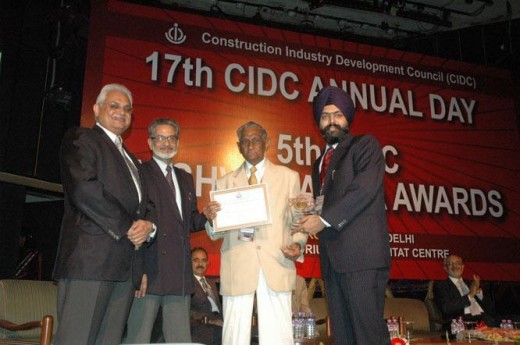
EngineeringCivil.com Awarded Best Online Publication Award by CIDC

About CIDC Vishwakarma Awards
The CIDC Vishwakarma awards are inspired by the spirit of construction and creation patronized by Lord Vishwakarma the ruling deity of the Construction practices in India. At the Annual CIDC Vishwakarma Awards, the work and achievements of individuals and organizations is recognized and applauded. The awards are an embodiment of encouraging truly successful efforts from individuals and organizations that have made a mark on the present Indian Construction Industry in terms of delivering better outputs, processes and creating higher benchmarks for construction industry to help in nation building.

Advertisements

Mix Design For Concrete Roads As Per IRC:15-2011

By
Kaushal Kishore, Materials Engineer, Roorkee

ABSTRACT:
The stresses induced in concrete pavements are mainly flexural. Therefore flexural strength is more often specified than compressive strength in the design of concrete mixes for pavement construction. A simple method of concrete mix design based on flexural strength for normal weight concrete mixes is described in the paper.

INTRODUCTION:
Usual criterion for the strength of concrete in the building industry is the compressive strength, which is considered as a measure of quality concrete. However, in pavement constructions, such as highway and airport runway, the flexural strength of concrete is considered more important, as the stresses induced in concrete pavements are mainly flexural. Therefore, flexural strength is more often specified than compressive strength in the design of concrete mixes for pavement construction. It is not perfectly reliable to predict flexural strength from compressive strength. Further, various codes of the world specified that the paving concrete mixes should preferably be designed in the laboratory and controlled in the field on the basis of its flexural strength. Therefore, there is a need to design concrete mixes based on flexural strength.
Read More

Non-destructive Testing Of Concrete By Rebound Hammer

By
Kaushal Kishore
Materials Engineer, Roorkee

INTRODUCTION
The standard method of determining strength of hardened concrete consists of testing concrete cubes in compression. The quality of entire concrete of a structure cannot be fully assessed by testing a few concrete cubes. The results obtained in testing cubes do not always reflect the actual strength of concrete in construction. In a whole day, concreting work cubes are cast in a few batches, the differences (unintentional and intentional) in the composition are not uncommon, their compaction and their hardening conditions always differ more or less from those of the structure. In addition, the number of test cubes is generally so small that they can only be considered as random tests. Some times, in case of failure of cubes, doubtful concrete, cracks, deterioration of concrete, etc. it becomes necessary to assess the quality and strength of concrete of the structure. As far back as early thirties, the necessity was felt to develop instruments by which in-situ strength of concrete may be obtained. Various non-destructive methods of testing concrete have been developed, which include, Firing method, Skramtayev’s method, Polakov’s method, Magnitostroy method, Fizdel ball hammer, Einbeck pendulum hammer, Ball indentation hammer, Rebound hammer, Pull out techniques, Windsor probe, Ultrasonic pulse velocity methods, Radioactive and nuclear methods, Magnetic and electrical methods. In all these methods of tests, due to simplicity, rebound hammer test based on surface hardness becomes most popular in the world for non-destructive testing of in-situ concrete.

Read More

Working at height is commonly defined in many countries as falling more than 2m. Why?

For more than 2 metres, it is commonly defined as high level fall in which most injuries are resulted from. However, there is an increasing trend that there has been similar number of injuries from low level falls (i.e. less than 2 metres) and from high level falls. As such, some countries have deleted the “2 metre rule” as the definition of falling at height. Instead, it is newly defined as working at a place from which a person could be injured by falling from it, regardless of whether it is above, at or below ground level without stating the level of fall.

Advertisements

This question is taken from book named – A Self Learning Manual – Mastering Different Fields of Civil Engineering Works (VC-Q-A-Method) by Vincent T. H. CHU.

How does safety helmet function?

The main principle of safety helmet is to protect workers against impact by falling objects or struck by swinging object by energy absorption. Upon hitting by an object, the helmet dissipates some of the energy in the following mechanisms:

(i) Stretching of harness inside the helmet;
(ii) Partial damage of outer shell of helmet.

Advertisements

The remaining energy is then evenly spread around the head to reduce the hitting stress on worker’s head.

This question is taken from book named – A Self Learning Manual – Mastering Different Fields of Civil Engineering Works (VC-Q-A-Method) by Vincent T. H. CHU.

What is the difference between sureties and security?

In construction contracts, if a contractor fails to perform the works, the employer would suffer from severe financial loss and therefore some forms of protection has to be established in the contract.

For surety bond, the contractor obtains a guarantee from a third party i.e. a bank or an insurance company, which in return for a fee, agrees to undertake the financial responsibility for the performance of contractor’s obligations. This third party will pay to the employer in case there is a contractor’s default.

Advertisements

For security, a sum of money is deposited in the employer’s account and upon satisfactory fulfillment of contractor’s obligations, the sum will be released to the contractor.

This question is taken from book named – A Self Learning Manual – Mastering Different Fields of Civil Engineering Works (VC-Q-A-Method) by Vincent T. H. CHU.

Should design life be the same as return period for design conditions?

Design life means the minimum duration a structure is expected to last. The longer is the design life; the higher is the cost of a project. Therefore, in choosing the design life for a structure, engineers should consider the design life which generates a economical project without sacrificing the required function.

In selection of return period of certain design conditions, winds, waves, etc., one should consider the consequences of exceedance. In fact, there are normally no extreme maximum values of these design conditions and its selection is based on the probability of exceedance which is related to return period.

Advertisements

Therefore, design life may not be equal to return period of design conditions because their selections are based on different considerations.

This question is taken from book named – A Self Learning Manual – Mastering Different Fields of Civil Engineering Works (VC-Q-A-Method) by Vincent T. H. CHU.

Is the procurement of third party insurance necessary to be incorporated in contract for construction works?

The purpose of third party insurance is to protect contractors from bankruptcy in case there are severe accidents happened to the third party due to the construction work. Therefore, in government contracts, contractors are requested contractually to procure third party insurance from the commencement of contract until the end of Maintenance Period. If contractors have the financial capability to handle the claims due to accidents to third party, the client is not bound to include this requirement in the contract.

Advertisements

This question is taken from book named – A Self Learning Manual – Mastering Different Fields of Civil Engineering Works (VC-Q-A-Method) by Vincent T. H. CHU.

If the contractor is liable for defective works for 12 years with contract under seal (6 years with contract not under seal), then what is the significance of Maintenance Period?

Defective works constitute a breach of contract in accordance with Limitation Ordinance (Cap. 347).

An action founded on simple contract (not under seal) shall not be brought after expiration of 6 years while an action founded with contract under seal shall not be brought after expiration of 12 years. For construction works, the date of counting these actions should be the date of substantial completion.

Advertisements

To answer the above question, one should note that under the contractual requirement, the contractor during Maintenance Period has the right to rectify the defects and the employer has also the right to request the contractor to make good defective work. However, after the expiry of Maintenance Period, in case of any arising of defects, the employer has to employ others to rectify these works and bring the action to court to claim the contractor for the costs associated.

This question is taken from book named – A Self Learning Manual – Mastering Different Fields of Civil Engineering Works (VC-Q-A-Method) by Vincent T. H. CHU.

What are the functions of different components of paint?

For normal paint application, there are mainly three main components of paint, namely primer, undercoat and finishing coat.

Primer: This is the first layer of a typical painting system and it is used to inhabit corrosion and provide a good bond for subsequent coats.

Undercoat: This component acts as a barrier to corrosion agents and even out irregularities of bonding surface. It also serves to hide the underlying background and prevent the details and colour of the area of application to affect the designed colour and finishing details of paint.
Read More

Ask a question