Awarded as the best online publication by CIDC

Posts by Kanwarjot Singh

In pumping stations one of the choices for the material of water tanks is fibre-reinforced plastic (FRP). What are the advantages associated with this kind of material?

There are two main advantages for FRP water tanks:

(i) It possesses high strength to weight ratio and this leads to the ease of site handling.

(ii) It is highly resistant to corrosion and thus it is more durable than steel water tank.

Advertisements

This question is taken from book named – A Self Learning Manual – Mastering Different Fields of Civil Engineering Works (VC-Q-A-Method) by Vincent T. H. CHU.

What are the components of a waterproofing system in the roof of a typical pumping station?

In the design of a waterproofing system at the roof of a pumping station, normally the following components are:

(i) Above the structural finish level of the concrete roof, a screed of uniform thickness is applied to provide a smooth surface for the application of waterproofing membrane. (Screed of varying thickness can also be designed on the roof to create a slope for drainage.) The screed used for providing a surface for membrane should be thin and possess good adhesion to the substrate. Moreover, the screed aids in the thermal insulation of the roof.

(ii) Above the screed, waterproofing membrane is provided to ensure watertightness of the roof.

Advertisements

(iii) An insulation board may be placed on top of waterproof membrane for thermal insulation. In cold weather condition where the loss of heat at the roof is significant, the insulation board helps to reduce these losses. On the contrary, in summer the roof is heated up by direct sunlight and the insulation layer reduces the temperature rise inside the pumping station.

This question is taken from book named – A Self Learning Manual – Mastering Different Fields of Civil Engineering Works (VC-Q-A-Method) by Vincent T. H. CHU.
In selecting screw pumps in polder scheme projects, what are the factors that affect the design capacity of screw pumps?

The commonly used angles of inclination for screw pumps are 30o, 35o and 38o. For screw pumps of relatively high lifting head, like over 6.5m, angle of inclination of 38o is normally used. However, for relatively lower head and high discharge requirement, angle of inclination of 30o shall be selected. In general, for a given capacity and lifting head, the screw pump diameter is smaller and its length is longer for a screw pump of 30o inclination when compared with a screw pump of 38o inclination.

Advertisements

To increase the discharge capacity of screw pumps, a larger number of flights should be selected. In fact, screw pumps with 2 flights are more economical that that with 3 flights in terms of efficiency and manufacturing cost. Moreover, the discharge capacity is also determined by the screw pump diameter and sizes of 300mm to 5000mm are available in current market.

This question is taken from book named – A Self Learning Manual – Mastering Different Fields of Civil Engineering Works (VC-Q-A-Method) by Vincent T. H. CHU.

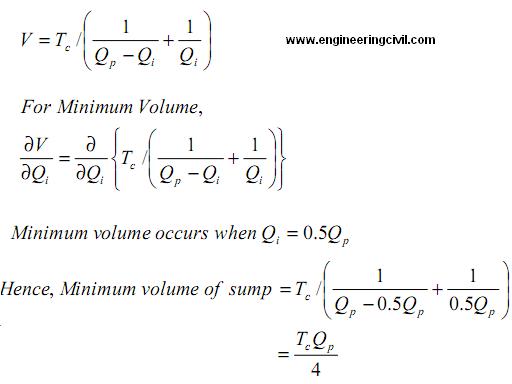
What is the minimum volume of sump volume for pumps?

Maximum pumping rate = Qp

Volume of sump= V

Inflow Rate= Qi

Cycle Time Tc = t1+t2

t1= V/[Qp-Qi]

t2= V/Qi

Tc= Minimum cycle time

minimum volume of sump volume for pumps

This question is taken from book named – A Self Learning Manual – Mastering Different Fields of Civil Engineering Works (VC-Q-A-Method) by Vincent T. H. CHU.

Advertisements

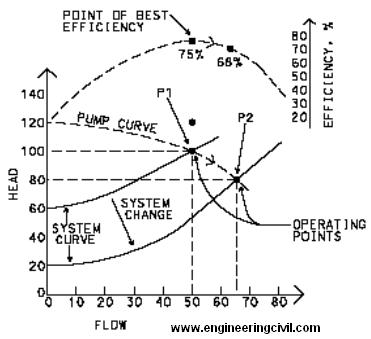
What is the difference between best efficiency point and operating point for pumps?

In a pumping system, a system curve can be derived based on the static head required to lift up the fluid and variable head due to possible head losses. The pump curves which relate the performance of the pumping to head against discharge can be obtained from pump suppliers. When the system curve is superimposed on the pump curve, the intersection point is defined as the operating point (or duty point). The operating point may not be necessarily the same as the best efficiency point. The best efficiency point is a function of the pump itself and it is the point of lowest internal friction inside the pump during pumping. These losses are induced by adverse pressure, shock losses and friction.

Losses due to adverse pressure gradient occur in pumps as the pressure of flow increases from the inlet to the outlet of pumps and the flow travels from a region of low pressure to high pressure. As such, it causes the formation of shear layers and flow separation. Flow oscillation may also occur which accounts for the noise and vibration of pumps. The effect of adverse pressure gradient is more significant in low flow condition.

Advertisements

For shock losses, they are induced when the inflow into pumps is not radial and contains swirl. In an ideal situation, the flow within the pump should be parallel to the impellers such that the flow angle is very close to the impeller angle. The deviation of the above situation from design causes energy losses and vibration.

head vs flow

This question is taken from book named – A Self Learning Manual – Mastering Different Fields of Civil Engineering Works (VC-Q-A-Method) by Vincent T. H. CHU.

What is the difference in function between backward curved vanes and forward curved vanes in pumps?

The power of a pump is related to discharge as follows:

Power=K1Q + [K2Q2]/tan A

where k1 and k2 are constants, Q is discharge and A is the angle between the tangent of impeller at vane location and the tangent to vane.

Advertisements

For A less than 90o (forward curved vanes) it is unstable owing to unrestricted power growth. Large losses result from high outflow velocity. The preferred configuration is achieved when A is more than 90o (i.e. backward curved vanes) because it has controlled power consumption and presents good fluid dynamic shape.

This question is taken from book named – A Self Learning Manual – Mastering Different Fields of Civil Engineering Works (VC-Q-A-Method) by Vincent T. H. CHU.

In terms of pumping performance, how should engineers determine the use of radial flow pumps and axial flow pumps?

Specific speed is usually defined for a pump operating at its maximum efficiency. In order to minimize the cost of future operation, it is desirable to operate the pumps as close to the maximum efficiency point as possible. The specific speed for radial flow pumps is relatively small when compared with that of axial flow pumps. This implies that radial flow pumps tend to give higher head with lower discharge while axial flow pumps tend to give higher discharge with lower head.

Advertisements

This question is taken from book named – A Self Learning Manual – Mastering Different Fields of Civil Engineering Works (VC-Q-A-Method) by Vincent T. H. CHU.

Why are axial flow pumps suitable for large flows and low heads?

It is well known that axial flow pumps are most suitable for providing large flows and low heads. The reason behind this is closely related to the configuration and design of the pumps. In axial flow pumps, the size of inlet diameter is greater than that of impeller diameter. For low flow condition the velocity is relatively small and this increases the chances of occurrence of separation which brings about additional head losses and vibration. On the contrary, if the discharge is large enough the problem of separation is minimized.

Advertisements

This question is taken from book named – A Self Learning Manual – Mastering Different Fields of Civil Engineering Works (VC-Q-A-Method) by Vincent T. H. CHU.

Why are radial flow pumps suitable for small flows and high heads?

In radial flow pumps, a diffuser/volute is normally designed at it outlet to convert the kinetic energy gained during the pumping process to pressure head. The diffuser is characterized by widening of outlet pipes, resulting in the decrease of velocity (by continuity equation) and an increase in pressure head (by Bernoulli’s equation). In case of large flows to be handled by the pumps, the large velocity results in formation of significant Coriolis force which tends to deviate the outlet flow from design conditions.

Advertisements

At the inlet part of the pumps, the inlet size is smaller than the diameter of the impeller. Consequently, the velocity of flow associated with a small area is relatively large and there is less problem of separation in low flow condition. All in all, the efficiency of radial flow pumps is high when handling small flows.

This question is taken from book named – A Self Learning Manual – Mastering Different Fields of Civil Engineering Works (VC-Q-A-Method) by Vincent T. H. CHU.

What is the purpose of adding cooling pipes or even using cold water for concrete in concreting operation?

All these measures aim at reducing the placing temperature and reducing thermal cracks induced during concreting of massive pours. Since the final concreting temperature should be the ambient temperature, reducing the initial placing temperature will also lower the peak hydration temperature. Therefore, the temperature difference between the hydration peak and the ambient temperature is reduced accordingly and subsequently the thermal effect to concrete structure can be reduced by controlling the placing temperature.

Advertisements

This question is taken from book named – A Self Learning Manual – Mastering Different Fields of Civil Engineering Works (VC-Q-A-Method) by Vincent T. H. CHU.

Ask a question