Awarded as the best online publication by CIDC

Posts by Kanwarjot Singh

Water Proofing By Ferrocement

By
Er. KAUSHAL KISHORE
Materials Engineer, Roorkee

Ferrocement as a construction material has now gained acceptance in different applications, namely : housing, agriculture, marine, water supply, sanitation, water proofing treatment etc. Numerous studies published have built up confidence in the material resulting its wider application,

Traditional methods of roof water proofing by lime concrete and mud phuska with thin burnt clay tiles are very cumbersome, time consuming involved high labor cost and also due to non availability of traditional skills and good materials these methods of water proofing are now not very popular. Though bitumen felts are also provided for water proofing their life is less than five years and need frequent replacement.

Read More

India’s Lodha World One To Be World’s Tallest Residential Tower

Lodha’s World One will bring India’s name in the list of some of the world re-known engineering projects as it will be the tallest residential tower in the world.

Project Details and Costing
Location- Upper Worli, Mumbai, Maharashtra, India.

Site Area – 17.5 acre

Land Acquired from Srinivas Cotton Mills By Lodha Group for Rs 250 crore (US$40 million)

Project Cost – Rs 20 billion (US$320 million)

Expected Revenue from Sales – Rs 50 billion (US$800 million)
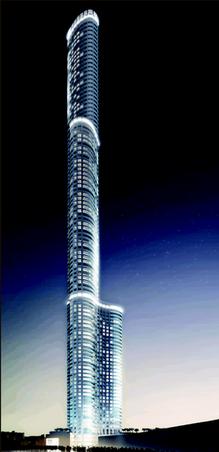
World_One_Mumbai_lodha_group

Architect
Pei Cobb Freed & Partners are the architects for World One. This company has more than 200 awards for design excellence which include 24 AIA National Honor Awards.

Advertisements

Structural Engineer
Leslie E. Robertson Associates (LERA) are the ones doing structure designs for this project. They have vast experience in designing tall buildings as their earlier projects included the Shanghai World Financial Center, Bitexco Financial Tower, World Trade Center in New York.

Types of Flats in World One

1) World residences – These are the ones starting from level 1 to level 43 with three and four bedroom houses along with curved glass living room and wide sundecks along each room.

2) World Villas – These lavish four-bedroom flats will be from level 43 to 117 and are designed in such a way that they offer 270 degree view of the city. Other amenities include home theatre, an outdoor Jacuzzi, a private pool and wide sundecks in every room.

3) World Mansions – These are the super luxurious flats starting from 117 storeys. These houses are sprawled over two floors and offer 360-degree view of the city.

Advertisements

This is not for even rich, these are only for superrich as the apartment prices start from Rs 7.5 crore (US$1.2 million) and go all the way to Rs 50 crore (US$8.0 million).

Image courtesy:http://en.wikipedia.org/wiki/World_One

Concrete Mix Design with Fly Ash and Superplasticizer

By
KAUSHAL KISHORE
Materials Engineer, Roorkee

Fly ash or pulverished fuel ash (pfa) is a finely divided powder thrown out as a waste material at the thermal power plants using pulverized coal for raising steam in the boilers. In the building industry, the use of fly ash a part replacement of cement in mortar and concrete at the construction site has been made all over the world including India and is well known. The important building materials which can be produced from fly ash are:

Read More

Alkali-Silica Reaction In Concrete

By
KAUSHAL KISHORE
Materials Engineer, Roorkee

The problem of Alkali-silica reaction was believed to be non-existent in India till 1983, when its occurrence was diagnosed in two concrete dams. This paper describes this problem with respect to Indian aggregates and cement. A rapid method of test for alkali-aggregate reaction is investigated and described in the paper.

INTRODUCTION
The most common causes of deterioration in structural concrete with steel reinforcement in it are

  • carbonation and chloride penetration leading to corrosion of steel resulting cracking and spelling of the concrete cover.
  • inadequate cover to reinforcing steel Less common causes of deterioration in clude,
  • freezing and thawing
  • sulphate attack
  • alkali-aggregate reaction.

There are three types of alkali-aggregate reactions, namely the alkali-silica, alkali-silicate and akali-carbonate reactions. Deterioration due to the alkali-silica reaction is more common and this paper refers to this aspect.
Read More

Concrete Curing Compound

By
Er. KAUSHAL KISHORE
Materials Engineer, Roorkee

NEED FOR CURING

The necessity for curing arises from the fact that hydration of cement can take place only in water-filled capillaries. That is why a loss of water by evaporation from the capillaries must be prevented. Evaporation of water from concrete, soon after placing depends on the temperature and relatively humidity of the surrounding air and on the velocity of wind over the surface of the concrete. Curing is essential in the production of concrete to have the desired properties. The strength and durability of concrete will be fully developed only if it is properly cured. The amount of mixing water in the concrete at the time of placement is normally more than required for hydration & that must be retained for curing. However, excessive loss of water by evaporation may reduce the amount of retained water below what necessary for development of desired properties. The potentially harmful effects of evaporation shall be prevented either by applying water or preventing excessive evaporation.
Read More

Green Architecture and Construction Materials Expo

Date: August 20-22, 2014
Venue: Shanghai New International Expo Center
Dimension: 80,000
Organizers: Shanghai Modern International Exhibition Co., Ltd.
Shanghai Building Materials Industry Association
Official web: www.expojc.com

Read More

M-80 Grade Pumpable Concrete

By
Kaushal Kishore
Materials Engineer, Roorkee

A mix of M-80 Grade suitable for pumped concrete is to be designed with the following materials and detail.

1. OPC 53 Grade, 7-day strength 52.5 N/mm2, Spgr 3.15

2. Silica Fume Specific Gravity 2.20

3. Standard deviation for the mix 5.0 N/mm2

4. Grading and properties of river sand and 12.5 mm crushed aggregate are given in Table-1

5. Superplasticizer based on modified Polycarboxylate, specific gravity 1.06, liquid pH 6.0. With the given set of materials, it was found that at a dosages of 2.5 % bwc it gives a reduction of 30% of water for the required slump of 100 mm after one hour at the average day site temperature of 37 degree C.
Read More

List of Projects Related to Earthquake Engineering

Here are some topics which you can use for your projects if you have chosen Seismic or Earthquake Engineering. You are free to add more project topics via comment section below.

1 Seismic Retrofitting Of Buildings
2 Seismic Behavior Analysis Of Bridges
3 Failure Of Foundation Due To Earthquake
4 Advanced Earthquake Resistant Techniques
5 Innovations In Earthquake Proof Structures
6 Seismic Behavior & Design Of RC Shear Walls
7 Earthquake & Earthquake Resistant Techniques
8 The Seismic Controlling Methods And Devices
9 Role Of Building Codes In Seismic Assessment.
10 Analysis For Seismic Retrofitting Of Buildings
11 Energy Dissipation Devices For Seismic Design.
12 Seismic Analysis and Up-gradation Of Structures
13 Earthquake Resistant Design and its Importance.
14 Steel Bracing Of RC Frames For Seismic Retrofitting
15 Recent Advances In Seismic Retrofitting Of RC Frames.
16 Calculation Of Earthquake – Actions On Building Structures
17 Evaluation Of Earthquake Affected Structure Using NDT WRT.
18 Earthquake Vibration Control Using Modified Frame-shear Wall
19 Seismic Response Of RC Frame Building With First Soft Storey
20 Seismic Design Force For Single-span Slab-girder Skewed Bridges

Advertisements

21 Development Length Requirements In Seismic Force-resisting Members
22 Response Spectrum Modelling For Regions Lacking Earthquake Records
23 Seismic Retrofitting Of RC Buildings Using Traditional Techniques.
24 An Investigation Of Joints Behavior In Seismic Response Of Arch Dams
25 Seismic Resistance Verification Of Confined Masonry Using Shock Table Studies
26 Earthquake Resistant Construction Of R.C.C Building And Construction Practices
27 Brick Masonry Building Model With Seismic Bands Under The Action Of Base Motion
28 Aspects Of Earthquake Disaster Mitigation Special References To Non Engineered Construction
29 An Investigation Of Design Issues related to Seismic Performance Of Pile-to-pile Cap Connections
30 Studies On Strength And Behavior Of Composite Tubes For Earthquake Resistant Industrial Structures
31 Studies On Sleeved Composite Columns Confined With Glass Fiber Reinforced Polymer(gfrp) For Seismic Resistance
32 Comparative Strength Analysis Of Rubbers And Cement And Mortar-encased Steel Composite Columns For Seismic Resistance
33 Shear Reinforcement At Slab-column Connections Of Slabs That Are Not Part Of The Lateral-force-resisting System Of A Building In A High Seismic Design Category

If you have any suggestion or feedback do comment below. Help other engineers by suggesting more engineering topics for presentations and reports below. In case you find any error or duplication in the above list, just comment below.

The 5 Shanghai International Green Wooden Residential Exhibition

Same Period Expo
2013 International wooden(bamboo)structure construction and auxiliary products Expo
2013 Shanghai International Green Architecture and Construction Materials Expo

Date: August 15-17, 2013
Venue: Shanghai New International Expo Center (No.2345 Longyang Road)
Dimension: 100,000
Organizers: China Architectural Association Wooden Special Committee
Shanghai Modern International Exhibition Co., Ltd.
Shanghai Building Materials Industry Association
Supporters: Chinese Wooden circulate Association
Chinese Architectural Association
Oversea Corporation: Canadian Forest Industry
Europe Forest Industry
Japan Wood-Products Export Promotion Council

Media: www.woodculture.cn

Subject: Advocate low carbon lifestyle, create a noble, fashion, comfortable and elegant living

Advertisements

Brief:
In the 80’s of last century, modern wooden architecture was officially introduced to Shanghai. At the beginning period of “Reform and Opening”, the infrastructure of Shanghai was lagging behind and lack high-end hotel. Even the hotel for receiving leaders from central government and foreign countries was out-of-date. Therefore, Shanghai government established some independent wooden structure villas in Xi Jiao Guesthouse. In the new century, with people’s living condition improving and environment-friendly awareness increasing, more and more people begin to pursue more energy-saving and more comfortable life. The wooden building and its natural ecological character, whose advantages, which showed on living and other using etc in all directions, appears more and more apparent, gradually started to blend into Shanghai and have got significant progresses. Recently, the economic and functional house base of Pudong Sanlin district will firstly carry out the pilot: “the public commercial building of wooden structure——concrete composite structure”,which covers about 2000.Compared to the lightweight houses and concrete structure, the wooden structure would conserve energy about 35% with more about 7% living space. Undoubtedly, it will increasingly promote the development of wooden structure house, Shanghai moreover East China district.
Read More

Sand For Concrete From Steel Mills Induction Furnace Waste Slag

By
Kaushal Kishore
Materials Engineer, Roorkee

INTRODUCTION:
For the last 20 years, the use of by products of various origins in the production of concrete has become an increasingly widespread practice in the world. The main advantages are all the elimination of scraps and a reduction in the over exploitation of quarries.

Blast furnace slag is used in blended cement. Although many studies have been conducted on the evaluation of the electric arc furnace slag to be use in concrete as aggregates replacing natural aggregates, no studies have been performed regarding the use of induction furnace slag in concrete as aggregates replacing natural aggregates.

In making mild steel ingot scrap to sponge iron is fed into the induction furnace which produces large quantity of slag. For example Kotdwar a small town of Uttarakhand Steel Mills induction furnances alone generates 15,000 tonnes of slag per year and about 1,50,000 tonnes of slag is lying as dump around this city posing an environmental problem. If about 20 steel factories of Kotdwar generate such quantity of slag it can be calculated how much slag is being generated by about 600 induction furnace units of India.
Read More

Ask a question