
Tar is commonly incorporated in bituminous materials because of the following reasons:
(i) Blending of tar with bitumen possesses better binding performance with roadstone than bitumen. Read More
Awarded as the best online publication by CIDC
Tar is commonly incorporated in bituminous materials because of the following reasons:
(i) Blending of tar with bitumen possesses better binding performance with roadstone than bitumen. Read More
Owing to the porous nature of friction course, its deterioration rate is faster than conventional bituminous materials and the durability of friction course is a main concern form users. The service life of friction course is reported to be around 8-10 years.
Read More
Friction course, which is known as porous asphalt, is often used as surface material in high speed roads and expressway. It is porous in nature which allows for speedy drainage of surface water. Road safety can be improved because it reduces the chance of hydroplaning/aquaplaning (i.e. there is a layer of water between the tires of the vehicle and the road surface. It may lead to the loss of traction and thus prevent the vehicle from responding to control inputs such as steering, braking or accelerating). It also decreases the splash and spray from vehicles in wet weather. It serves as a drainage channel for water to flow beneath the pavement surface.
Read More
“Stone contact mechanism” applies to well graded aggregates coated with bitumen (e.g. dense bitumen macadam) where the traffic loads on bituminous roads are resisted by stone-to-stone contact and by interlocking and frictional forces between the aggregates. It is essential to adopt aggregates with a high crushing strength. The bitumen coatings on the surface of aggregates merely serve to cement the aggregates together.
Read More
Roadbase is the most important structural layer in bituminous pavement. It is designed to take up the function of distributing the traffic loads so as not to exceed the bearing capacity of subgrade. In addition, it helps to provide sufficient resistance to fatigue under cyclic loads and to offer a higher stiffness for the pavement structure.
Read More
T Beam designing tool in Microsoft excel using macros developed by Shankar Tayal a 3rd year student of school of infrastructure, Indian Institute of Technology,Bhubaneswar.
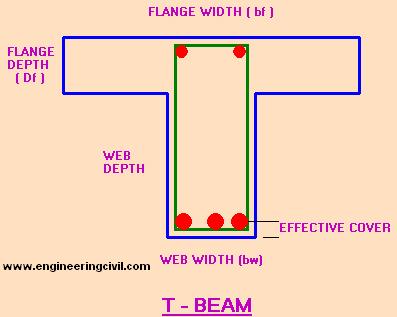
INPUTS:
Depth of the web
Depth of the flange
Design Moment
Grade of concrete ( M15 or M20 )
grade of steel ( Fe 250 or Fe 415 or Fe 500)
Flange Width
Read More
PAPER ON EFFECT OF ECCENTRICITY ON ANALYSIS & DESIGN OF ISOLATED FOOTINGS
(A CASE STUDY OF Jammu and Kashmir)
Note – Right click on images and click view image to see actual size of image
ABSTRACT
Footings are often subjected to moments from columns in addition to the axial loads. The presence of certain amount of eccentricity of loading in the footing induces moment on footing. A careful consideration has to be given to the presence of eccentricity, while performing the analysis and design of such footings, as an increase in eccentricity beyond certain limit renders a considerable area of footing ineffective to resist the stresses due to development of tension. Under these circumstances, the conventional flexural equation becomes inapplicable, thereby imparting more complexity in the analysis.
In this Thesis an attempt has been made to understand the behaviour of footings subjected to Uniaxial and biaxial eccentricity.
Two cases of uniaxial eccentricity are considered, Case I with column placed away from centre of footing, load being concentric with the column and Case II with column at centre of footing and load placed at certain eccentricity. For each case three conditions of eccentricity are considered ie e=0, eL/6. Complete analysis has been performed using Limit State Method for SBC = 40, 50, 65 and 100 KN/Sq m which are prevalent in the region under consideration. For biaxial cases two eccentricity conditions with eL/6 and SBC = 100 KN/Sq m have been analyzed. The analysis of footing subjected to biaxial eccentricity was carried out manually and as per charts and tables prevalent in literature.
A comparative study was conducted for both cases with reference to the design parameters and permissible values. The effect of eccentricity on quantity, cost and various other parameters were studied. The analysis was also carried out using SAP – 2000 Software for both Uniaxial and Biaxial Cases. The results obtained manually and by the use of software have been compared and difference analyzed. A computer program was developed for Analysis and Design of footing for Uniaxial and Biaxial cases in M.S. Excel to reduce the iterative work and to save time.
It was observed that there is a remarkable increase in quantity of concrete and steel when the loads are eccentric, the increasing factor being more in case of column placed away from the centre of footing as compared to the column placed at centre of footing. The results also highlight that the foundations become highly uneconomical if the geotechnical investigation reveals incorrect values of safe bearing capacities.
Read More
For land development, what makes a development sustainable? All forms of land development will affect the livability, economics, and environment of the region surrounding the developed site. Each individual new development becomes part of a patchwork that forms the quilt of a “city”. The problem today is that most land developments are not sustainable, which presents a domino effect that can ultimately destroy a cities long term livability –it cannot sustain itself.
The United Nations defines sustainability as a balance of People, Planet and Profit, or the 3-P’s as also adopted by Sustainable Land Development Initiative (www.sldi.org). The problem with the three P’s is it was developed for all situations, including third world countries where life’s basic needs may not be addressed, vs. developed industrial societies. The other problem is that P which states “Profit” inferring that the developer walks away with a larger bank account, but what happens for the decades and centuries the development exists far beyond that initial home sale or commercial lease?
Read More
Two way RCC slab designing tool in Microsoft excel developed by Shankar Tayal a 3rd year student of school of infrastructure, Indian Institute of Technology, Bhubaneswar.
Read More
One of the methods to control settlement of nearby buildings due to excavation work is by recharging. Water collected in wells in deep excavation is put back to the top of excavation in order to raise the drawn-down water table.