
Awarded as the best online publication by CIDC

Posts by Kanwarjot Singh

Can joint sealant provide a perfect watertight seal in joints?

The two main principal functions of joint sealant are to minimize the entry of surface water and prevent the ingress of incompressible material from entering the joint. Other minor function of joint sealant is to reduce the possibility of corrosion of dowel bar by the entrance of de-icing chemicals.

Advertisements

Water entry into joints is undesirable because it leads to the softening of subgrade and pumping of subgrade fines under heavy traffic. However, it is impractical to maintain a completely watertight pavement structure. In fact, vacuum tests show that no sealants could provide 100% watertight seal. The current philosophy to combat water ingress into joints is only to minimize but not to completely prevent water from entering the pavement structure. Instead, a permeable subbase is designed to remove water from the pavement.

This question is taken from book named – A Self Learning Manual – Mastering Different Fields of Civil Engineering Works (VC-Q-A-Method) by Vincent T. H. CHU.
Which joint sealant is better, acrylic, polysulfide, polyurethane or silicone?

There are four generic types of joint sealant with high performance. Their properties are highlighted in the following table:

Acrylic Polysulfide Polyurethane Silicone
Accommodate 12% movement. Poor recovery

in high cyclic

movements

Accommodate

50% movement.

Accommodate

50% movement.

Exhibit shrinkage upon curing Exhibit excellent

chemical resistance

Excellent bonding, can

be used without primer

Excellent low temperature

movement capability

Solvent-based. Good performance in submerged conditions. Good UV

resistance

Excellent UV and heat stability
Advertisements

This question is taken from book named – A Self Learning Manual – Mastering Different Fields of Civil Engineering Works (VC-Q-A-Method) by Vincent T. H. CHU.

Can all utility detectors detect the depth of utilities?

In Hong Kong, underground utility detectors are normally divided into two types: electromagnetic detector and ground penetrating radar (GPR).

For electromagnetic detector, it can detect the signals emitted by metallic utilities themselves by passive mode. While in active mode, the detector has to pick up the signals through a transmitter and sonda connected directly to the non-metallic utility. Both the alignment and depth can be found in active mode while only alignment can be found in passive mode. The electromagnetic detector available in market can detect utilities up to depth of 3m.

Advertisements

For ground penetrating radar, it sends radio waves into the ground and receives signals from reflections from utilities. It has the advantage of locating both the depth and alignment of utilities. More importantly, it can detect both metallic and non-metallic utilities. However, it suffers from the disadvantage that it is quite expensive and interpretation of data is not simple. Reference is made to LD, DSD (2000).

This question is taken from book named – A Self Learning Manual – Mastering Different Fields of Civil Engineering Works (VC-Q-A-Method) by Vincent T. H. CHU.

For compaction of paving blocks, should the jointing sand be applied before or after the compaction process?

The common practice is to apply jointing sand at the first place followed by subsequent compaction. However, there are several potential problems associated with this method. Firstly, the presence of sand provides support to paving blocks leading to inadequate compaction. Secondly, the excess jointing sand may be crushed during compaction and leaves stains on the surface of paving blocks. Thirdly, damaged paving blocks appear to be difficult for removal owing to frictional grip by jointing sand.

Advertisements

The alternative method is to carry out compaction firstly and then followed by application of joint sand and then re-compaction is carried out again. This method eliminates all the shortcomings of the first method described above. However, it suffers from the demerit of two passes of compaction instead of a single stage of compaction is required. Moreover, the compaction operation tends to be noisier because of the absence of the infilling sand which helps to reduce noise level. The direct contact between individual paving blocks is more vulnerable to spalling during compaction.

This question is taken from book named – A Self Learning Manual – Mastering Different Fields of Civil Engineering Works (VC-Q-A-Method) by Vincent T. H. CHU.

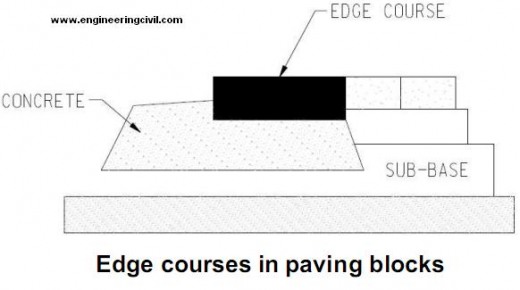
What is the purpose of edge courses in paving blocks pavement?

The principal function of edge courses is to form a retaining structure with concrete bedding and haunching to resist sideway movement arising from traffic loads. Other functions of edge courses include:

(i) It serves as level guides when carrying out screeding of sand bedding.
Read More

Why should edge courses of paving blocks sit on concrete bedding?

In pavement made up of paving blocks, the edge courses are normally designed to sit on concrete bedding and haunching. The reason of such provision is to prevent lateral movement of paving blocks when subjected to traffic loads. In essence, the edges formed by edge courses tie the body of the paving blocks as a single unit and they have to rely on concrete bedding and haunching to resist the sideway forces generated by moving traffic.

Advertisements

The concrete bed serves to keep the edge courses in position for surface level and it provides the dead loads in the retaining structure. On the other hand, concrete haunching also holds the edge courses in position from the point of view of lateral movement.

edges-paving-block

This question is taken from book named – A Self Learning Manual – Mastering Different Fields of Civil Engineering Works (VC-Q-A-Method) by Vincent T. H. CHU.

Should sand layer or cement sand be used as bedding of precast concrete paving units?

Cement sand is a mixture of cement and sand and it acts as a cohesive mass once mixed. Normally, a 20mm to 30mm sand layer is laid underneath precast paving block units. However, in locations of steep gradients where it stands a high possibility that rain runoff will wash out infilling sand and sand layers, cement sand should be sued instead. Similarly, when high pressure jetting is anticipated to be employed frequently in routine maintenance, sand layers beneath precast paving block units is not preferable owing to the reason of potential washing out of sand.

Advertisements

This question is taken from book named – A Self Learning Manual – Mastering Different Fields of Civil Engineering Works (VC-Q-A-Method) by Vincent T. H. CHU.

Can the sand bedding be omitted in paving block pavement?

In the paving block pavement, it normally consists of the following main elements: sub-base, sand bedding and paving blocks. Sub-base is the main structural element to take up traffic load and spread it into larger area so that the traffic stress is small enough for subgrade to sustain. Sand bedding is used for providing correct line and level for paving blocks to lie on. To achieve this, screeding of bedding layer is implemented so that the paving blocks could be laid directly on it without the need of further leveling.
Read More

What is Efflorescence in Bricks and Concrete?

Paper of Efflorescence in Bricks and Efflorescence and Leaching in Concrete by Sir. Kaushal Kishore
Materials Engineer, Roorkee

Efflorescence is the usual terms for deposit of soluble salts, formed in or near the surface of a porous material, as a result of evaporation of water in which they have been dissolved.

EFFLORESCENCE IN BRICKS:
Usually sulphate of magnesium, calcium, sulphate and carbonate (and sometimes chloride and nitrates) of sodium and potassium are found in efflorescence. These salts may be traced to the brick itself, sand used in construction, the foundation soil, ground water, water used in the construction and loose earth left over in contact with brick work. Bricks with magnesium sulphate content higher than 0.05 percent should not be used in construction. Soluble salt content in sand (chloride and sulphate together) should not exceed 0.1 percent.
Read More

What are Green Buildings?

By
Er. Kaushal Kishore ,
Materials Engineer, Roorkee

INTRODUCTION:
A green building is that building which is constructed at a well planed location with proper design and sustainable materials. Fitted and painted with eco friendly materials. The building should gives to its occupants healthy and comfortable environment in all climates. It remains cool in summer, warm in winter, inside fully protected from rain, gives natural pollution free air and light through doors, windows and ventilators without any artificial means. For particular requirements it has solar, wind power and eco friendly electrical, mechanical etc. devices.
Read More

Ask a question