
Awarded as the best online publication by CIDC

Posts by Kanwarjot Singh

For a concrete pavement constructed over a box culvert, why is it important to match the location of transverse joints with boundary of box culvert?

When a concrete pavement is constructed over a box culvert, it is important to match the location of transverse joints with boundary of box culvert. Otherwise, it is likely that full-depth transverse cracks would develop on the pavement slabs just above the location of boundary of box culvert. In case a layer of granular sub-base is introduced to place under the pavement slabs, the sub-base layer serves as crack-arresting layer and the possibility of development of transverse cracks in concrete pavement is reduced.

Advertisements

This question is taken from book named – A Self Learning Manual – Mastering Different Fields of Civil Engineering Works (VC-Q-A-Method) by Vincent T. H. CHU.
World’s Highest Railway Bridge To be Built In India

With aspiration of becoming a global superpower, India’s construction industry is now thinking beyond the box. Mumbai Worli Sea Link as one of the biggest achievements has boosted the construction industry and now they are building world’s highest railway bridge over Chenab in Reasi in Jammu between two villages Bakkal and Kauri.

The 1.3 km, 359 meters from the river bed is nick named as Sky Bridge and is part of the 73 km Katra-Dharam section of the Udhampur-Srinagar-Baramulla Rail Link USBRL project.

Some facts about this Bridge
1) It will be 19 m higher than the currently tallest rail bridge i.e the bridge on France’s Tarn River (340m)
2) It will be 35 m taller than the Eiffel Tower in Paris.
3) It will be six times the height of the Panvalnadi bridge in Maharashtra which is considered asthe tallest so rail bridge in India so far

Advertisements

Bridge Design
The design of this bridge is divided as
1) A 467 meter steel arch in the centre
2) A 185-meter approach deck from the Bakkal end
3) A 650-meter approach deck from the Kauri end.

The construction details and photographs of this bridge are awaited.

We are very thankful to Er Vipun Paul for submitting this useful information to us.

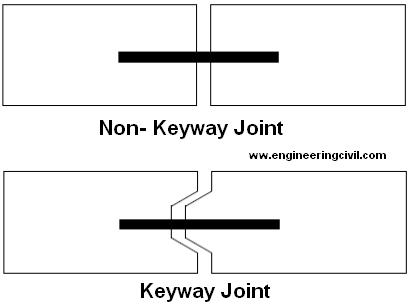
In concrete pavement, keyway joint are sometimes adopted in longitudinal joint. Why?

Longitudinal joints are installed in concrete pavement to prevent differential settlement between adjacent concrete panels. Moreover, it serves to control cracking from stresses caused by volumetric changes of concrete owing to moisture and thermal gradients. In essence, the joint contains tie bars to enhance efficient load transfer between adjacent concrete panels.

Advertisements

Sometimes keyway joint are designed in longitudinal joint to improve the performance of the joint. Though the installation of keyway joint does not appear to increase the load transfer efficiency of longitudinal joint, it proves to help reduce the deflection of concrete pavement. Keyways are not recommended for thin slab (less than 250mm thick) because of the difficulty in construction. Moreover, keyways are prone to failure in thin concrete slabs where they are too large or too close to slab surface.

non-keyway-joint

This question is taken from book named – A Self Learning Manual – Mastering Different Fields of Civil Engineering Works (VC-Q-A-Method) by Vincent T. H. CHU.

What is the difference between tie bars and dowel bars in concrete carriageway?

Tie bars are deformed rebars or connectors used for holding faces of rigid slabs in contact to maintain aggregate interlock. Tie bars are not load transferring device. For instance, tie bars are used in longitudinal joints in concrete pavement.

Advertisements

Dowel bars are smooth round bars which mainly serve as load transfer device across concrete joints. They are placed across transverse joints of concrete pavement to allow movement to take place. Where movement is purposely designed for longitudinal joints, dowel bars can be adopted.

This question is taken from book named – A Self Learning Manual – Mastering Different Fields of Civil Engineering Works (VC-Q-A-Method) by Vincent T. H. CHU.

Why are contraction joints in concrete pavement normally designed to be unsealed?

For unreinforced concrete pavement, the contraction joint is an approximately 3mm wide groove with a depth of about one-third to one-fourth of slab thickness and a regular spacing of normally 5m. The grooves are designed such that they are too narrow for stones to fall into when the cracks are open due to the contraction of concrete. The groove location is a plane of weakness and the groove acts as a potential crack-inducing device where any potential cracks due to shrinkage and thermal contraction may form will be confined to the base of the groove. It will not cause any unpleasant visual appearance on the exposed surface of unreinforced concrete pavement.

Advertisements

The above-mentioned contraction joints can be designed as unsealed. These grooves are very narrow so that stones can hardly get into these grooves even when the joint undergoes contraction. The fine particles or grit entering into the groove are likely to be sucked out by the passing vehicles. The joints can be self-cleansing and it may not be necessary to seal the joints for fear of attracting the accumulation of rubbish and dirt
Advertisements

This question is taken from book named – A Self Learning Manual – Mastering Different Fields of Civil Engineering Works (VC-Q-A-Method) by Vincent T. H. CHU.

What is the function of longitudinal joints in concrete road pavements?

A longitudinal joint consists of a tie bar placed at the mid-depth of a concrete pavement and it is not intended for joint lateral movement. Then one may doubt the reasons of placing longitudinal joints in concrete pavements. In fact, longitudinal joints are normally designed at a regular spacing e.g. 4.5m to accommodate the effect of differential settlement of pavement foundation. When uneven settlement occurs, the tie bars in longitudinal joints perform as hinges (Ministry of Transport (1955)) which allow for the settlement of concrete carriageway. Moreover, it also serves to cater for the effect of warping of concrete due to moisture and temperature gradients by permission of a small amount of angular movement to occur so that stresses induced by restrained warping can be avoided.

Advertisements

Dowel bars are provided in longitudinal joints for the following reasons:
(i) In case of the occurrence of uneven settlement between adjacent panels, it helps to maintain a level surface by transfer of loads through dowel bars.
(ii) Keep the longitudinal joints close.

This question is taken from book named – A Self Learning Manual – Mastering Different Fields of Civil Engineering Works (VC-Q-A-Method) by Vincent T. H. CHU.

If the construction of concrete carriageway is carried out in summer, can expansion joints be omitted?

If the construction of concrete carriageway is carried out in summer, expansion joints may not be necessary as suggested by Arthur Wignall, Peter S. Kendrick and Roy Ancil. Expansion of concrete carriageway is mainly due to seasonal changes with an increase in temperature from that during construction to the ambient temperature (i.e. the temperature in summer). However, if the construction of concrete carriageway takes place in summer, the concrete carriageway will undergo contraction in the following winter, thus the space available in contraction joints can accommodate the future expansion in the next summer.

Advertisements

This question is taken from book named – A Self Learning Manual – Mastering Different Fields of Civil Engineering Works (VC-Q-A-Method) by Vincent T. H. CHU.

Presentation on Reinforcing Detailing Of R.C.C Members

Presented By
Er.T.RANGARAJAN, B.E, M.Sc(struct.engg), F.I.E, FACCE, LACI, LISSE, LIASE

WHO IS AN ENGINEER?
According to USA President Herbert Hoover, who was an engineer before he became a politician, said:
The great liability of the engineer …compared to men of other professions……is that his works are out in the open where all can see them.
His acts …..step by step …are in hard substances.
He cannot bury his mistakes in the grave like the DOCTORS.
He cannot argue them into thin air…..or blame the judge…..like the LAWYERS.
He cannot, like the ARCHITECT, cover his figures with trees and vines.
He cannot, like the politicians, screen his shortcomings by blaming his opponents….and hope the people will forget. The ENGINEER simply cannot deny he did it.
If his works do not work……he is damned.

Important Points from Presentation
A design engineer’s responsibility should include assuring the structural safety of the design, details, checking shop drawing.
Read More

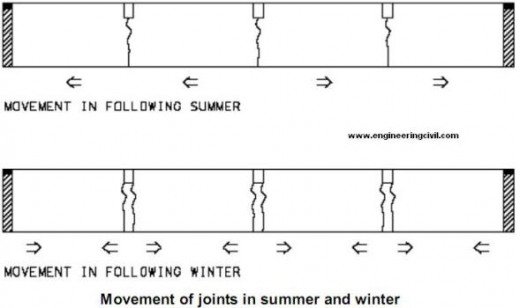
For unreinforced concrete carriageway, what is the sequence of closing and opening of expansion joints and contraction joints?

Let’s take an example to illustrate the sequence of closing and opening of joints (Ministry of Transport (1955)). For instance, an unreinforced concrete carriageway is constructed in winter. When temperature rises in the following summer, the section between expansion joints will expand as a whole single element resulting in the closure of expansion joints. This section of concrete pavement will move outwards from the mid-point
between the expansion joints. In the next winter, each bay (i.e. concrete pavement between adjacent contraction joints) of concrete contracts about the midpoint of its length with opening of contraction joints.

Advertisements

Movement of joints in summer and winter

This question is taken from book named – A Self Learning Manual – Mastering Different Fields of Civil Engineering Works (VC-Q-A-Method) by Vincent T. H. CHU.

In expansion joints why are plastic sleeve normally used in dowel bars instead of debonding agent?

The purpose of plastic sleeve or debonding agent around dowels bars in expansion joints is to minimize the frictional resistance between the bar and its surrounding concrete. This is the reason why plain round bars are usually used instead of deformed bars which provide mechanical interlock with concrete and hence it hinders the free movement of the dowel bar.

Advertisements

Both bituman-based paint (debonding agent) and plastic sleeve could serve the purpose of reducing friction between dowel bar and surrounding concrete. From practical point of view, the use of plastic sleeve (e.g. PVC dowel sleeve) around dowel bars can well prepared off-site and manufactured well in advance, thus saving the time of construction.

This question is taken from book named – A Self Learning Manual – Mastering Different Fields of Civil Engineering Works (VC-Q-A-Method) by Vincent T. H. CHU.

Ask a question