
Awarded as the best online publication by CIDC

Posts by Kanwarjot Singh

Do soil compaction test results over 100% mean over-compaction?

Soils can experience over-compaction if the compactor makes too many passes over it. In fact, relative soil compaction test results over 100% do not necessarily mean over-compaction because the relative compaction is based on the maximum dry density of the soil obtained by the Proctor test and this does not necessarily refer to absolute maximum dry density.

Advertisements

Over-compaction is considered undesirable because it may eventually create cracks in the underlying compacted material so that it results in a decrease in density. Moreover, it causes waste of machine power and manpower which is undesirable.

This question is taken from book named – A Self Learning Manual – Mastering Different Fields of Civil Engineering Works (VC-Q-A-Method) by Vincent T. H. CHU.

Why should excess slurry head be maintained in diaphragm wall?

For the construction of diaphragm walls adjacent to buildings, previous experience showed that excess slurry head above groundwater level had to be maintained to limit the ground settlements during the construction of diaphragm walls. In fact, the excess slurry head can be achieved by the following methods. The first one is to construct a ring of well points to lower the piezometric level to achieve a higher excess slurry head in diaphragm walls. Alternatively, guide walls may be raised above ground level to accommodate the slurry column.

Advertisements

This question is taken from book named – A Self Learning Manual – Mastering Different Fields of Civil Engineering Works (VC-Q-A-Method) by Vincent T. H. CHU.

What are the functions of Diaphragm Walls?

The functions of diaphragm walls are as follows:

(i) It is designed to retain soils during the construction of underground structures.

(ii) It helps to control the movement of ground during construction.

(iii) It is intended to take up high vertical loads from above ground structures during construction (e.g. top-down approach). In addition, during the servicing of the completed structures, the diaphragm walls, internal piles and basement raft act together as a single unit to perform as piled raft.

Advertisements

This question is taken from book named – A Self Learning Manual – Mastering Different Fields of Civil Engineering Works (VC-Q-A-Method) by Vincent T. H. CHU.

What is the significance of free length and fixed length in tiebacks in anchored excavation?

The use of tiebacks in deep excavation allows uninterrupted earth moving within the excavation zone owing to the absence of interior obstructions. The spacing of tieback should not be placed too close as this may impair the capacity of tieback because of the interference between adjacent grouted zones.

Advertisements

A tieback is made first by drilling a hole by a drill rig, followed by placing a bar in the drilled hole. Concrete is then poured in the hole and the connection of tieback with wall is made lastly. A tieback anchor consists of an anchorage located in a bearing layer and the anchor is tensioned at the front face of the wall. The portion of the anchor which transmits the force to the surrounding soil is called the “fixed length”. One the other hand, the “free length” of tieback transfers the force from the fixed length through the anchor head to the wall.

free length and fixed length of tieback

This question is taken from book named – A Self Learning Manual – Mastering Different Fields of Civil Engineering Works (VC-Q-A-Method) by Vincent T. H. CHU.

What is the purpose of installation of grout curtain around excavation?

When excavation work is carried out in grounds with highly permeable soils, other than the installation of well points to lower down the groundwater table, consideration may be given to the injection of grout to the soils.

Advertisements

The purpose of the injection of grout is to fill the pore spaces and cavities of soils with grout and to reduce the permeability of soils. The method of grouting is effective in coarse soils but not for sands. In essence, “grout curtain” is constructed around the excavation by installation of several rows of injection holes for grouting.

This question is taken from book named – A Self Learning Manual – Mastering Different Fields of Civil Engineering Works (VC-Q-A-Method) by Vincent T. H. CHU.

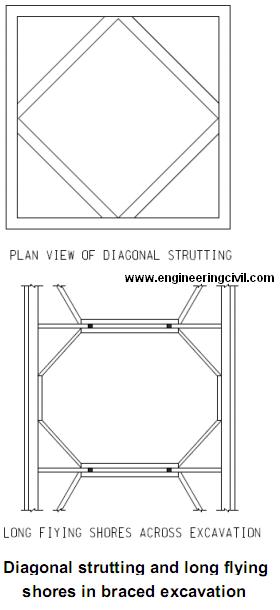
What are the applications of diagonal strutting and long flying shores in braced excavation?

Diagonal strutting is sometimes used at the corners of excavation to leave a large working space at excavation level. Sometimes, raking struts are observed in long flying shores across excavation and these struts serve to decrease the span length of struts.

Advertisements

diagonal strutting and long flying shores

This question is taken from book named – A Self Learning Manual – Mastering Different Fields of Civil Engineering Works (VC-Q-A-Method) by Vincent T. H. CHU.

Unit Weight of Materials Used at Construction Site

Following table shows unit weight of materials used at construction site. Please note this is for reference purpose only and may vary from place and type of material.

Advertisements

We are thankful to Engineer Ravi Verma for submitting this very useful information to us. If you also have any other formula and shortcuts which can be used on construction site do submit it to us using the submit form here

S.No

Material

Theoretical

Weight in(KG/M³)

Approx Weight at Site in

Remarks

Kg

Per

1 Cement 1440 50 Bag
2 Steel 7850 d²/162 d -dia in mm
3 Sand-
Dry 1600 50 to 55 farma 1 farma=1.25cft
River 1840 57 to 63 farma 1 farma=1.25cft
4 Stone(basalt) 2850 to 2960 48 to 52 farma metal 12mm to 20mm
5 Water 1000 1 liter
6 PCC 2240 8.24 to 8.5 Cube mould cube mould size=15x15x15cm
7 RCC 2% Steel 2420
8 Bricks 1600 to 1920 1.9 to 2 no 9x4x2 3/4″
4.8 to 4.9 no 9x6x3 3/4”
9 Brick Masonry 1920
10 Soil(damp) 1760 50 to 55 cft Black cotton
11 Cement concrete block(solid) 1800 18 to 20 cft 30x15x20 cm
10 to 11 no 30x10x20 cm
12 Cement Mortar 2080 57 to 62 cft
13 Lime Mortar 1760 48 to 52 cft
14 Lime 640 30 bag
15 Glass 2530 0.9 to 0.95 sft 4mm tk plain
16 Teak Wood 670 to 830 18 to 20 cft
17 Sal Wood 990 22 to 24 cft
18 Marble mosaic tile 2.8 to 3.2 no 25x25x22mm
4.8 to 5.2 no 30x30x25mm
19 Chequered tile 2.5 to 2.8 no 25x25x22mm
20 Glazed tile15x15cm 0.20 to 0.25 no 5mm tk
21 Marble Stone 2620 5.1 sft 3/4″tk
22 Granite Stone 2460-2800 5.35 sft 3/4″tk
23 Coddappa 2720 6.4 sft 1 1/4″tk
24 A.C.sheet corrugated 16 1.2 sft
25 Bitumen 1040 220 Drum 200liter drum
26 Window frame (simple design) 1.9 to2.1 sft
27 Door Frame
a)3’00×7’0 25 to 27 no section 4″x2 1/2″
b)2’6″x7’0 24 to 26 no section 4″x2 1/2″

What are the IS codes for Wood And Other Lignocellulosic Products?

Following are the IS codes which are used for Wood And Other Lignocellulosic Products. These IS Codes include standardization in the field of Wood Products including Composite Wood Products

IS 303:1989 Specification for plywood for general purposes

IS 652:1960 Specification for wooden separators for lead-acid storage batteries

IS 709:1974 Specification for medium strength aircraft plywood

IS 710:1976 Specification for marine plywood

IS 848:2006 Specification for synthetic resin adhesives for plywood (pnenolic and aminoplastic)

IS 851:1978 Specification for synthetic resin adhesives for construction work (non-structural) in wood

IS 852:1994 Specification for animal glue for general wood working purposes

IS 1328:1996 Specification for veneered decorative plywood
Read More

Should high preloads be adopted in struts in braced excavation?

Preloading in struts in braced excavation helps eliminate the potential movement. The application of preload decreases the shear stress in soils established previously by excavation. As a result of stiffening of soils, the soil movement is declined accordingly.

Advertisements

However, the use of very high preloads in struts may not be desirable because the local outward movement at struts may cause damage to nearby utilities.

This question is taken from book named – A Self Learning Manual – Mastering Different Fields of Civil Engineering Works (VC-Q-A-Method) by Vincent T. H. CHU.

For Peck’s pressure envelope for braced excavation, should total weight or effective weight be used in rectangular and trapezoidal envelope?

The use of active and at-rest theory is not applicable in braced excavation. In essence, upper struts tend to be more heavily loaded while lower struts appear to be less loaded when compared with active pressure theory.

Peck then measured the bracing loads which were converted back to soil pressures. For example, the pressure envelope for non-cohesive soils is 0.65rHKa
where
r=soil density
H=height of excavation
Ka=active pressure coefficient

Advertisements

Some engineers consider r as total soil weight without applying any water pressure. However, Peck has said “the earth pressures are essentially effective active pressures multiplied by a factor and redistributed as a
rectangle or a trapezoid.” Hence, effective weight of soils should be used for r with water pressures added separately.

This question is taken from book named – A Self Learning Manual – Mastering Different Fields of Civil Engineering Works (VC-Q-A-Method) by Vincent T. H. CHU.

Ask a question