
Ground water flow into excavations constructed by sheet pile walls should be minimized in order to save the cost of the provision of pumping systems or well points to lower the water table inside the excavation.
How could counterforts in counterfort retaining wall assist in resisting earth pressure?
This question is taken from book named – A Self Learning Manual – Mastering Different Fields of Civil Engineering Works (VC-Q-A-Method) by Vincent T. H. CHU.
Counterforts are used for high walls with height greater than 8 to 12 m. They are also used in situations where there is high lateral pressure, i.e. where the backfill soils are heavily surcharged.
The counterforts tie the base slab and wall stem together and they act as tension bracing which strengthen the connection between wall and base slab. The counterforts help to reduce bending moment and shear forces induced by soil pressure to the retaining wall. Moreover, it also serves to increase the self-weight of the retaining wall which adds stability to the retaining wall.
Advertisements
This question is taken from book named – A Self Learning Manual – Mastering Different Fields of Civil Engineering Works (VC-Q-A-Method) by Vincent T. H. CHU.
What is the function of mortar in brick walls?
Bricks are bedded on mortar which serves the following purposes:
(i) bond the bricks as a single unit to help resist lateral loads;
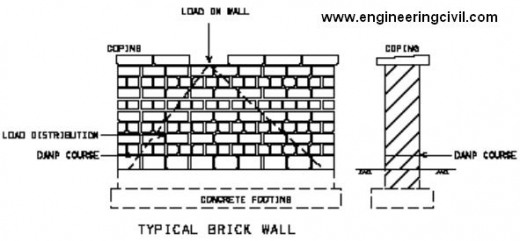
A typical brick wall structure normally contains the following components:
(i) a coping on top of the brick wall to protect it from weather;
(ii) a firm foundation to support the loads on the brick wall; and
(iii) a damp course near the base of the brick wall to avoid the occurrence of rising damp from the ground.
Advertisements
Bricks are bedded on mortar which serves the following purposes:
(i) bond the bricks as a single unit to help resist lateral loads;
(ii) render the brick wall weatherproof and waterproof; and
(iii) provide even beds to enhance uniform distribution of loads.
This question is taken from book named – A Self Learning Manual – Mastering Different Fields of Civil Engineering Works (VC-Q-A-Method) by Vincent T. H. CHU.
How does pressure distribution vary under rigid and flexible footings?
For flexible footings on weak and compressible soils, the bearing pressures under footing would not be linear. As such, a detailed investigation of soil pressures is required in order to determine the bending moment and shear forces of the structure.
For thick and rigid footings, the pressure distribution under the footings is normally assumed to be linear. If uniform and symmetrical loadings are exerted on the footings, the bearing pressure is uniformly distributed. However, if unsymmetrical loads are encountered, then a trapezoidal shape of bearing reaction would result.
Advertisements
For flexible footings on weak and compressible soils, the bearing pressures under footing would not be linear. As such, a detailed investigation of soil pressures is required in order to determine the bending moment and shear forces of the structure.
This question is taken from book named – A Self Learning Manual – Mastering Different Fields of Civil Engineering Works (VC-Q-A-Method) by Vincent T. H. CHU.
Are layers of granular fill and rock fill essential at the base of concrete retaining walls?
Layers of granular fill and rockfill materials are not standard details of concrete retaining wall. If we are fully satisfied that the founding material could support the loads arising from retaining walls, it is not necessary to provide these layers of granular fill and rockfill materials.
It is not uncommon that granular fill layers and rockfill layers are placed beneath the bottom of concrete retaining walls. The purpose of such provision is to spread the loading in view of insufficient bearing capacity of foundation material to sustain the loads of retaining walls. Upon placing of granular fill layers and rockfill layers, the same imposed loads are supported by a larger area of founding material and hence the stress exerted by loads is reduced accordingly.
Advertisements
Layers of granular fill and rockfill materials are not standard details of concrete retaining wall. If we are fully satisfied that the founding material could support the loads arising from retaining walls, it is not necessary to provide these layers of granular fill and rockfill materials.
This question is taken from book named – A Self Learning Manual – Mastering Different Fields of Civil Engineering Works (VC-Q-A-Method) by Vincent T. H. CHU.
What are the IS Codes for Fire Fighting?
Following are the IS codes which are used for standardization of Fire Fighting including standardization in the field of Fire Fighting Equipment Including Water Fittings, Fire Fighting Units, Fire Detection And Fire Alarm Systems, Helmets, Equipment For Fire Protection And Fire Fighting, Personal Safety – Protective Clothing and Equipment.
IS 884:1985 Specification for first-aid hose reel for fire fighting
IS 901:1988 Specification for couplings, double male and double female, instantaneous pattern for fire fighting
IS 902:1992 Specification for suction hose couplings for fire fighting purposes
IS 903:1993 Specification for fire hose delivery couplings, branch pipe, nozzles and nozzlespanner
IS 904:1983 Specification for 2-way and 3-way suction collecting heads for fire fighting purposes
Read More
BUILDREAMS 2012
Here opens the gates to the battle to be won by creativity and thinking alone.A challenge to the architects and civil engineers out there to think of and come out with ideas that break stereotypes.
In BUILDREAMS, you will be posed with a few real life problem statements dealing with planning and designing of buildings and the various aspects of it.
Read More
TREMOR – Event by Techkriti
Continuing its great legacy, this year also Techkriti, IIT Kanpur’s Annual Technical and Entrepreneurship Festival is organizing TREMOR. As some of you might know, TREMOR has been the prestigious contest of Techkriti as it gives you opportunity to challenge The Earthquakes. And this time, it comes with a challenge to save your apartment building from being wracked by the mighty vibrations.
For more information you can visit the following link:
http://www.techkriti.org/competitions/tremor/
Read More
DECO 2012
What is “DECO”?
As one of the most important student organizations in Bo?aziçi University, DECO (Design&Construct) is a steel bridge competition held by Bo?aziçi University Construction Club since 2007. This Europe’s one of a kind competition is held in the unique atmosphere of Bo?aziçi University South Campus with participants from both Turkey and Europe. The aim of the competition is to create an opportunity for civil engineering and architecture students from different universities/countries to meet, to present the bridges that they designed and compete against time and other students; and also introduce them the historical and cultural places of Istanbul. Thanks to “Design&Construct,” theoretical lessons are turned into live applications by more than 100 students each year in the magical atmosphere of our university. During this competition, in which the important construction companies have stands, students can meet the representatives and get internship and career advices.
Read More
What is Concrete Strength and what are the factors affecting it?
By
Er. Kaushal Kishore ,
Materials Engineer, Roorkee
Concrete Strength
Cement like water, aggregates and some times admixtures is one of the ingredient of concrete. The mixing of these materials in specified proportions produces concrete. Accordingly cement alone is not a building material, it is the concrete which is a building material. For a given cement and acceptable aggregates, the strength that may be developed by a workable, properly placed mixture of cement, aggregates, and water (under same mixing, curing and testing conditions) is influenced by the :
a) Ratio of cement to mixing water
b) Ratio of cement to aggregates, the strength of the mortar, the bond between the mortar and the coarse aggregate.
c) Grading, surface texture, shape, strength, and stiffness of aggregate particles.
d) Maximum size of aggregate.
Strength of concrete is directly related to the structure of the hydrated cement paste. Air in concrete produces voids. Excess of water in concrete evaporate leave the voids in the concrete. Consequently, as the W/C ratio increases, the porosity of the cement paste in the concrete also increases. As the porosity increases, the compressive strength of the concrete decreases.