


WATER ABSORPTION
This test helps to determine the water absorption of coarse aggregates as per IS: 2386 (Part III) – 1963. For this test a sample not less than 2000g should be used. The apparatus used for this test are :-
Wire basket – perforated, electroplated or plastic coated with wire hangers for suspending it from the balance, Water-tight container for suspending the basket, Dry soft absorbent cloth – 75cm x 45cm (2 nos.), Shallow tray of minimum 650 sq.cm area, Air-tight container of a capacity similar to the basket and Oven.
Procedure to determine water absorption of Aggregates.
i) The sample should be thoroughly washed to remove finer particles and dust, drained and then placed in the wire basket and immersed in distilled water at a temperature between 22 and 32oC.
ii) After immersion, the entrapped air should be removed by lifting the basket and allowing it to drop 25 times in 25 seconds. The basket and sample should remain immersed for a period of 24 + ½ hrs afterwards.
iii) The basket and aggregates should then be removed from the water, allowed to drain for a few minutes, after which the aggregates should be gently emptied from the basket on to one of the dry clothes and gently surface-dried with the cloth,transferring it to a second dry cloth when the first would remove no further moisture.The aggregates should be spread on the second cloth and exposed to the atmosphere away from direct sunlight till it appears to be completely surface-dry.The aggregates should be weighed (Weight ‘A’).
iv) The aggregates should then be placed in an oven at a temperature of 100 to 110oC for 24hrs. It should then be removed from the oven, cooled and weighed (Weight ‘B’).
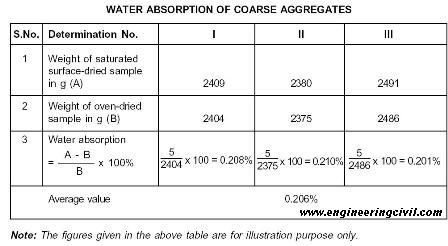
Formula used is Water absorption = [(A – B)/B] x 100%.
Two such tests should be done and the individual and mean results should be reported. A sample proforma for the record of the test is
If you have a query, you can ask a question here.
what is the aggregate absorption LIMIT ?
THAT MEANS 1% OR 5%
Aggregate and sand shall have a maximum absorption of 3%
Whic IS & Limit is specify any Indian Standard
Hi Mr. Rajkumar
Can you please mention the standards, where it is written that water absorption is less or equal 3%
limit of water absorption value of aggregate is .1% to 2% in road surface
Hi Murali Krishna
As per BS 8007, page 17, clause 6.2.2, water absorption is less than 3% but it is also refer BS 882, BS 1047, BS 812 part-2 after check all reference there is no result found
What are the standard limits to accept or reject.
iam a civil engineer, kindly mail me the mix design for m10,m15
((The Best Creator Next To God Is A Civil Engineer.))
The previous statment is refused.Because no comparison. ALLAAH is the only God. ALLAAH created the whole universe from nothing. But humanbeing (from which are civil engineers) manufacture, produce and create facilities according to their needs. Civil Engineers create and produce from available resources facilities that might have defects or faults. So no comparison.
The aggregates used for surface dressing may have the absorption values between 0.1 to 2.0 percent.on the other hand,they may posses a value of 4.0 percent when they are used in base course.
generally 0.6% absorption value is considered to be the standard value for the aggregates.
How do you calc absorption for a blend?
kindly mail me the limits of tests values and tests for aggregates which are used in suface drain….
Maximum water absorption for Aggregate 2-2.5%
Can we use coarse aggregate if it have water absorption of 2.1% for concerting? If not for what purpose that coarse aggregate is to be used.
limit is 2%.. if it exceed by 2% soundness test will be conducted
kindly mail me the format of A.I.V of Coarse Aggregate, Cube Testing Report,Test of Cement mortar
Please clearly specify the standard limits for uniform interpretation. Thank you and more power!
I am a civil engineer in railways, in my design mix of M25 water absorption of sand they have given 1% and surface moisture they have given 2%, at the time of concreting I have to make correction for water ,sand and course aggregate for this please explain me how to calculate correction factor.
mail me the test procedures with example result ,that we do in a construction site lab(on going project)
what is the percentage of water absorption of bricks, stone and sand……….? does the percentage vary from stone to stone……..?
What should be the acceptable values of Water Absorption of aggregates used for RCC construction. Indian Standards have no limits specified. MOST specs specifies for max of 2%. Can aggregates having water absorption 3 – 5% be used for manufacturing concrete. What impact does it have on the concrete quality and behaviour. Can gardes M80 – M100 be manufactured with such aggregates?
what s the maximum water absorption for coarse aggregate ? and in which is its specified?
Its was 2% and it was in IS 2386 PART-3;
Hi Mithu
Which page/ clause no. it is written, can you please clarify
if doctor make mistake only dead one or around one,if civil eng make mistake no one can imagine how many will lost.
i m civil engineer please mail me all soil , GSB, WMM , bitumen test method
what is the value of absorption of water in aggregate used in building construction.
what is the light weight aggregate impact & water absorption value?
is there any standard related to this except for IS standards?