


This test is done to determine the flash point and the fire point of asphaltic bitumen and fluxed native asphalt, cutback bitumen and blown type bitumen as per IS: 1209 – 1978. The principle behind this test is given below :
Flash Point – The flash point of a material is the lowest temperature at which the application of test flame causes the vapours from the material to momentarily catch fire in the form of a flash under specified conditions of the test.
Fire Point – The fire point is the lowest temperature at which the application of test flame causes the material to ignite and burn at least for 5 seconds under specified conditions of the test.
The apparatus required for this test is
i) Pensky-Martens apparatus
ii) Thermometer- Low Range : -7 to 110oC, Graduation 0.5oC
High Range : 90 to 370oC, Graduation 2oC
The sample should be just sufficient to fill the cup upto the mark given on it.
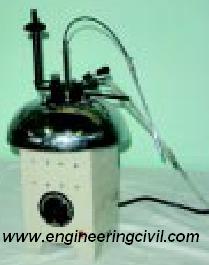
Procedure to determine the Flash And Fire Point Of Bitumen
A) FLASH POINT
i) Soften the bitumen between 75 and 100oC. Stir it thoroughly to remove air bubbles and water.
ii) Fill the cup with the material to be tested upto the filling mark. Place it on the bath. Fix the open clip. Insert the thermometer of high or low range as per requirement and also the stirrer, to stir it.
iii) Light the test flame, adjust it. Supply heat at such a rate that the temperature increase, recorded by the thermometer is neither less than 5oC nor more than 6oC per minute.
iv) Open flash point is taken as that temperature when a flash first appears at any point on the surface of the material in the cup. Take care that the bluish halo that sometimes surrounds the test flame is not confused with the true flash. Discontinue the stirring during the application of the test
flame.
v) Flash point should be taken as the temperature read on the thermometer at the time the flash occurs.
B) FIRE POINT
i) After flash point, heating should be continued at such a rate that the increase in temperature recorded by the thermometer is neither less than 5oC nor more than 6oC per minute.
ii) The test flame should be lighted and adjusted so that it is of the size of a bead 4mm in dia.
REPORTING OF RESULTS
i) The flash point should be taken as the temperature read on the thermometer at the time of the flame application that causes a distinct flash in the interior of the cup.
ii) The fire point should be taken as the temperature read on the thermometer at which the application of test flame causes the material to ignite and burn for at least 5 seconds.
If you have a query, you can ask a question here.
I need a list of fuel and their flash and fire point ( minimum 5 fuels)
Thanks for the define those terms . I need a minimum 5 fuels of flash and fire point .
Why take advantage of the knowledge of the temperature flash point and fire point ?????
for safety point of view this tests are conducted,if bitumen is heated beyond flash point it catches fire ,therefore utmost care is taken to see that heating is limited to a temperature well below the flash point and used along the aggregates for the construction of pavements
as icreases in firing point of the bitumen what we gives for that during construction ,it will be safer side due to the higher tempurature and causes due to friction makes it to higher flash and fire so for that we do..
i hope so,u gought it…..
The IS 1209 is a very old and unsupported test method that will not be able to be carried out by the vast majority of Pensky-Martens test apparatus.
The supported apparatus for carrying out flash and fire point tests on bitumens and asphalts is the Cleveland Open Cup test method ASTM D92. This Determining Flash And Fire Point Of Bitumen article should make this clear
Mike
Thank you for your help
may i know what is the consistency in this experiment??
What is the minimum value of fire point specified by ISI ?
Minimum value of flash point for all grades of bitumen is 175′ C
I need the method of determine flash point(demonstration )
Thanks alot.
pls, what are the advantages of modern flashpoint testers over this deign?
what should be the value of flash and fire point to be a bitumen sample good?
RECOMMENDED VALUES:
The minimum value of flash point by Pensky Martens closed type apparatus is 175°C for all grades of bitumen
please i want to know the formular for base course gradation,secondly how can i become a certified technician.Thank you.
these infofmation have been very helpful, good job!
Please i want to know the flash and fire point temperature of 80-100 pen. grade bitumen.
Can we use d same methods of bitumen flash point determination for gasoline,kerosene etc.And 2.is fire point the same thing as ignition point.thanks
please give 2d diagrams of abels,pensky nd open cup(cleaveland) apparatus
please give me some result of this experiment
pls.give me the ignition point,volatile matter of a charcoal from eucalytus wood
it is necessary to mention flash and fire point of bitumen
What is the standard values of flash point and fire point