

Concrete Mix Design
Introduction
The process of selecting suitable ingredients of concrete and determining their relative amounts with the objective of producing a concrete of the required, strength, durability, and workability as economically as possible, is termed the concrete mix design. The proportioning of ingredient of concrete is governed by the required performance of concrete in 2 states, namely the plastic and the hardened states. If the plastic concrete is not workable, it cannot be properly placed and compacted. The property of workability, therefore, becomes of vital importance.
The compressive strength of hardened concrete which is generally considered to be an index of its other properties, depends upon many factors, e.g. quality and quantity of cement, water and aggregates; batching and mixing; placing, compaction and curing. The cost of concrete is made up of the cost of materials, plant and labour. The variations in the cost of materials arise from the fact that the cement is several times costly than the aggregate, thus the aim is to produce as lean a mix as possible. From technical point of view the rich mixes may lead to high shrinkage and cracking in the structural concrete, and to evolution of high heat of hydration in mass concrete which may cause cracking.
The actual cost of concrete is related to the cost of materials required for producing a minimum mean strength called characteristic strength that is specified by the designer of the structure. This depends on the quality control measures, but there is no doubt that the quality control adds to the cost of concrete. The extent of quality control is often an economic compromise, and depends on the size and type of job. The cost of labour depends on the workability of mix, e.g., a concrete mix of inadequate workability may result in a high cost of labour to obtain a degree of compaction with available equipment.
Requirements of concrete mix design
The requirements which form the basis of selection and proportioning of mix ingredients are :
a ) The minimum compressive strength required from structural consideration
b) The adequate workability necessary for full compaction with the compacting equipment available.
c) Maximum water-cement ratio and/or maximum cement content to give adequate durability for the particular site conditions
d) Maximum cement content to avoid shrinkage cracking due to temperature cycle in mass concrete.
Types of Mixes
1. Nominal Mixes
In the past the specifications for concrete prescribed the proportions of cement, fine and coarse aggregates. These mixes of fixed cement-aggregate ratio which ensures adequate strength are termed nominal mixes. These offer simplicity and under normal circumstances, have a margin of strength above that specified. However, due to the variability of mix ingredients the nominal concrete for a given workability varies widely in strength.
2. Standard mixes
The nominal mixes of fixed cement-aggregate ratio (by volume) vary widely in strength and may result in under- or over-rich mixes. For this reason, the minimum compressive strength has been included in many specifications. These mixes are termed standard mixes.
IS 456-2000 has designated the concrete mixes into a number of grades as M10, M15, M20, M25, M30, M35 and M40. In this designation the letter M refers to the mix and the number to the specified 28 day cube strength of mix in N/mm2. The mixes of grades M10, M15, M20 and M25 correspond approximately to the mix proportions (1:3:6), (1:2:4), (1:1.5:3) and (1:1:2) respectively.
3. Designed Mixes
In these mixes the performance of the concrete is specified by the designer but the mix proportions are determined by the producer of concrete, except that the minimum cement content can be laid down. This is most rational approach to the selection of mix proportions with specific materials in mind possessing more or less unique characteristics. The approach results in the production of concrete with the appropriate properties most economically. However, the designed mix does not serve as a guide since this does not guarantee the correct mix proportions for the prescribed performance.
For the concrete with undemanding performance nominal or standard mixes (prescribed in the codes by quantities of dry ingredients per cubic meter and by slump) may be used only for very small jobs, when the 28-day strength of concrete does not exceed 30 N/mm2. No control testing is necessary reliance being placed on the masses of the ingredients.
Factors affecting the choice of mix proportions
The various factors affecting the mix design are:
1. Compressive strength
It is one of the most important properties of concrete and influences many other describable properties of the hardened concrete. The mean compressive strength required at a specific age, usually 28 days, determines the nominal water-cement ratio of the mix. The other factor affecting the strength of concrete at a given age and cured at a prescribed temperature is the degree of compaction. According to Abraham’s law the strength of fully compacted concrete is inversely proportional to the water-cement ratio.
2. Workability
The degree of workability required depends on three factors. These are the size of the section to be concreted, the amount of reinforcement, and the method of compaction to be used. For the narrow and complicated section with numerous corners or inaccessible parts, the concrete must have a high workability so that full compaction can be achieved with a reasonable amount of effort. This also applies to the embedded steel sections. The desired workability depends on the compacting equipment available at the site.
3. Durability
The durability of concrete is its resistance to the aggressive environmental conditions. High strength concrete is generally more durable than low strength concrete. In the situations when the high strength is not necessary but the conditions of exposure are such that high durability is vital, the durability requirement will determine the water-cement ratio to be used.
4. Maximum nominal size of aggregate
In general, larger the maximum size of aggregate, smaller is the cement requirement for a particular water-cement ratio, because the workability of concrete increases with increase in maximum size of the aggregate. However, the compressive strength tends to increase with the decrease in size of aggregate.
IS 456:2000 and IS 1343:1980 recommend that the nominal size of the aggregate should be as large as possible.
5. Grading and type of aggregate
The grading of aggregate influences the mix proportions for a specified workability and water-cement ratio. Coarser the grading leaner will be mix which can be used. Very lean mix is not desirable since it does not contain enough finer material to make the concrete cohesive.
The type of aggregate influences strongly the aggregate-cement ratio for the desired workability and stipulated water cement ratio. An important feature of a satisfactory aggregate is the uniformity of the grading which can be achieved by mixing different size fractions.
6. Quality Control
The degree of control can be estimated statistically by the variations in test results. The variation in strength results from the variations in the properties of the mix ingredients and lack of control of accuracy in batching, mixing, placing, curing and testing. The lower the difference between the mean and minimum strengths of the mix lower will be the cement-content required. The factor controlling this difference is termed as quality control.
Mix Proportion designations
The common method of expressing the proportions of ingredients of a concrete mix is in the terms of parts or ratios of cement, fine and coarse aggregates. For e.g., a concrete mix of proportions 1:2:4 means that cement, fine and coarse aggregate are in the ratio 1:2:4 or the mix contains one part of cement, two parts of fine aggregate and four parts of coarse aggregate. The proportions are either by volume or by mass. The water-cement ratio is usually expressed in mass
Factors to be considered for mix design
ð The grade designation giving the characteristic strength requirement of concrete.
ð The type of cement influences the rate of development of compressive strength of concrete.
ð Maximum nominal size of aggregates to be used in concrete may be as large as possible within the limits prescribed by IS 456:2000.
ð The cement content is to be limited from shrinkage, cracking and creep.
ð The workability of concrete for satisfactory placing and compaction is related to the size and shape of section, quantity and spacing of reinforcement and technique used for transportation, placing and compaction.
Procedure
1. Determine the mean target strength ft from the specified characteristic compressive strength at 28-day fck and the level of quality control.
ft = fck + 1.65 S
where S is the standard deviation obtained from the Table of approximate contents given after the design mix.
2. Obtain the water cement ratio for the desired mean target using the emperical relationship between compressive strength and water cement ratio so chosen is checked against the limiting water cement ratio. The water cement ratio so chosen is checked against the limiting water cement ratio for the requirements of durability given in table and adopts the lower of the two values.
3. Estimate the amount of entrapped air for maximum nominal size of the aggregate from the table.
4. Select the water content, for the required workability and maximum size of aggregates (for aggregates in saturated surface dry condition) from table.
5. Determine the percentage of fine aggregate in total aggregate by absolute volume from table for the concrete using crushed coarse aggregate.
6. Adjust the values of water content and percentage of sand as provided in the table for any difference in workability, water cement ratio, grading of fine aggregate and for rounded aggregate the values are given in table.
7. Calculate the cement content form the water-cement ratio and the final water content as arrived after adjustment. Check the cement against the minimum cement content from the requirements of the durability, and greater of the two values is adopted.
8. From the quantities of water and cement per unit volume of concrete and the percentage of sand already determined in steps 6 and 7 above, calculate the content of coarse and fine aggregates per unit volume of concrete from the following relations:
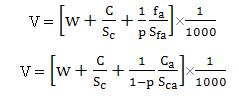
where V = absolute volume of concrete
= gross volume (1m3) minus the volume of entrapped air
Sc = specific gravity of cement
W = Mass of water per cubic metre of concrete, kg
C = mass of cement per cubic metre of concrete, kg
p = ratio of fine aggregate to total aggregate by absolute volume
fa, Ca = total masses of fine and coarse aggregates, per cubic metre of concrete, respectively, kg, and
Sfa, Sca = specific gravities of saturated surface dry fine and coarse aggregates, respectively
9. Determine the concrete mix proportions for the first trial mix.
10. Prepare the concrete using the calculated proportions and cast three cubes of 150 mm size and test them wet after 28-days moist curing and check for the strength.
11. Prepare trial mixes with suitable adjustments till the final mix proportions are arrived at.
If you have a query, you can ask a question here.
good one
i like the literature.
thank you,
avadhut sutar
Dear Sir, I found the Contents Very Useful, Explanatory & interesting As this is not my
Subject but i have a interest in this & would like to ask a few Questions , hope you wont
mind Answering Them.
1) Can we use Low Grade Iron-ore having Fe2o3 from 60 to70% as one of the Ingredients
along with Dry Fly ash & Sand for making Dry Ready Mix Concrete latter to be Added with
cement , If yes in what Ratio of Product Mix & Cement, for achieving M10 /M20 /M30 / M40
Strength Concrect.
2) Do you have a ready Reckoner Which Can Help us to Design our own product Mix For
varrious applications of Concrect like Flooring / Plastering / Slab etc etc.
its really good
Its really useful to me.
Now i am doing my project on DURABILITY STUDIES ON GLASS FIBER CONCRETE.
explanation is very helpful to me.
thank you sir.
it is really useful.i want to know about M-55 & M-60 grade conc.which is used for prestressed conc. sleepers.
It is very helpful to me but you have no any detail of plasticizer, superplastizer and
hyper plazticizer and how it is benficial to pouring by concrete pump
Its very Use full for me as i am involved in Mix design.
Very good , usefull for civil engineers and we neeed all specs to be available like that
Best Regards
Hosny Nofal
Construction Manager
Hill international
It’s very useful for the Engg. students for references….
Jose
S6CA
MACE
Very informative and helpful. Appreciate if you can provide the mix proportions for grade M30 concrete.
Regards
Sir,
plz give the detailed specification if we go for design mix with available aggregates and sand by samll mixers at site, if we follows all the instruction given for design mix e;g, water 1.cement ratio 2. grading of aggregates and sand prticlles,2. proper batching and mixing, 3. proper placing with applying vibrator and many other precautions norms of quality control
Thanks
Bimal
hii…i’m an Civil Engg Student, i found this article very informative…thanks a lot!
i am a B.E. final year civil engineering student and i realize this article is very useful for making mix design on Indian standard. Thanks for this
DEAR;
SIR GIVE ME THE DETALS DRSIGN MIX OR M20 CONCRETE
GOOD PROCEDURE AND SIMPLE TO FOLLOW
COMPARE THE MIX DESIGN PROCEDURES WITH D.O.E METHOD
simply super
Dear Sir,
Do we have any specific IS code for use of recycled water in concrete ? In a ready mix plant, we are using concrete recycling system. Slurry OR recycled water is a bi-product of this, which contains cement, fly ash and sand particles. In Europian contires, these type of equipment and recycled water is widely used in concrete mixing. Do we have any code for this is INDIA ?
If so, please let me know about this. I will like to buy the code material for my interest.
Your help in this regard will be highly appriciated.
Regards,
Abhay Marathe
Dear Sir,
I am mtech student i need mix design for m60 grade concrete for my project work.do you have any procedure for design as per Is code pls help me sir
Regards,
sathish
Dear sathish
i think you use M-40 grade concrete+ maicro silica 20% of cement then you get M-60 grade concrete.
PLEASE CONFORM ANY QA/QC PERSON BEFORE USE.
PL. give me the suggestion for M-30 Using PPC.