Awarded as the best online publication by CIDC

Er. Kaushal Kishore

Screeners – River Bed Uncrushed Aggregates For Concrete

By
Kaushal Kishore
Materials Engineer
Roorkee

INTRODUCTION:
SCREENERS companies near Dehradun and elsewhere have set up highly sophisticated as well as, eco-friendly screening and washing plants for the production of uncrushed (Shingle) coarse aggregates and coarse sand direct from river bed. These plants are producing and supplying uncrushed (Shingle) aggregates of sizes 40 mm, 20 mm, 12.5 mm and river coarse sand, which complies to the specifications of
IS : 383-19702.

Our construction sites, particularly Govt. Departments hesitates in the use of uncrushed coarse aggregate as so far they are being supplied to them direct from river bed or by manual sieving without washing them with water. Thus neither they are clean nor properly graded. This draw back is not with the uncrushed aggregates produces and supplied from SCREENERS modern plants with regular quality control. In this booklet the readers will find that when quality uncrushed aggregates are available not only economically but locally, our construction sites particularly Govt. Departments should not hesitate in the use of uncrushed aggregates from the river bed and save our environment, as crusher generate pollution. Further in all the Civil Engineering Codes uncrushed aggregates from river bed has been specified to be used in our all Civil Engineering Construction.
Read More
What is Concrete Strength and what are the factors affecting it?

By
Er. Kaushal Kishore ,
Materials Engineer, Roorkee

Concrete Strength
Cement like water, aggregates and some times admixtures is one of the ingredient of concrete. The mixing of these materials in specified proportions produces concrete. Accordingly cement alone is not a building material, it is the concrete which is a building material. For a given cement and acceptable aggregates, the strength that may be developed by a workable, properly placed mixture of cement, aggregates, and water (under same mixing, curing and testing conditions) is influenced by the :

a) Ratio of cement to mixing water
b) Ratio of cement to aggregates, the strength of the mortar, the bond between the mortar and the coarse aggregate.
c) Grading, surface texture, shape, strength, and stiffness of aggregate particles.
d) Maximum size of aggregate.

Strength of concrete is directly related to the structure of the hydrated cement paste. Air in concrete produces voids. Excess of water in concrete evaporate leave the voids in the concrete. Consequently, as the W/C ratio increases, the porosity of the cement paste in the concrete also increases. As the porosity increases, the compressive strength of the concrete decreases.

Read More

Water Measuring Jar for Concrete Mixer

By
Er. Kaushal Kishore ,
Materials Engineer, Roorkee

In about 80% of our construction sites, the water in the concrete mixer is added in a very crude manner either direct from a hoze pipe or by some container without any proper measured quantity. Thus no consideration is given to maintain free Water/Cement ration to its correct specified value resulting production of poor quality of concrete. The addition of mixing water in the concrete mixer with these crude methods always add more water then actually required. This excess water in due course evaporated leaving voids and increasing the porosity of the concrete. Such concrete will have lower strength and also will be not durable.

Advertisements

Therefore it is very important to maintain free W/C ration to its correct value in all the batches of concrete. Free W/C ratio means mixing water added to saturated and surface dry aggregates ie, if the site aggregates are dry extra water is to be added in the mixing water as per the absorption of aggregate, and if the site aggregates contains surface water, this surface water is to be deducted from the mixing water. The weight of aggregates should also be adjusted accordingly. A Concrete Mix Design is reported in standard moisture condition of aggregates and this is saturated and surface dry aggregates. If aggregates are being taken by volume bulking of sand should be taken into consideration.

Advertisements

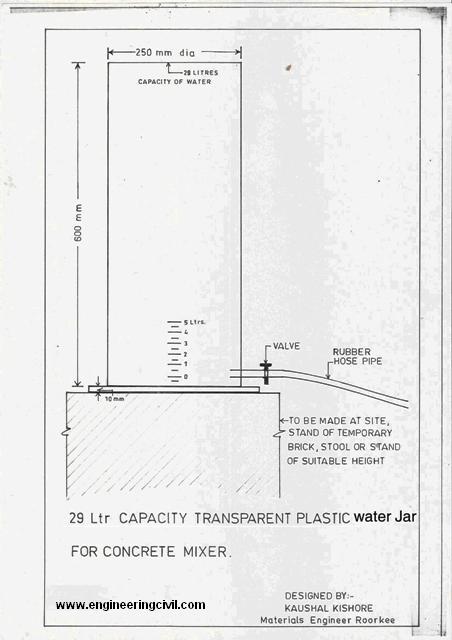
To solve the construction sites mixing water problems, a simple graduated transparent plastic jar of least count 0.5 ltr, as per drawing should be supplied along with the mixer or may be fabricated at site. This Jar be installed at site near concrete mixer as shown in the drawing. The water may be filled in the jar to the quantity of required gauging water. While mixer is running the measured water in the jar slowly drain in the mixer drum through rubber hoze by opening the valve. If ADMIXTURES are to be used and required to be mixed with the gauging water, this may be mixed with water of the jar.

Water measuring Jar for Concrete Mixer

We at engineeringcivil.com thankful to Sir Kaushal Kishore for publishing his paper on “Water Measuring Jar for Concrete Mixer”.

ICI-JA Life Time Achievement Award 2011

We at engineeringcivil.com are pleased to announce that our website supporter and regular contributor, Sir. Kaushal Kishore have been awarded “NATIONAL (N) ICI-JA LIFE TIME ACHIEVEMENT AWARD – 2011” for his valuable contributions to the field of civil engineering.

lifetime-award

lifetime-achievement-award

Advertisements

We congratulate Sir. Kaushal Kishore and hope his work in civil engineering field gets more and more recognition and we here at engineeringcivil.com continue to get his support and knowledge which will be of tremendous use to the upcoming engineers.

What is Efflorescence in Bricks and Concrete?

Paper of Efflorescence in Bricks and Efflorescence and Leaching in Concrete by Sir. Kaushal Kishore
Materials Engineer, Roorkee

Efflorescence is the usual terms for deposit of soluble salts, formed in or near the surface of a porous material, as a result of evaporation of water in which they have been dissolved.

EFFLORESCENCE IN BRICKS:
Usually sulphate of magnesium, calcium, sulphate and carbonate (and sometimes chloride and nitrates) of sodium and potassium are found in efflorescence. These salts may be traced to the brick itself, sand used in construction, the foundation soil, ground water, water used in the construction and loose earth left over in contact with brick work. Bricks with magnesium sulphate content higher than 0.05 percent should not be used in construction. Soluble salt content in sand (chloride and sulphate together) should not exceed 0.1 percent.
Read More

What are Green Buildings?

By
Er. Kaushal Kishore ,
Materials Engineer, Roorkee

INTRODUCTION:
A green building is that building which is constructed at a well planed location with proper design and sustainable materials. Fitted and painted with eco friendly materials. The building should gives to its occupants healthy and comfortable environment in all climates. It remains cool in summer, warm in winter, inside fully protected from rain, gives natural pollution free air and light through doors, windows and ventilators without any artificial means. For particular requirements it has solar, wind power and eco friendly electrical, mechanical etc. devices.
Read More

Testing of Concrete Blocks

By
Er. Kaushal Kishore ,
Materials Engineer, Roorkee

INTRODUCTION
Concrete can be converted into precast masonry units such as Hollow and Solid normal and light weight concrete blocks of suitable size to be used for load and non-load bearing units for wallings. Use of such concrete blocks are more appropriate in region where soil bricks are costly, poor in strength and are not available. Depending upon the structural requirements of masonry unit, concrete mixes can be designed using ingredients available locally or if not found suitable then with in the most economical distance. The concrete mix used for normal hollow and solid blocks shall not be richer than one part by volume of cement to 6 parts by volume of combined room dry aggregates before mixing. Hollow concrete blocks for normal work used in masonry when reinforced is used shall not be leaner than 1 part cement to 8 parts room dry sand by volume. The mixes are designed with the available materials to give overall economy and the required properties of the products. The hollow load bearing concrete blocks of the standard size 400 x 200 x 200 mm will weight between 17 and 26 kg (1063 to 1625 kg/m3) when made with normal weight aggregates. Normal weight blocks are made with cement, sand, gravel, crushed stone and air-cooled slag. The grading for sand used in Hollow concrete block shall be as given below:
Read More

CIDC Vishwakarma Awards 2011

We are pleased to announce that Sir Kaushal Kishore who has been helping engineering students all over the world with his useful research and project paper submissions here at engineeringcivil.com has been awarded Vishwa Karma Award 2011 by CONSTRUCTION INDUSTRY DEVELOPMENT COUNCIL (CIDC Set up by Planning Commission Govt of India) for Category Academician/Technologist/Scientist/Innovator on 7th March 2011 at New Delhi.

Advertisements

We wish him heartiest congratulations and hope he will win more and more awards and show us the way to make this Civil Engineering Portal a great learning website for civil engineers.
CIDC Vishwakarma Awards 2011

Cement And Water Saving With Water Reducers

By
Er. Kaushal Kishore ,
Materials Engineer, Roorkee

In India 0.93 kg of CO2 is emitted in the production of one kg of cement. In the financial year 2009-10 India produces 200 million tonnes of cement. In the production of this cement 186 million tonnes of CO2 was emitted in the atmosphere during financial year of 2009-10.

The availability of water in India per person per year in 1950 was 5177 cu.m. In the year 2009 it is reduces to 1700 cu.m.

If 50 million tonnes cement in making concrete uses water reducers 7500000 tonnes of cement can be saved. 3750000 kl of potable water will be saved and the saving of Rs. 3300 crores per year to construction industry. This amount is worked out after adjusting the cost of water reducers. Less cement used means less cement required to be produce by the cement factories resulting 6975000 tonnes of CO2 will be prevented to be emitted to the atmosphere. These are worked out with an average saving of 15% cement and 15% water.

CO2 emission is word problem, but for India in addition to CO2 it has problems of Air, Water, Soil, Food and Noise pollutions. Less densily populated countries may cope with these problems but for India it is of the top concern. The population figures of 2009 is, India 350 person per sq.km, China 132 person per sq.km and USA only 34 person per sq.km. The figures of 2006 CO¬2 emissions are USA 658.60 tonnes per sq.km, China 611.76 tonnes per sq.km and India 459.35 tonnes per sq.km. Every one should contribute his or her efforts to save the environment from pollution. Those involve in the construction activities can contribute their share by proper design of concrete Mixes. This is best illustrated by the following examples.
Read More

Mix Design For Concrete Roads As Per IRC-15-2002

By
Er. Kaushal Kishore ,
Materials Engineer, Roorkee

Check out the Mix Design For Concrete Roads As Per IRC:15-2011

ABSTRACT:
The stresses induced in concrete pavements are mainly flexural. Therefore flexural strength is more often specified than compressive strength in the design of concrete mixes for pavement construction. A simple method of concrete mix design based on flexural strength for normal weight concrete mixes is described in the paper.

INTRODUCTION:
Usual criterion for the strength of concrete in the building industry is the compressive strength, which is considered as a measure of quality concrete. however, in pavement constructions, such as highway and airport runway, the flexural strength of concrete is considered more important, as the stresses induced in concrete pavements are mainly flexural. Therefore, flexural strength is more often specified than compressive strength in the design of concrete mixes for pavement construction. It is not perfectly reliable to predict flexural strength from compressive strength. Further, various codes of the world specified that the paving concrete mixes should preferably be designed in the laboratory and controlled in the field on the basis of its flexural strength. Therefore, there is a need to design concrete mixes based on flexural strength.

Read More

Ask a question