Awarded as the best online publication by CIDC

Posts by Kanwarjot Singh

Why are fill slopes compacted to dense state instead of loose state?

In rainstorm, the runoff from rainfall infiltrate into the top layer of fill slopes. It may result in saturation of this layer of fills leading to the decrease in soil suction. Consequently shallow slope failure may occur.

If the fill slope is in a loose state, the soils would tend to decrease in volume during deformation. As a result this induces a rise in pore-water pressure which triggers slope failure in form of mud-avalanche.

Advertisements

If the fill slope is in a dense state, the soils would tend in increase in volume during deformation and it only fails like a mud slump.

This question is taken from book named – A Self Learning Manual – Mastering Different Fields of Civil Engineering Works (VC-Q-A-Method) by Vincent T. H. CHU.

Is force and moment equilibrium satisfied by Janbu’s method, Bishop’s method and Morgenstern-Price method?

Janbu’s method and Morgenstern-Price method are non-circular analytical method and they are frequently used for soil slopes while Bishop’s method is circular analytical method. Bishop’s Simplified method and Janbu’s Simplified method assume that the inter-slice forces are horizontal and inter-slice shear forces are neglected.

Advertisements

Equilibrium Method

Moment

Equilibrium

Force Equilibrium
Horizontal Vertical
Janbu’s Simplified No Yes Yes
Bishop’s Simplified Yes No Yes
Morgenstern-Price Yes Yes Yes

This question is taken from book named – A Self Learning Manual – Mastering Different Fields of Civil Engineering Works (VC-Q-A-Method) by Vincent T. H. CHU.

What are the advantages of using rockfill over earthfill to build road embankment?

With the use of rockfill to build embankment, it is not a concern regarding the build-up of pore water pressure during construction so that the embankment can be filled at the faster rate. Moreover, the use of rockfill allows a steeper angle in forming road embankment when compared with earthfill so that it results in a small amount of fill. As such, it helps save the cost of construction.

Advertisements

This question is taken from book named – A Self Learning Manual – Mastering Different Fields of Civil Engineering Works (VC-Q-A-Method) by Vincent T. H. CHU.

Why is hot applied thermoplastic road marking normally used instead of cold applied road paint?

Hot applied thermoplastic road marking appears to be more commonly used than cold applied road paint as road marking materials. For hot applied thermoplastic road marking, it allows the addition of solid glass head which enhances reflectorisation effect. This essentially makes great improvement on the visibility of road markings at night time. Moreover, from past experience the durability of thermoplastic road marking is higher than that of road paint.

Advertisements

This question is taken from book named – A Self Learning Manual – Mastering Different Fields of Civil Engineering Works (VC-Q-A-Method) by Vincent T. H. CHU.

What is the importance of glass beads in road markings?

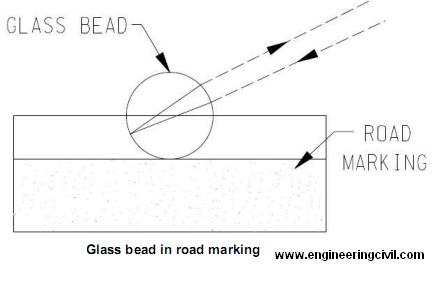
Retroreflectivity refers to the part of incident light from headlights of a vehicle being reflected back to the driver. Retroreflectivity is normally achieved in road marking materials by using glass beads or ceramic beads.

Advertisements

These beads are sprayed on the marking materials when the road is marked. The beads are transparent and serve as lenses. When the light passes through the beads, it is refracted through the beads and then reflected back towards the original path of entry. The use of glass beads enhances retroreflectivity which raises the safety level for night driving.

glass-bead-on-roads

This question is taken from book named – A Self Learning Manual – Mastering Different Fields of Civil Engineering Works (VC-Q-A-Method) by Vincent T. H. CHU.

India’s 11 Super Expressways

India, a developing country has world’s third largest road network but when we talk about expressways, we can hardly name a few like Mumbai-Pune Expressway and Delhi-Gurgaon Expressway. So we decided to tell you about some of the other expressways in India.

Here is the list of India’s top 11 Super Expressways

1) Ahmedabad Vadodara Expressway
Ahmedabad Vadodara Expressway is 95 km long and joins Ahmedabad and Baroda in Gujarat. It is also referred as National Expressway 1. This expressway was opened to public in 2004 and was constructed under the Golden Quadrilateral Project by NHAI.

2) Mumbai-Pune Expressway
Mumbai-Pune Expressway (official name is the Yashwantrao Chavan Expressway) is 93 km long and is considered as one of the best expressways in India. It is India’s first six lane high speed expressway and was made by Maharashtra State Road Development Corporation (MSRDC) at a staggering cost of Rs 1,630 crore (US$363.49 million). It was opened to public in April 2002

Advertisements

3) Jaipur-Kishangarh Expressway
Jaipur-Kishangarh Expressway is 90km long and it connects Jaipur with Kishangarh. It was constructed under the Golden Quadrilateral National Highways Development Project and its cost was USD 154 million. More than 20,000 vehicles pass from this highway everyday.

4) Allahabad Bypass
Allahabad Bypass covers a distance of 86 km and is one of the most remarkable achievements of the Golden Quadrilateral project. It connects India’s four main metropolians New Delhi, Kolkata, Mumbai and Chennai.

5) Ambala Chandigarh Expressway
Ambala Chandigarh Expressway covers a distance of 35 km and has reduced the traffic congestion to a much greater extent. It was opened in 2009 and was built at a cost of Rs 298 crore ($66.45 million)

6) Chennai Bypass
Chennai Bypass covers a distance of 32 km and connects four national highways (NH45, NH4, NH205 and NH5) around Chennai. The cost of this project was Rs 405 crore (Rs 4.05 billion).

7) Delhi-Gurgaon Expressway
Delhi-Gurgaon Expressway covers a distance of 28 km and has been a life saver for commuters. Before construction of this expressway huge traffic jams were seen on the roads. Though this problem has not been solved 100% but still this expressway has brought some relief to the commuters. Delhi-Gurgaon Expressway starts at Dhaula Kuan in Delhi and ends at Manesar which is on the outskirts of Gurgaon. The cost of this project was $223 million and it was opened for public use in January 2008.

8 ) Noida-Greater Noida Expressway
Noida-Greater Noida Expressway covers a distance of 24.53 km. This six-lane highway connects Noida to Greater Noida. The total cost to build this expressway is about 400 crores (Rs 4 billion).

9) Delhi Noida Direct Flyway
Delhi Noida Direct Flyway or popularly known as the DND flyway is an eight lane road having a total length of 9.2 km and connects Delhi to Noida. It was built by The Noida Toll Bridge Company Ltd.

Advertisements

10) Hyderabad elevated expressway
Two separate elevated expressways were to be constructed in Hyderabad to overcome the congestion problem. The first one is P.V. Narasimha Rao Elevated Expressway which covers a distance of 11.6 km and the other Rajiv Elevated Expressway which will cover the distance of 20 km. P.V. Narasimha Rao Elevated Expressway was completed in 2009 and it connects Hyderabad International Airport to Mehdipatnam. Rajiv Elevated Expressway was proposed as an extension and will cover Secunderabad-Shamirpet stretch via Karkhana, Trimulgherry and Bollarum. But this project is currently under suspension due to high project costs.

11) Hosur Road Elevated Expressway
Hosur Road Elevated Expressway covers a distance of 9.98 km and connects Bangalore to Hosur. This expressway has the distinction of becoming the tallest expressway in Bangalore at the height of 17 meters i.e. 56 ft. This project was started in 2006 by BETL and was inaugurated on 22 January 2010.

We have many more expressways in India which are under construction or are already approved but work has not started yet. But still India needs many more of those expressways, to reduce the traveling time and for better connectivity across other Indian cities and states.

What are the causes of delays in implementation of Projects?

“A project” is a discrete set of inter-related work activities constrained by a specific scope, budget, and schedule to deliver, performed in a logical sequence to attain a specific result and achieve the strategic goals of an Organisation. Each activity, and the entire project, has a Start and Finish date.

“Project Management” is the tools, techniques, and processes for defining, initiating, planning, organizing, controlling, and leading a project to conclusion and delivering the predefined results. Projects are parts, or subsystems, of much bigger systems called businesses of the organisation. Projects, of course, are not implemented and operated in a vacuum. Each project has or uses elements such as processes, participants, policies, procedures, and requirements, some of which are dependent upon and interact with related elements in the larger business system.

Read More

Project Management Skills Presentation

By Sanjay Sharma BE (Civil Engineering), MBA (International Business Operations), PhM (Infrastructure Management)

Presentation Outline
Introduction to Project Management

To understand the project Life Cycle
1. Project Planning
2. W B S
3. Project Scheduling
4. Project Control

Advertisements

To apply tools and technique’s
Gantt chart /& Mail stone chart CPM
PERT & Probabilistic Activity Times
Project Crashing and Time-Cost Trade-off
Describe how CPM / PERT have developed and merged together to provide a useful technique for managing projects.

Download the Project Management Skills Presentation in pdf format here

What is the purpose of road studs in roads?

In nighttime, car drivers could not see where the road ends and where the alignment of road changes in direction. Without sufficient number of road lightings, it is necessary to provide some means to guide the drivers along dark roads. Hence, in 1933 Percy Shaw invented the cat’s eye (i.e. road studs) which is based on the principle of cat’s eyes. When a ray of light enters the eyes of a cat, the light shall be reflected back towards to the emitting source. As such, with the reflection of car’s headlights by road studs, it is possible to identify road conditions and alignment in darkness.

Advertisements

However, the provision of cats’ eye is not without problem. For instance, there have been reported accidents arising from loosely installed cat’s eye. Some new design of cat’s eye uses LEDs which flash at about 100 times per second. However, it is claimed to cause epileptic fits of drivers.

This question is taken from book named – A Self Learning Manual – Mastering Different Fields of Civil Engineering Works (VC-Q-A-Method) by Vincent T. H. CHU.

Are kerbs necessary in road pavements?

In general, kerbs are essential in road pavements due to the following reasons (based on Arthur Wignall, Peter S. Kendrick and Roy Ancil):

(i) They provide strength to the sides of road pavements and avoid lateral displacement of carriageway due to traffic loads.

(ii) In terms of road safety, they serve as a separation line between footway and carriageway and aid car drivers in driving safely.

Advertisements

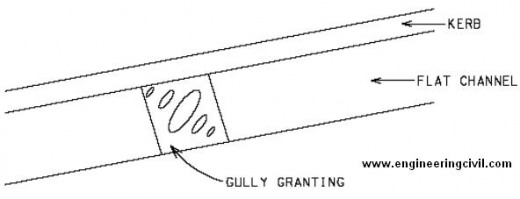
(iii) They act as a vertical barrier to guide the surface runoff collected in road pavements to the gullies.

gully-granting

This question is taken from book named – A Self Learning Manual – Mastering Different Fields of Civil Engineering Works (VC-Q-A-Method) by Vincent T. H. CHU.

Ask a question