After the completion of launching process, the superstructure has to be lifted up to allow for installation of bearings. This is usually achieved by means of jacks to raise 5-10mm successively at each pier.
Central prestressing is normally required during construction in Incremental Launching method. Why?
The erection condition plays an important role to the structural design of bridges when incremental launching method is adopted.
Each section of superstructure is manufactured directly against the preceding one and after concrete hardens, the whole structure is moved forward by the length of one section. When the superstructure is launched at prefabrication area behind one of the abutments, it is continually subjected to alternating bending moments. Each section of superstructure (about 15m to 25m long) is pushed from a region of positive moment and then to a region of negative moment and this loading cycled is repeated. As such, tensile stresses occur alternately at the bottom and top portion of superstructure section. For steel, it is of equal strength in both compression and tension and it has no difficulty in handling such alternating stress during launching process. However concrete could only resist small tensile stresses and therefore, central prestressing is carried out to reduce the tensile stress to acceptable levels.
What is the purpose of leveling pad in bridge bearing?
Bridge bearings should be installed to lie horizontally on bridge piers and columns so that it would not induce eccentricity forces on substructure. However, the bridge superstructure requires different longitudinal and transverse level and gradient in order to keep in line with the geometry of the road.
Setting Up Small Testing Laboratory at Field
By
Er. Kaushal Kishore ,
Materials Engineer, Roorkee
Designers and builders of construction projects no longer can consider quality control testing an option or convenience. In the past decade, testing for the quality of materials and finished construction has become a necessity that no responsible builder can neglect.
The truth of this statement is proved not only by construction delays and cost overruns but also by catastrophic failures of major structures. Such catastrophies include dam failures, collapses and foundation breakdowns in multi-storeyed office and apartment structures; and other failures in stadia, factories, schools, auditoria, public buildings and bridges.
Each construction project determines its own individualized testing needs. A variety of factors influence the type of testing required. Among these factors are size of the structures, terrain, type of soil and subsurface conditions at the construction site and other conditions peculiar to the specific location. The expertise of the construction engineers and technical personnel working on the project will also have an influence on the testing and inspection need.
Read More
Roof Waterproofing By Brick Bat Coba
By
Er. Kaushal Kishore ,
Materials Engineer, Roorkee
INTRODUCTION
Waterproofing is a treatment of a surface or structure to prevent the passage of water under hydrostatic pressure. Waterproofing barrier system may be placed on the positive or negative side. Damp proofing is a treatment of a surface or structure to resit the passage of water in the absence of hydrostatic pressure. A damp proofing barrier system is used to perform the same functions as a waterproofing system but cannot be used to protect against water pressure. Water may be forced through building members by hydrostatic pressure, water vapour gradient, capillary action, wind-driven rain, or any combination of these. This movement is aggravated by porous concrete, cracks or structural defects, or joints that are improperly designed or installed. Leakage of water into structure may cause structural damage, and invariably cause damage to the contents of the structure.
Save Environment With Green Construction
By
Er. Kaushal Kishore ,
Materials Engineer, Roorkee
NEW CEMENT
Portland cement, is made by a calcareous material, such as limestone or chalk, and from alumina and silica found as clay or shale. The process of manufacture of cement consists essentially of grinding the raw materials, mixing them intimately in certain proportions and burning in a large rotary kilin at a temperature of up to about 14500C. When the material sinters and partially fuses into balls known as clinker, the clinker is cooled and ground to a fine powder, with some gypsum added, and the resulting product is the commercial portland cement so widely used through out the world. The manufacturing of this cement release in the atmosphere 0.8 tonnes of CO2 in the production of one tonne of cement. When water is mixed with cement and aggregates in the production of concrete for use in the construction, each tonne of cement can absorb up to 0.4 tonnes of CO2 , but that still leaves an overall carbon footprint per tonne of 0.4 tonnes. In the year 2009 about 2000 million tonnes of CO2 was emitted in the atmosphere in the production of cement.
The above problems have been overcome from researches by Nikolas Vlasopoulos Chief Scientist and his colleagues at Imperial College, London, and they have set up a company of Novacem’s cement which is making cement from magnesium silicate that absorb more CO2 as it hardens. Valaspoulos responded that magnesium slicates are abundant world wide with 10,000 billion tonnes available. He is confident that material will be strong enough for use in buildings but acknowledge that getting licence to use it will take several years of testing.
Read More
Is Civil Engineering Suitable For Girls?
This question has been raised again and again whether girls should do civil engineering or not. I am still not able to understand why people think girls are not suitable for civil engineering. In fact, in my opinion girls can and should do civil engineering. Many people say Civil engineering is field engineering and girls would have difficult time in working with labor class and would face numerous other site problems. But why those people forget that civil engineering is not limited to only field engineering, in fact its one of the broadest field of engineering. Girls can opt for office jobs like analysis, designing, tendering, managing projects and many other office jobs.
Mix Design With Superplasticizers
By
Er. Kaushal Kishore ,
Materials Engineer, Roorkee
INTRODUCTION
Superplasticizers belongs to a class of water reducer chemically different from the normal water reducers and capable of reducing water content by about 30%. The Superplasticizers are broadly classified into four groups: sulfonated melamine formaldehyde condensate (SMF), sulphonated naphthalene formaldehyde condensate (SNF), modified lignosulphonate (MLS) and others including sulphonic acid ester, polyacrylates, polystryrene sulphonates, etc. The benefits obtained by Superplasticizers in the reduction of water in the concrete mixes are best illustrated by the following examples.
Read More
Required Steel Bars
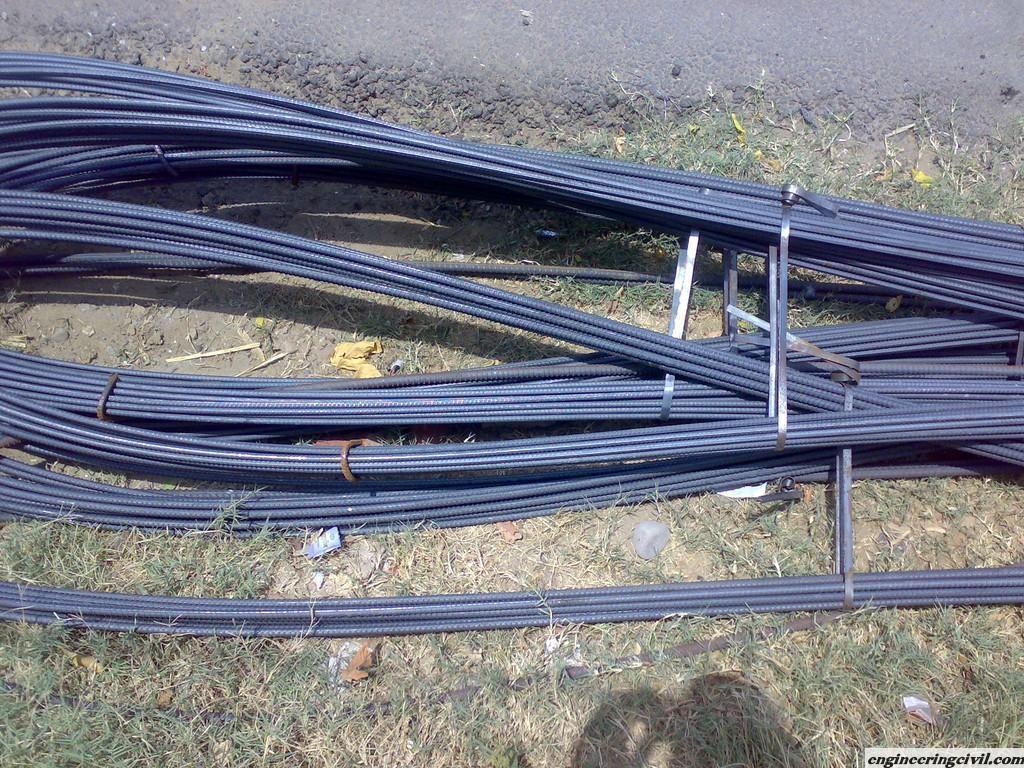
Once we get the full length of steel bars at sight, bar bender then cuts the long lengths into the required lengths. These required lengths are taken from the drawing and are then binded with the help of binding wires.
Steel Bar
A steel bar as brought from the factory. This is the picture of steel bar before cutting down into required pieces. The normal length of this bar is 40 feet with a fold at 20 feet. Steel is the main stay when we talk about reinforced concrete. This adds to the strength of our building.