


When the depth of a box girder bridge exceeds 1/6 or 1/5 of the bridge width, it is recommended to be designed as a single cell box girder bridge.
However, if the bridge depth is smaller than 1/6 of the bridge width, then a twin-cell or multiple cell is a better choice . However, even for wider bridges with small depths, the number of cells should be minimized because there is not much improvement in transverse load distribution when the number of cells of box girder is increased to three or more.
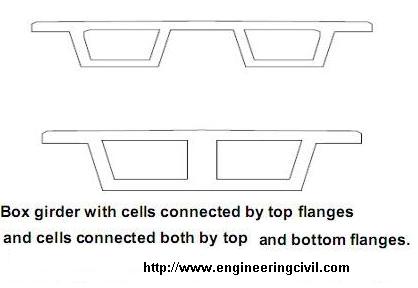
For multiple-cell box girders, there are generally two arrangements. The first one is that independent cells are connected by their top flanges only while the other one is that the cells are connected both at the top and bottom flanges. From the structural point of view, it is recommended to adopt the second arrangement. For the case of cells connected by top flanges only, their flanges are heavily stressed in the transverse direction owing to flexure which cannot be effectively distributed across the cross section.
This question is taken from book named – A Self Learning Manual – Mastering Different Fields of Civil Engineering Works (VC-Q-A-Method) by Vincent T. H. CHU.
If you have a query, you can ask a question here.