
Lateral Pressures In Cohesionless Soils

Posted in Soil Engineering | Email This Post Email This Post

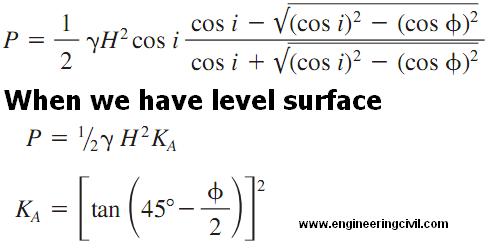
For walls that retain cohesionless soils and are free to move an appreciable amount, the total thrust from the soil is

P = [½ g H2cosi[cos i - {(cos i )2 – (cosf) 2 }1/2]/ [cos i +{(cos i )2 – (cosf)2}1/2

When the surface behind the wall is level, the thrust is

P=0.5gH2KA

where

KA=[tan(45-f/2]2

The thrust is applied at a point H /3 above the bottom of the wall, and the pressure distribution is triangular, with the maximum pressure of 2P / H occurring at the bottom of the wall.

For walls that retain cohesionless soils and are free to move only a slight amount, the total thrust is 1.12P, where P is as given earlier. The thrust is applied at the midpoint of the wall, and the pressure distribution is trapezoidal, with the maximum pressure of 1.4P / H extending over the middle six-tenth of the height of the wall.

For walls that retain cohesionless soils and are completely restrained (very rare), the total thrust from the soil is

P = [½ g H2cosi[cos i + {(cos i )2 – (cosf) 2 }1/2]/ [cos i -{(cos i )2 – (cosf)2}1/2

When the surface behind the wall is level, the thrust is

P=0.5gH2KP

where

KP=[tan(45-f/2]2

The thrust is applied at a point H /3 above the bottom of the wall, and the pressure distribution is triangular, with the maximum pressure of 2P / H occurring at the bottom of the wall.

More Entries :
Leave a Comment

Share Information

What is Civil Engineering

Journals And Softwares

Branches Of Civil Engineering

Civil Engineering Jobs

Knowledge Center

Civil Engineering Universities/Events

Gallery - Civil Engineering Pictures

Search


Author

Top Contributors

Yahoo Group - Civil Engineering Portal

Subscribe to EngineeringCivil.com


Powered by groups.yahoo.com

Recently Added

Civil Engineering Links

Spread the Word