Awarded as the best online publication by CIDC

Posts by Kanwarjot Singh

Construction Terms Beginning With Letter: D

Dado– A groove cut into a board or panel intended to receive the edge of a connecting board or panel.

Damper– A metal “door” placed within the fireplace chimney. Normally closed when the fireplace is not in use.

Dampproofing– The black, tar like waterproofing material applied to the exterior of a foundation wall.

Daylight– The end of a pipe (the terminal end) that is not attached to anything.

Dead bolt– An exterior security lock installed on exterior entry doors that can be activated only with a key or thumb-turn. Unlike a latch, which has a beveled tongue, dead bolts have square ends.

Dead light– The fixed, non-operable window section of a window unit.

Read More

Construction Terms Beginning With Letter: C

CO– An abbreviation for “Certificate of Occupancy“. This certificate is issued by the local municipality and is required before anyone can occupy and live within the home. It is issued only after the local municipality has made all inspections and all monies and fees have been paid.

Caisson– A 10″ or 12″ diameter hole drilled into the earth and embedded into bedrock 3 – 4 feet. The structural support for a type of foundation wall, porch, patio, monopost, or other structure. Two or more “sticks” of reinforcing bars (rebar) are inserted into and run the full length of the hole and concrete is poured into the caisson hole

Cantilever– An overhang. Where one floor extends beyond and over a foundation wall. For example at a fireplace location or bay window cantilever. Normally, not extending over 2 feet.

Read More

Construction Terms Beginning With Letter: B

Back Charge– Billings for work performed or costs incurred by one party that, in accordance with the agreement, should have been performed or incurred by the party to whom billed. Owners bill back charges to general contractors, and general contractors bill back charges to subcontractors. Examples of back charges include charges for cleanup work or to repair something damaged by another subcontractor, such as a tub chip or broken window.

Backfill– The replacement of excavated earth into a trench around or against a basement /crawl space foundationwall.

Backing– Frame lumber installed between the wall studs to give additional support for drywall or an interior trim related item, such as handrail brackets, cabinets, and towel bars. In this way, items are screwed and mounted into solid wood rather than weak drywall that may allow the item to break loose from the wall. Carpet backing holds the pile fabric in place.

Backout– Work the framing contractor does after the mechanical subcontractors (Heating-Plumbing-Electrical) finish their phase of work at the Rough (before insulation) stage to get the home ready for a municipal frame inspection. Generally, the framing contractor repairs anything disturbed by others and completes all framing necessary to pass a Rough Frame Inspection.

Ballast– A transformer that steps up the voltage in a florescent lamp.

Read More

Construction Terms Beginning With Letter: A

A/C– An abbreviation for air conditioner or air conditioning.

A/C Condenser– The outside fan unit of the Air Conditioning system. It removes the heat from the freon gas and “turns” the gas back into a liquid and pumps the liquid back to the coil in the furnace.

A/C Disconnect– The main electrical ON-OFF switch near the A/C Condenser.

Aerator– The round screened screw-on tip of a sink spout. It mixes water and air for a smooth flow.

Aggregate– A mixture of sand and stone and a major component of concrete.

Air space – The area between insulation facing and interior of exterior wall coverings. Normally a 1″ air gap.

Allowance(s) – A sum of money set aside in the construction contract for items which have not been selected and specified in the construction contract. For example, selection of tile as a flooring may require an allowance for an underlayment material, or an electrical allowance which sets aside an amount of money to be spent on electrical fixtures.

Read More

Notes From Various Universities.

If you are associated with any university or college and have online notes please do tell us so that we can compile a comprehensive list of university notes so that civil engineering students can take guidance from them.

Project Management Lecture notes from MIT-USA

Engineering Mechanics Lecture notes from MIT-USA

Structural Engineering Lecture notes from MIT-USA

Mechanics and Design of Concrete Structures Lecture notes from MIT-USA

Read More

Combined Axial Compression Or Tension And Bending

The AISC specification for allowable stress design for buildings includes three interaction formulas for combined axial compression and bending.

When the ratio of computed axial stress to allowable axial stress f /F a exceeds 0.15, both of the following equations must be satisfied:

( f a / F a ) + ( C m x f b x ) / (1– f a /F e x ) F b x + C m y f b y / (1 – f a / F e y ) F b y ? 1

f a / 0.60F y + f b x /F b x + f b y / F b y ? 1

when f a /F a ? 0.15, the following equation may be used instead of the preceding two:

f a / F a + f b x / F b x + f b y / F b y ? 1

In the preceding equations, subscripts x and y indicate the axis of bending about which the stress occurs, and

Read More

Deflections of Bents and Shear Walls

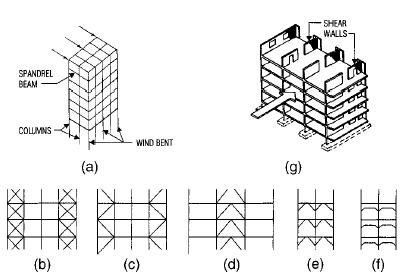
Horizontal deflections in the planes of bents and shear walls can be computed on the assumption that they act as cantilevers. Deflections of braced bents can be calculated
by the dummy-unit-load method or a matrix method. Deflections of rigid frames can be computed by adding the drifts of the stories, as determined by moment distribution
or a matrix method.

Building frame resists lateral forces
Figure showing Building frame resists lateral forces with (a) wind bents or (g) shear walls or a combination of the two. Bents may be braced in any of several ways, including (b) X bracing, (c) K bracing, (d) inverted V bracing, (e) knee bracing, and (f) rigid connections.

Read More

Load Distribution To Bents And Shear Walls

Provision should be made for all structures to transmit lateral loads, such as those from wind, earthquakes, and traction and braking of vehicles, to foundations and their supports

Read More

Plate Girder In Buildings

For greatest resistance to bending, as much of a plate girder cross section as practicable should be concentrated in the flanges, at the greatest distance from the neutral axis. This might require, however, a web so thin that the girder would fail by web buckling before it reached its bending capacity.

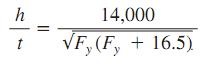
To preclude this, the AISC specification limits h/t.

For an unstiffened web, this ratio should not exceed.
Plate Girder In Buildings
where Fy = yield strength of compression flange,ksi (MPa).

Larger values of h/t may be used, however, if the web is stiffened at appropriate intervals.
Read More

Bearing Of Milled Surfaces

In building construction, allowable bearing stress for milled surfaces, including bearing stiffeners, and pins in reamed, drilled, or bored holes, is Fp= 0.90Fy, where Fy is the yield strength of the steel, ksi (MPa)

For expansion rollers and rockers, the allowable bearing stress, kip/linear in (kN/mm), is

Read More

Ask a question