


ULTRASONIC PULSE VELOCITY
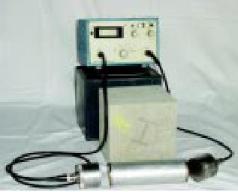
This test is done to assess the quality of concrete by ultrasonic pulse velocity method as per IS: 13311 (Part 1) – 1992. The underlying principle of this test is –
The method consists of measuring the time of travel of an ultrasonic pulse passing through the concrete being tested. Comparatively higher velocity is obtained when concrete quality is good in terms of density, uniformity, homogeneity etc.
Procedure to determine strength of hardened concrete by Ultrasonic Pulse Velocity.
i) Preparing for use: Before switching on the ‘V’ meter, the transducers should be connected to the sockets marked “TRAN” and ” REC”.
The ‘V’ meter may be operated with either:
a) the internal battery,
b) an external battery or
c) the A.C line.
ii) Set reference: A reference bar is provided to check the instrument zero. The pulse time for the bar is engraved on it. Apply a smear of grease to the transducer faces before placing it on the opposite ends of the bar. Adjust the ‘SET REF’ control until the reference bar transit time is obtained on the instrument read-out.
iii) Range selection: For maximum accuracy, it is recommended that the 0.1 microsecond range be selected for path length upto 400mm.
iv) Pulse velocity: Having determined the most suitable test points on the material to be tested, make careful measurement of the path length ‘L’. Apply couplant to the surfaces of the transducers and press it hard onto the surface of the material. Do not move the transducers while a reading is being taken, as this can generate noise signals and errors in measurements. Continue holding the transducers onto the surface of the material until a consistent reading appears on the display, which is the time in microsecond for the ultrasonic pulse to travel the distance ‘L’. The mean value of the display readings should be taken when the units digit hunts between two values.
Pulse velocity=(Path length/Travel time)
v) Separation of transducer leads: It is advisable to prevent the two transducer leads from coming into close contact with each other when the transit time measurements are being taken. If this is not done, the receiver lead might pick-up unwanted signals from the transmitter lead and this would result in an incorrect display of the transit time.
Interpretation of Results
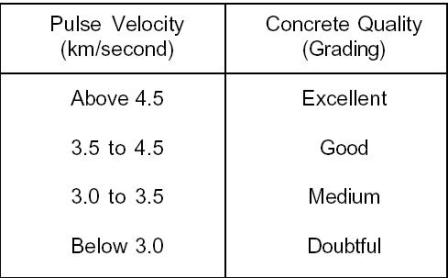
The quality of concrete in terms of uniformity, incidence or absence of internal flaws, cracks and segregation, etc,indicative of the level of workmanship employed, can thus be assessed using the guidelines given below, which have been evolved for characterizing the quality of concrete in structures in terms of the ultrasonic pulse velocity.
If you have a query, you can ask a question here.
Dear Sir
I want to buy ULTRASONIC PULSE VELOCITY
pls send to the type and price and from where,i am from Egypt
Thanks and B,Regards
Hany
Dear Sir
I want to buy ULTRASONIC PULSE VELOCITY
please send to the type and price and from where,i am from indonesia (Bandung)
Thanks
Dear Sir,
I am interested to buy Ultrasonic Pulse Velocity for testing of concrete strength. Kindly guide me from where I can purchase the same. I am from India.
Thank’s
Dear Sir,
I am interested to buy Ultrasonic Pulse Velocity for testing of concrete strength. Kindly guide me from where I can purchase the same. I am from India.
Thank’s
dear sir
i want aresult of ultra sonic test in laboratory and there relation between it and the compressive strength in concrete
I would like to know the various tests carried out on concrete. (Non Destructive Tests)
dear sir
i am a post graduate student from Nigeria working on a research topic “comparative analysis of non destructive testing methods” and my research requires laying my hands on some nondestructive instruments some of which i’ll like to know the prices.
i’ll like to know the prices of some nondestructive testing instruments such as ultrasonic pulse velocity tester, windsore probe penetrometer, pull out tester and maturity loggers as well as maturity meter.
thanks alot
The specification / Indian standard which are follow for Quality of Concrete is Very much old by –1978 and Last revision was –1992 !!
Technology of NON DESTRUCTIVE Test & Instruments now 20 times more Advance and Automatic then what we know About Ultra Sonic Pulse Velocity Test ,If we understand how to select Probes (Transducers in Khz ) We can find many Things About Concrete Structure, As – Module of elasticity , Size shape and ideal Location of Discontinuity, also compressive strength
Ali Haider
Devli Khanpur
New Delhi
Can we find the compressive strength of harden concrete by using ultrasonic pulse velocity instrument?
If yes, what is the procedure?
i m naveen from gurgaon-haryana, INDIA
I want to buy ultrasonic pulse velocity test & profometer equipment
where i can purchase it or please refer me any model or its qtsn
i am a post graduate student my research topic “FRP wraps for Corrosion control and Rehabilitation of RC Beams ” i want to know the how the UPV work,
we are required non-destructive testing equipments
so, pls give us information for same. We are loacted in India, Delhi.
Sir,
our govt.labo.want to buy ultrasonic pulse velocity test & profometer equipment
where i can purchase it or please refer me any model or its qtsn.Also mail me related lit.regarding how to carry test.
Thanks
Dear Sir
I want to buy ULTRASONIC PULSE VELOCITY
pls send to the type and price in singapore,
i am from Indonesia, i plan buy in singapore.
Thanks and Regards
conversion of km/sec to N/sec
Please sent me the detail about dispersion of concrete and the method of testing and
calculating procedure of dispersion factor and the related IS Code.
Please its urgent.
Regards
Jagodish Kumar Sarkar
Dear Sirs,
Can anybody explain the relationship between pulse velocity and the following factors.
a)Pulse Lenght
b)Compaction
c)Carbonation
d)Density of concrete.
Thanks You
Regards
Steven Lee
I am using an Ultrasonic Pulse velocity tester of proceq make with a 54 Hz transducer. can anybody let me know that the actual depth of influence when measuring the surface velocity.Does the density of the concrete measured using the surface velocity really indicates the density of the concrete. We aare facing a problem, that when the core compressive strength are getting good results; the pulse velocity is very poor.
Hi,
I am interested in Ultrasonic Pulse Velocity Tester. Kindly inform from where can I purchase the same. Please provide the name of a dealer either in India or Dubai.
Thanks in advance,
Nasim Ahmad
Dubai.
pls mail me (amd_nasim@yahoo.com)
Please tell about Corelationship of UPVT results with concrete strengths
it is good for concrete testing