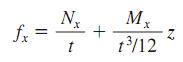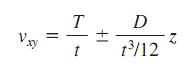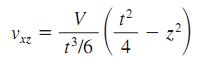
Allowable Stress Design For Shear in Buildings

The AISC specification for ASD specifies the following allowable shear stresses F v , ksi ( ksi X 6.894 = MPa) :
F v = 0.40 F y h / t w £ 380 / (F y ) ½
F v = C v F y / 289 £ 0.40 F y h / t w > 380 / (F y ) ½

Where C v = 45,000k v / F y ( h / t w ) 2 for C v < 0.8
= (( 36,000 k v / F y ( h / t w ) 2 ) ½ for C v > 0.8
k v = 4.00 + 5.34 / (a / h ) 2 for a / h < 1.0
= 5.34 + 4.00 / (a / h ) 2 for a / h > 1.0
a = clear distance between transverse stiffeners
The allowable shear stress with tension- field action is
F v = F y / 289 [ C v + ( 1- C v ) / 1.15 ( 1+ (a/h ) 2 ) ½ ] £ 0.40 F y
Where C v £ 1
When the shear in the web exceeds F v , stiffeners are required.
Within the boundaries of a rigid connection of two or more members with webs lying in a common plane, shear stresses in the webs generally are high. The commentary on the AISC specification for buildings states that such webs should be reinforced when the calculated shear stresses,
Civil Engineering and building

such as those along plane AA in Fig. exceed F v , that is, when SF is larger than d c t w F v , where d c is the depth and t w is the web thickness of the member resisting S F. The shear may be calculated from
S F = M 1 / 0.95d 1 + M 2 / 0.95d 2 - V s

where V s = shear on the section

M 1 = M 1L + M 1G

M 1L = moment due to the gravity load on the leeward side of the connection

M 1G = moment due to the lateral load on the leeward side of the connection

M 2 = M 2L - M 2G

M 2L = moment due to the lateral load on the windward side of the connection

M 2G = moment due to the gravity load on the windward side of the connection

posted in Building | 0 Comments

Load & Resistance Factor Design For Building Beams

For a compact section bent about the major axis, the unbraced length L b of the compression flange, where plastic hinges may form at failure, may not exceed L pd , given by Eqs. given in post . For beams bent about the minor axis and square and circular beams, L b is not restricted for plastic analysis.

For I-shaped beams, symmetrical about both the major and the minor axis or symmetrical about the minor axis but with the compression flange larger than the tension flange, including hybrid girders, loaded in the plane of the web:

Lpd= ( [3600 + 22000 ( M 1 / M p ) ] / F yc ) r y

Where F yc =minimum yield stress of compression flange, ksi (MPa)

M 1 =smaller of the moments, in-kip (mm MPa) at the ends of the unbraced length of beam

M p =plastic moment, in kip (mm MPa)

R y =radius of gyration, in (mm), about minor axis
The plastic moment M p equals F y Z for homogeneous sections, where Z = plastic modulus, in l 3 (mm 3 ); and for hybrid girders, it may be computed from the fully plastic distribution. M 1 / M p is positive for beams with reverse curvature.
For solid rectangular bars and symmetrical box beams:
L pd = ( [5000 + 3000 ( M 1 / M p ) ] / F y ) r y ³ 3000 r y / F y

The flexural design strength 0.90M NSE is determined by the limit state of lateral-torsional buckling and should be calculated for the region of the last hinge to form and for regions not adjacent to a plastic hinge. The specification gives formulas for M NSE that depend on the geometry of the section and the bracing provided for the compression flange.
For compact sections bent about the major axis, for example, M NSE depends on the following unbraced lengths:
L b =the distance, in (mm), between points braced against lateral displacement of the compression flange or between points braced to prevent twist
L p =limiting laterally unbraced length, in (mm), for full plastic-bending capacity
=300 r y / ( F yf ) ½ for I shape and channels
=3750 (r y /M p ) / (JA) ½ for solid rectangular bars and box beams
F yf =flange yield stress, ksi (MPa)
J=torsional constant, in 4 (mm 4 ) (see AISC “Manual of Steel Construction” on LRFD)
A=cross-sectional area, in 2 (mm 2 )

L r =limiting laterally unbraced length, in (mm), for inelastic lateral buckling

For I-shaped beams symmetrical about the major or the minor axis, or symmetrical about the minor axis with the compression flange larger than the tension flange and channels loaded in the plane of the web:
L r = r y x 1 / (F yw - F r )) ½ ( 1 + ( 1 + X 2 F 2 L ) ½ ) ½

Where F yw =specified minimum yield stress of web, ksi (MPa)
F r =compressive residual stress in flange
=10 ksi (68.9 MPa) for rolled shapes, 16.5 ksi (113.6 MPa), for welded sections
F L =smaller of F yf - F r or F yw
F yf =specified minimum yield stress of flange, ksi (MPa)
X 1 =( p / S x ) (EGJA/2) ½
X 2 =( 4 C w /l y ) (S x /GJ) 2
E=elastic modulus of the steel
G=shear modulus of elasticity
S x =section modulus about major axis, in 3 (mm 3 ) (with respect to the compression flange if that flange is larger than the tension flange)
C w =warping constant, in 6 (mm 6 ) (see AISC manual on LRFD)
l y =moment of inertia about minor axis, in 4 (mm 4 )
For the previously mentioned shapes, the limiting buckling moment M r , ksi (MPa), may be computed from
M r = F S x
For compact beams with b £ L r , bent about the major axis:
M n = C b [ M p - ( M p - M r ) ( L b - L p ) /( L r - L p )] £ M p

Where C b = 1.75 + 1.05 ( M 1 / M 2 ) + 0.3 ( M 1 / M 2 ) £ 2.3, where M 1 is the smaller and M 2 the larger end moment in the unbraced segment of the beam; M 1 /M 2 is positive for reverse curvature and equals 1.0 for unbraced cantilevers and beams with moments over much of the unbraced segment equal to or greater than the larger of the segment end moments.

For solid rectangular bars bent about the major axis:

L r =57,000 ( r y / M r ) ( JA) ½

and the limiting buckling moment is given by:

M r =F y S x

For compact beams with L b > L r , bent about the major axis:

M n =M cr £ C b M r

where M cr =critical elastic moment, kip in (MPa mm).

M cr =C b (p / Lb) (El y GJ + l y C w ( p E / L b ) 2 ) ½

For solid rectangular bars and symmetrical box sections:

M cr =57,000 C b ( JA) ½ / ( L b / r y )

For determination of the flexural strength of noncompact plate girders and other shapes not covered by the preceding requirements, see the AISC manual on LRFD.

posted in Building | 0 Comments

Allowable Stress Design For Building Beams

The maximum fiber stress in bending for laterally supported beams and girders is F b = 0.66F y if they are compact, except for hybrid girders and members with yield points exceeding 65 ksi (448.1 MPa). F b = 0.60F y for non-compact sections. F y is the minimum specified yield strength of the steel, ksi (MPa). Table lists values of F b for two grades of steel.

Yield strength,ksi (MPa) Compact0.66Fy (MPa) Non-compact,0.60 Fy (MPa)
36 ( 248.2) 24 (165.5) 22 (151.7)
50 (344.7) 33 (227.5) 30 (206.8)

The allowable extreme-fiber stress of 0.60F y applies to laterally supported, unsymmetrical members, except channels, and to non-compact box sections. Compression on outer surfaces of channels bent about their major axis should not exceed 0.60F y

The allowable stress of 0.66F y for compact members should be reduced to 0.60F y when the compression flange is unsupported for a length, in (mm), exceeding the smaller of

l max =76.0b f / ( F y ) ½

l max =20,000 / F y d / A f

where b f =width of compression flange, in (mm)

d=beam depth, in (mm)

A f =area of compression flange, in 2 (mm) 2
The allowable stress should be reduced even more when l/r T exceeds certain limits, where l is the unbraced length, in (mm), of the compression flange, and r T is the radius of gyration, in (mm), of a portion of the beam consisting of the compression flange and one-third of the part of the web in compression.
For (102,000 C b / F y ) ½ £ l / r T £ (510,000 C b / F y ) ½ use
F b =[ 2 / 3 - F y (l / r T ) 2 / 1,530,000C b ] F y
For l / r T > ( 510,000 C b / F y ) ½ use
F b = 170,000 C b / ( l/r T ) 2
Where C b = modifier for moment gradient

When, however, the compression flange is solid and nearly rectangular in cross section, and its area is not less than that of the tension flange, the allowable stress may be taken as

F b = 12,00C b / ld/A f
When Eq. applies (except for channels), F b should be taken as the larger of the values computed from Eqs above, but not more than 0.60F y .
The moment-gradient factor C b in Eqs. above may be computed from
C b = 1.75 + 1.05 M 1 / M 2 + 0.3 ( M 1 / M 2 ) 2 £ 2.3 (9.6)
Where M 1 = smaller beam end moment, and M 2 = larger beam end moment.
The algebraic sign of M 1 / M 2 is positive for double curvature bending and negative for single-curvature bending. When the bending moment at any point within an unbraced length is larger than that at both ends, the value of C b should be taken as unity. For braced frames, C b should be taken as unity for computation of F bx and F by .
Equations can be simplified by introducing a new term:
Q=(l / r T ) 2 F y
Now, for 0.2 £ Q £ 1,
F b =( 2 – Q ) F y /3
For Q > 1:
F b =F y / 3 Q

posted in Building | 0 Comments

Load & Resistance Factor Design For Building Column

Plastic analysis of prismatic compression members in buildings is permitted if ( F y ) ½ (l/r) does not exceed 800 and F u £ 65 ksi (448 MPa). For axially loaded members with b/t £ l r , the maximum load P u , ksi (MPa= 6.894 X ksi), may be computed from

P u = 0.85A g F cr

WhereA g =gross cross-sectional area of the member

F cr =0.658 l F y for l £ 2.25

=0.877 F y / l for l > 2.25

l =(Kl / r) 2 (F y / 286,220)

The AISC specification for LRFD presents formulas for designing members with slender elements

posted in Building | 0 Comments

Allowable Stress Design For Building Columns

The AISC specification for allowable-stress design (ASD) for buildings provides two formulas for computing allowable compressive stress Fa, ksi (MPa), for main members. The formula to use depends on the relationship of the largest effective slenderness ratio Kl/r of the cross section of any unbraced segment to a factor C c defined by the following equation and table below:
Cc = ( 2p 2 E / F y ) ½ = 756.6 / ( F y ) ½

Where E = modulus of elasticity of steel

= 29,000 ksi ( 128.99 GPa )

F y = yield stress of steel, ksi (MPa)

When Kl/r is less than C c ,

F y =36 C c =126.1

F y =50 C c =107

F a = ( [ 1 – ( Kl/r) 2 /2C 2 c ] F y ) / F. S.

Where F.S. = safety factor = 5/3 + 3 (Kl/r) / 8C c - ( Kl/r) l 3 / 8 C 3 c

When Kl/r exceeds C c ,

F a = ( 12p 2 E ) / ( 23 ( Kl/r) 2 = 150,000 / ( Kl/r) 2

The effective-length factor K, equal to the ratio of effective-column length to actual unbraced length, may be greater or less than 1.0. Theoretical K values for six idealized conditions, in which joint rotation and translation are either fully realized or nonexistent, are tabulated in Figure below

FIgure Showing Values of K For idealised Conditions

posted in Building | 0 Comments

Page 4 of 5«12345»